Advertisements
Advertisements
Question
Work in pairs. Take turns and speak about spices.
| Saritha | Saritha: Hi Divya, how are you? |
| Divya | Hi, I’m fine Saritha. |
| Saritha | What did you have for breakfast? |
| Divya | ______ with onion chutney. |
| Saritha | Do ______ onions ______? |
| Divya | ______ Central Asia. |
| Saritha | Do you know chilli too has come from somewhere else? |
| Divya | Is it from______? |
| Saritha | Yes______right. |
| Divya | Many of the ______ came ______. |
Advertisements
Solution
| Saritha | Hi Divya, how are you? |
| Divya | Hi, I’m fine Saritha. |
| Saritha | What did you have for breakfast? |
| Divya | I had idlies with onion chutney. |
| Saritha | Do you know where onions came from? |
| Divya | Yes, I guess it is from Central Asia. |
| Saritha | Do you know chilli too has come from somewhere else? |
| Divya | Is it from Portuguese? |
| Saritha | Yes you are right. |
| Divya | Many of the spices & vegetables came from foreign nations. |
APPEARS IN
RELATED QUESTIONS
Deliver a short speech for about five minutes on the following.
Think of a situation where all the trees can speak. What will they talk about?
Ms. Pavithra Rao, the squash player who won the gold medal at the recent Asian Games, is holding a press conference. Let the discussion focus more on the strategies that helped her to win.
Do you have art / craft session in your school?
Imagine that you are going to interview one of the survivors of the Pan Am Hijack. Discuss with your partner and write down the conversation. Then one of you play the role of the interviewer and other the survivor. You can use the sample questions given below.
- Do you have any information regarding the suspects of the hijack?
- Which countries did the hijackers belong?
- What are the details of the hijacked flight?
- How many passengers were aboard?
- What happened in the last few minutes of the hijack drama?
- Do you have information regarding the victims?
- Was there any recorded communication to/from the plane during the hijacking?
- How many terrorists were there?
- How did you feel when you were in the flight?
- Can you recall Neerja’s role in safeguarding the passengers?
Imagine a world with no books, but only e-books. How would you find such a world? Deliver a two-minute talk.
In groups of five, discuss what you enjoy doing alone and what you like doing in a group. Now prepare a list as shown below.
| Things I like doing alone | Things I like doing in a group |
Answer these questions about yourself.
- What is your name?
- What languages do you speak?
- How old are you?
- Which is your favourite food?
- Where did you go yesterday?
- Which country do you belong to?
- When do you go to sleep?
- Why do you drink milk?
Pick out the names of the games mentioned in the story.
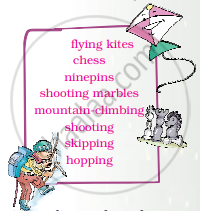
Tell the class a joke in your mother tongue.
The word galore means in great numbers. Do you also have a class library or a school library which keeps many books? Can you borrow books?
