Advertisements
Advertisements
Question
Identify the poetic lines where the following figures of speech are employed and complete the tabular column.
| Figure of speech | Meaning | Lines |
| Synecdoche | A figure of speech in which a part is made to represent the whole or vice versa. e.g. “The Western wave was all a-flame. ” The “Western wave” is a synecdoche as it refers to the sea by the name of one of its parts i.e. wave. |
|
| Paradox |
A figure of speech in which a statement appears to contradict itself. e.g. To bring peace we must war. Be cruel to be kind. |
|
| Onomatopoeia |
A figure of speech wherein the word imitates the sound associated with the object it refers to. e.g. Pitter-patter, pitter-patter Raindrops on my pane. |
|
| Rhetorical Questions |
A figure of speech in the form of a question that is asked to make a point rather than to elicit an answer. e.g. And what is so rare as a day in June? |
Advertisements
Solution
| Figure of speech | Meaning | Lines |
| Synecdoche | A figure of speech in which a part is made to represent the whole or vice versa. e.g. “The Western wave was all a-flame. ” The “Western wave” is a synecdoche as it refers to the sea by the name of one of its parts i.e. wave. |
On this warm summer day in May. Here, warm summer is a synecdoche. Inside it has a tone of space |
| Paradox |
A figure of speech in which a statement appears to contradict itself. e.g. To bring peace we must war. Be cruel to be kind. |
It just sits there never getting small or growing tall. |
| Onomatopoeia |
A figure of speech wherein the word imitates the sound associated with the object it refers to. e.g. Pitter-patter, pitter-patter Raindrops on my pane. |
Lights flicker on and off. |
| Rhetorical Questions |
A figure of speech in the form of a question that is asked to make a point rather than to elicit an answer. e.g. And what is so rare as a day in June? |
How could this be? What happened inside the house? |
APPEARS IN
RELATED QUESTIONS
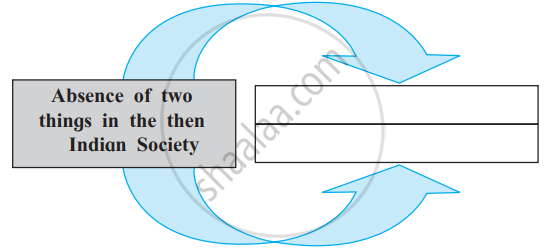
In his speech, Dr. B. R. Ambedkar has expressed his deep concern over the absence of two things in the then Indian society. Discuss with your partner and complete the web.
Figures of Speech
| There is alliteration in the line: And I sunned it with smiles. The sound /s/ is repeated in the words ‘sunned’ and ‘smiles’. | Pick out at least two instances of alliteration from the poem. |
Mention the rhyme scheme of the poem.
When I was a little boy ______,
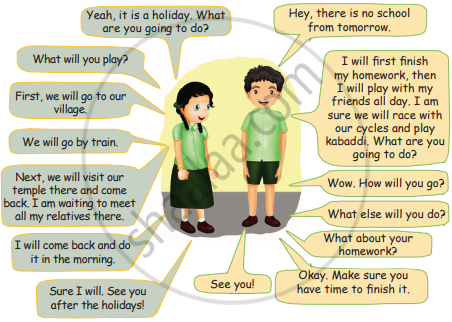
A boy and a girl are talking about their holidays.
What are the things your mother asks you to do?
| Things you like to do | Things you do not like to do |
Some letter are missing in each word.
b ______ p
What do you do when it is dark?
What kinds of stories do you like?
Now, write a set of 8 to 10 instruction for the following situation.
A traffic police personnel to the public, as to how to move around in safety, in crowded public places during festival seasons.
