Advertisements
Advertisements
प्रश्न
Complete the flow chart showing the events on the day of the assault.

Advertisements
उत्तर
- On 2-3 July 1999, Air Force targeted a tiger hill and hit the bull’s eye several times during its missions.
- At 1900 hours on 3 July 18 Grenadiers commenced its multidirectional assault under the cover of bad weather and darkness, supported by the firepower of artillery and mortars.
- At 0130 hours on 4 July, ‘A’ company captured an intermediate position called Tongue.
- ‘D’ Company leader Captain Sachin Nimbalkar led the assault from the east.
- ‘D’ Company occupied the eastern portion of Area Collar, which lay within 100 meters of Tiger Hill Top.
- A toehold was obtained on the north-eastern spur just 30 meters from the top in a surprise attack by ‘C’ Company and Ghatak (Commando) platoon under Lieutenant Balwan Singh.
- At 0400 hours on 4 July after a carefully orchestrated artillery bombardment, Sachin Nimbalkar and Balwan Singh along with their men approached Tiger Hill Top by climbing a sheer cliff and caught the enemy unawares.
- After a short period of hand-to-hand fighting, Sachin Nimbalkar and Balwan Singh and their men succeeded in capturing a hold on Tiger Hilltop.
- On 8th July, the Indian Tricolour was hoisted on the Tiger Hilltop.
APPEARS IN
संबंधित प्रश्न
“The best things in life come free”. Write for or against the statement.
What are the poetic devices (figurative language) in the poem? How do they contribute to the meaning/how do they effect the poem?
What brought the six humans together? Where were they?
Which literary device is used in the last two lines:
Tinkling, luminous, tender, and clear, Like her bridal laughter and bridal tear.
The caged bird sings with
A fearful trill of things unknown
But longed for still and his
Tune is heard on the distant hill
For the caged bird sings of freedom.
Read the above lines and answer the question that follow.
What parallel can be drawn to the poet’s feelings and that of the caged bird?
It was roses, roses, all the way,
With myrtle mixed in my path like mad;
The house-roofs seemed to heave and sway,
The church-spires flamed, such flags they had,
A year ago on this very day.
Read the above lines and answer the question that follow.
By which flower was the patriot welcomed?
What surprises Abou the next night? What message has the poet conveyed to all of us?
Who won the race as described in the end.
The eight other runners pulled up on their heels
The ones who had trained for so long to complete
one by one they all turned around and went back to help him
And brought the young boy to his feet.
Then all the nine runners joined hands and continued
The hundred-yard dash now reduced to a walk
And a banner above that said (Special Olympics)
Could not have been more on the mark.
That's how the race ended, with nine gold medals
They came to the finish line holding hands still
And a standing ovation and nine beaming faces
Said more than these words ever will.
Read the lines given above and answer the following question:
Explain the following phrases in a sentence or two.
(a) Pulled up on their heels
(b) Brought the young boy to his feet.
The author shows death as a relief from a harsh life. Justify with reference to the story.
Why was Margot unhappy on Venus in “All Summer in a Day”?
You are the editor of your school magazine. You have recently attended a cultural program in your city. Write an account of this program (in approximately 300 words) using the points given below:
| Date and venue — occasion — Chief Guest — other invitees — inauguration — events —other important features — highlights — reaction of audience — conclusion. |
Join the following sentence to make one complete sentence without using and, but or so.
She was so excited about her performance. She could not sleep at night.
Re-write the following sentence according to the instructions are given. Make other changes that may be necessary, but do not change the meaning of the sentence.
Harish was so tired that he could not keep his eyes open.
(Begin: Harish was too……….)
She shouted angrily_________ the disobedient boy.
He drew a beautiful diagram________ the board.
They had to climb ____________the steep pathway to reach the top.
Distinguish between the following pairs of sentences.
He was visibly moved.
Examine the subtle humour in the narration of the story that lightens the gravity of the subject matter.
How does the author succeed in raising crucial social issues not through open criticism but through subtle suggestion?
How did the narrator learn to distinguish between 'a flask' and 'a thermos'?
Give reasons for the following.
Srinath’s disappointment with Satyajit.
Locate instances of irony in the story.
Your teacher will speak the word given below. Write against two new words that rhyme with it.
fast ______ ______
Multiple Choice Question:
The poet had a quarrel with her ______
We add ‘un-’ to make opposites. For example, true — untrue. Add ‘un’– to the word below to make its opposite. Then look up the meaning of the word you have formed in the dictionary.
identified ______
Discuss with your partner and complete the web of different activities related to climbing.

Find out from your grandparents or parents the names of vegetables and fruits they had eaten in their childhood and mention how the vegetables and fruits are different from the one's today.
| Name of the vegetable or fruit | Shape | Colour | Taste |
| 1. | |||
| 2. | |||
| 3. |
“Lend thy ears to all but few thy tongue”…. is a famous quote by William Shakespeare. Justify.
Given below is a list of words used to develop a CV or a Resume. Prepare a CV/Resume of your own.
Personal Information
- Name
- Address
- Date of birth
- Telephone / E-mail
- Nationality
- Marital status
Work Experience
- Experience/ Occupation / Position
- Employer / Employment History
- Internships
- Activities and responsibilities
Education
- Education and Training
- Primary school
- Secondary school
- Other qualification
Personal Skills and Competencies
- Competencies / Personal Competencies / Personal Skills/ Computer skills Mother tongue/ Other languages / Foreign languages
Imagine that you are a compere of a ‘Prize Distribution Ceremony’ of your college. Write a script for the same.
You can take the help of the following points.
- Introduction – A brief introduction of the programme / function / show
- Welcome speech – Welcome to all guests. Felicitation – felicitation of the guests (the principal, vice-principal, etc.).
- Lighting the lamp
- Welcome song
- Main events
- Vote of thanks
Use the details given in the story and your imagination and prepare a timetable for the trip to the moon.
Write a letter to your Class Teacher or the Principal of your school to make the following request.
Your school library subscribes to a few newspapers. Your class wants old issues of the newspapers for some educational activity in the classroom. You are required to make cuttings / news clipping. Therefore, the papers cannot be returned to the library but you will use them in a responsible manner. Use the format of a formal letter given below.
What is the meaning of ‘intellectual rubbish’?
Write in your own words:-
What are the latest modern methods of depositing money in your own or somebody else’s account?
The poem describes the sad demise of the Captain. How would you console the son of the Captain? Write a short paragraph using the points given below.
- Expressing grief on the death.
- An act of God.
- Words/sentences giving strengths and courage to face the situation.
- Add your own points.
Fill in the template given for limerick.
There once was a ______(8 syllable)
______(8 syllable)
______(5 syllable)
______ (5 syllable)
______(8 syllable)
Create a pamphlet for the following.
Make a pamphlet on the latest gadgets (Mention the variety of models, uses, needs, and availability).
Your friend has presented a beautiful art piece on your birthday. Write a letter to her appreciating her art work.
Using the given informal letter as a model, write a letter about the topic given below.
Write a letter to your father asking permission to go on an educational tour.
Arrange the jumbled sentences and write a paragraph. Use appropriate conjunctions.
Jane Eyre is an orphan.
She lives with her aunt Mrs. Reed.
Mrs. Reed does not like Jane because Jane is not her daughter.
Jane’s uncle Mr. Reed likes Jane, but he dies.
He makes Mrs. Reed promise to take care of Jane, but instead she sends Jane away.
Jane is ten years old, she is sent to Lowood school.
Jane graduates and stays there to teach.
She leaves for Thornfield, where she is a governess.
She is very happy there.
Here are some answers about the given picture.
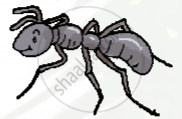
- The colour of the ant is black.
- It lives on land.
- It has two long antennae.
- It crawls on the ground.
- It eats sugar.
Now frame questions for the above answers.
______ do you go to school?
Can we try to complete another dialogue now?
Rathi is visiting a shop to buy a pen. Let us try and complete the dialogues between her and the shopkeeper.
| Rathi | Hi Akka! |
| Shopkeeper | Hi! How can I help? |
| Rathi | I need a______. |
| Shopkeeper | Sure. Which colour? |
| Rathi | Give a______ pen. |
| Shopkeeper | Do you need a ten rupee pen or a five rupee pen? |
| Rathi | Give me the ______rupee pen. |
| Shopkeeper | Do you want anything else? |
| Rathi | ______. |
| Shopkeeper | Thank you. Goodbye. |
| Rathi | ______ |
The word in the sentence is jumbled. Write them in order.
was island the inhabited.
Now complete the following suitably.
_______ a dog ran out onto the road.
Connect the pairs of sentences below using and or but.
- Raju plays cricket.
- He also plays hockey.
Find one word from the story that means
to be inquisitive c ______.
In the sentence below the capital letter, comma, full stop and question mark are missing. Put these in the correct place.
the tailor went to the market mr singh
Explain the following phrase selected from the story in your own word and work with a partner to make sentence using these phrase:
a double-distilled idiot
Are children afraid of visiting the dentist? Give reasons.
Why did the author go to the photo studio?
The photographer had made changes ______.
Now write a short story to explain these proverb.
Actions speak louder than words
Answer the following question as briefly as possible and with close reference to the relevant text.
Referring closely to the short story, The Singing Lesson relate what Basil wrote in his letter to Miss Meadows. What do you conclude about Basil from the tone and wording of the letter?
Imagine a situation where you get an opportunity to change one thing in your school. What would it be? Why do you want to change it? How would you bring about the change?
A certain book/chapter has been included in your syllabus. You have heard that a film version is now available. Write a letter to the Manager of a film theatre near your school, requesting that the film be shown. Tell him/her why it will be beneficial to the students.
Write an original short story that begins with the following words:
My mother stopped suddenly at the doorway and stared in amazement at ..........
Discuss the challenges that people have to face due to disabilities.
What provisions should be made in public places so that everyone gets the same access to public facilities?
