Advertisements
Advertisements
प्रश्न
Frame a pointwise Analysis of the poem ‘The worm’. Use the following points.
- Poem and poet:
- Theme:
- Tone:
- Structure and stanzas:
- Rhyme and Rhythm:
- Language and Imagery:
- Figures of Speech:
Advertisements
उत्तर
- Poem and poet: 'The Worm' by Thomas Gisborne.
- Theme: Respect every creature big or small, for each has played in this universe.
- Tone: Serious their own role to and thought-provoking; in the imperative.
- Structure and stanzas: Stanzas of four lines each; short lines.
- Rhyme and Rhythm: Rhyme scheme: abab, cdcd, and so on. The last words of the first and third lines and the second and fourth lines of every stanza rhyme. The rhythm is smooth.
- Language and Imagery: Archaic language; no imagery.
- Figures of Speech: Apostrophe, Inversion.
संबंधित प्रश्न
Give reasons -
Chaitanya’s silver medal in a running race was very special for the writer, because :
(i) __________________
(ii) __________________
Thus I entered, and thus I go!
In triumphs, people have dropped down dead,
"Paid by the world, what dost thou owe
Me? "....God might question; now instead,
'Tis God shall repay: I am safer so.
Read the above lines and amswer the question that follow.
Give an example of Antithesis from the poem ‘The Patriot: An Old Story.’
Words which describe ‘sleek’, ‘alert’, and ‘abrupt’
Find out the information about the qualification and eligibility required in the profession related to wild life such as:
Forest officer / Ranger
State whether the following statement is true or false. Correct the false statement.
Hero-worship leads to dictatorship.
Write a letter to your friend about the Great Indian Bustard. You may use the following points:
- Why we need to protect the bird.
- What you plan to do to help the bird.
Write a letter to the manager of a famous daily, ordering a subscription for your school library.
Tortoises and Turtles are not the same. Read the facts given below. List the similarities and differences between them.
| Tortoise | Turtle |
| reptile family | reptile family |
| land animal | sea animal |
| has a long life | lives for many years |
| uses tiny feet to walk | use flippers to swim |
| eats grass, weeds and flowers | eats insects and bugs |
| Similarities | Differences |
The children in the picture are watching an exciting sporting event, where their school team is winning. Suggest suitable utterances reflecting their feelings:
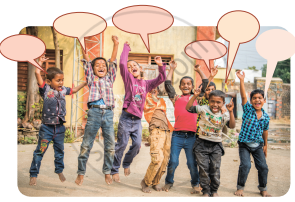
Write conversation on the following situation.
Between two friends on a picnic they enjoyed recently
