Topics
Psychology : A Scientific Discipline
- Science of Psychology
- Key Features of Science
- History of Psychology as a Science
- Research Methods in Psychology> Experimental Method
- Research Methods in Psychology> Survey Method
- Research Methods in Psychology> Observation Method
- Research Methods in Psychology> Case Study Method
- Research Methods in Psychology> Correlation Studies
- Challenges in Establishing Psychology as a Science
- Importance of Rationality
Intelligence
- Concept of Intelligence
- Perspectives on Intelligence
- Intelligence as a Single, General Ability
- Theories of Intelligence
- E. L. Thorndike's Theory
- Louis Thurstone’s Multifactor Theory
- Charles Spearman's Two Factor Theory
- Theory of Intelligence by Cattell
- Howard Gardner's Multiple Intelligence Theory
- Measurement of Intelligence
- History of Measurement of Intelligence
- Mental Age
- Intelligence Quotient
- Types of Intelligence Tests
- Individual Test
- Group Test
- Verbal Test
- Non-Verbal Test
- Applications of Intelligence Testing
- New Trends in Intelligence> Social Intelligence
- New Trends in Intelligence> Emotional Intelligence
- New Trends in Intelligence> Artificial Intelligence
Personality
Cognitive Processes
Emotions
- Concept of Emotions
- History of Emotions
- Basic Emotions
- Plutchik’s Model
- Physiological Changes During Emotions
- Emotional Well-Being
- Achieving Emotional Well Being
- Benefits of Emotional Well-Being
- Emotional Abuse
- Managing Emotions
- Anger Management
- Anticipating and Managing Anger
- The 3 R's: Relax, Reassess, and Respond
Psychological Disorders
- Concept of Abnormal Behaviour
- Nature of Psychological Disorders
- Criteria for Psychological Disorders
- Concept of Mental Wellness
- Mental Disorders - Its Classification
- Major Psychological Disorder> Anxiety Disorders
- Depressive Disorders
- Major Psychological Disorder> Bipolar Disorder
- Major Psychological Disorder> Trauma and Stress Related Disorders
- Major Psychological Disorder> Substance-Related and Addictive Disorders
- Major Psychological Disorder> Schizophrenia
- Identifying and Treating Psychological Disorders
First Aid in Mental Health
Positive Psychology
Estimated time: 28 minutes
- Introduction
- Features of Individual Tests
- Major Intelligence Testing Scales
- Advantages of Individual Tests
- Disadvantages of Individual Tests
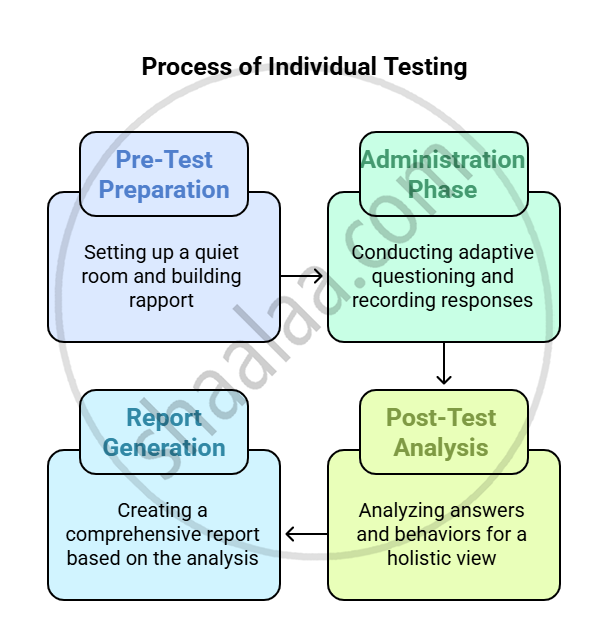
- Process of Individual Testing
- Real-Life Applications
- Key Points: Individual Test
CISCE: Class 12
Introduction
Individual tests of intelligence are psychological assessments designed to be administered to one person at a time by a trained examiner. Unlike group tests, where multiple students can be tested simultaneously, individual tests require a dedicated one-on-one session between the examiner and the test-taker.
CISCE: Class 12
Features of Individual Tests
1. One-on-One Administration
- Only one individual is tested per session, ensuring the examiner's full attention.
- Example: Binet’s Intelligence Scale, Wechsler Scales.
2. Examiner-Subject Rapport
-
The examiner builds comfort and trust, observing both verbal and non-verbal responses.
3. Flexible Response Formats
- Responses may be oral, written, or manipulative (e.g., arranging blocks).
- Verbal and performance (non-verbal) tasks included.
4. Adaptive and Observational Approach
-
Examiner adapts questions as needed and notes the subject’s approach, effort, anxiety, and behavior.
CISCE: Class 12
Major Intelligence Testing Scales
| Test Name | Target Group | Sample Material/Tasks |
|---|---|---|
| Stanford-Binet Intelligence Scale | Children & Adults (2+ years) | Verbal puzzles; object arrangement; picture tests |
| Wechsler Intelligence Scales | Children/Adults/Preschoolers | Block design; picture arrangement; vocabulary |
| Dr. Bhatia’s Performance Test | Indian children & adults | Non-verbal tasks: maze, block-building |
| Koh’s Block Design | All ages | Pattern assembly with colored blocks |
CISCE: Class 12
Advantages of Individual Tests
- Detailed and holistic assessment: Both cognitive and behavioral data collected.
- Personalized interaction: Provides accommodations tailored to individual needs.
- Superior creativity evaluation: Open-ended and non-standard responses permitted.
- Rich behavioral observation: Notes on anxiety, persistence, strategy, etc.
CISCE: Class 12
Disadvantages of Individual Tests
- Resource-intensive: Time-consuming (one examiner per test), resulting in higher costs.
- Requires training: Needs expert examiners for reliable administration and interpretation.
- Limited scalability: Not feasible for large groups or mass testing programs.
CISCE: Class 12
Process of Individual Testing
CISCE: Class 12
Real-Life Applications
- Education: Special education placements; diagnosing learning disabilities.
- Clinical & Neuropsychology: Cognitive assessment after brain injury; developmental delay evaluation.
- Counseling: Career guidance; identifying exceptional or gifted learners.
CBSE: Class 12
Maharashtra State Board: Class 12
CISCE: Class 12
Maharashtra State Board: Class 12
CISCE: Class 12
Key Points: Individual Test
- Meaning: Individual intelligence tests are administered one-on-one, allowing for personalized interaction and observation of the subject's behavior, emotions, and responses.
- Examples: Common individual tests include Binet’s Scale, Wechsler Scale, Dr. Bhatia’s Performance Test, Arthur Point Scale, and Koh’s Block Design.
- Advantages: They enable better rapport-building, deeper insight into the subject’s emotional state, and are more effective for assessing creative thinking.
- Disadvantages: These tests are time-consuming, costly, and require a trained examiner for proper administration and interpretation.
- Characteristics: Tasks are untimed and performance-based, often involving object manipulation; non-verbal apparatus-based tests must be administered individually due to logistical limitations.
