- The word “personality” comes from the Latin term “persona,” which means “mask.”
- In ancient Greek and Roman theatre, actors wore masks (personae) to represent different characters.
- The mask symbolized the role or image shown to others, rather than the actor’s true self.
- Over time, “persona” evolved to describe the characteristic way people present themselves to the world.
- Just like a mask changes appearance without changing identity, outward behavior may not always reflect a person’s true inner traits.
Topics
Psychology : A Scientific Discipline
- Science of Psychology
- Key Features of Science
- History of Psychology as a Science
- Research Methods in Psychology> Experimental Method
- Research Methods in Psychology> Survey Method
- Research Methods in Psychology> Observation Method
- Research Methods in Psychology> Case Study Method
- Research Methods in Psychology> Correlation Studies
- Challenges in Establishing Psychology as a Science
- Importance of Rationality
Intelligence
- Concept of Intelligence
- Perspectives on Intelligence
- Intelligence as a Single, General Ability
- Theories of Intelligence
- E. L. Thorndike's Theory
- Louis Thurstone’s Multifactor Theory
- Charles Spearman's Two Factor Theory
- Theory of Intelligence by Cattell
- Howard Gardner's Multiple Intelligence Theory
- Measurement of Intelligence
- History of Measurement of Intelligence
- Mental Age
- Intelligence Quotient
- Types of Intelligence Tests
- Individual Test
- Group Test
- Verbal Test
- Non-Verbal Test
- Applications of Intelligence Testing
- New Trends in Intelligence> Social Intelligence
- New Trends in Intelligence> Emotional Intelligence
- New Trends in Intelligence> Artificial Intelligence
Personality
Cognitive Processes
Emotions
- Concept of Emotions
- History of Emotions
- Basic Emotions
- Plutchik’s Model
- Physiological Changes During Emotions
- Emotional Well-Being
- Achieving Emotional Well Being
- Benefits of Emotional Well-Being
- Emotional Abuse
- Managing Emotions
- Anger Management
- Anticipating and Managing Anger
- The 3 R's: Relax, Reassess, and Respond
Psychological Disorders
- Concept of Abnormal Behaviour
- Nature of Psychological Disorders
- Criteria for Psychological Disorders
- Concept of Mental Wellness
- Mental Disorders - Its Classification
- Major Psychological Disorder> Anxiety Disorders
- Depressive Disorders
- Major Psychological Disorder> Bipolar Disorder
- Major Psychological Disorder> Trauma and Stress Related Disorders
- Major Psychological Disorder> Substance-Related and Addictive Disorders
- Major Psychological Disorder> Schizophrenia
- Identifying and Treating Psychological Disorders
First Aid in Mental Health
Positive Psychology
Estimated time: 31 minutes
- Introduction
- Etymology and Historical Context
- Definition: Personality
- Activity: Understanding Personality Traits
- Approaches of Personality
- Features of Personality
- Major Dimensions: The Big Five
- Common Misconceptions
- Key Point: Concept of Personality
CISCE: Class 12
Introduction
Personality is the unique and consistent pattern of a person’s thoughts, feelings, and behaviors that make them who they are. It comes from inner traits rather than appearance and helps individuals adjust to different situations.
CISCE: Class 12
Etymology and Historical Context
CBSE: Class 12
CISCE: Class 12
CISCE: Class 12
Definition: Personality
- According to Norman Munn, “Personality is a unique combination of an individual's physical structure, needs, interests, abilities, and aptitudes.”
- According to Gordon Allport, “Personality is the dynamic organization within the individual of those psychophysical systems that determine his unique adjustments to the environment.”
- Warren states that "Personality is the entire mental organisation of a human being at any stage of his development."
- According to Dashiell, "The system of reactions and reaction possibilities in toto as viewed by fellow members of the society is called one 'personality'."
- Morton Prince has defined personality as "the sum total of all the biological, innate dispositions, impulses, tendencies, appetites and instincts of the individual and the acquired dispositions and tendencies acquired by experience."
CISCE: Class 12
Activity: Understanding Personality Traits
Read the following examples and express your opinion about the concept of personality:
-
Rohan is a good-looking boy. He is a genius, but extremely arrogant. He always shouts at his friends. He always talks very rudely to his parents.
-
Ruchi is a girl with ordinary looks. She is poor in her studies but always gets along nicely with her friends. She always talks in a polite manner to everyone.
Answer:
CISCE: Class 12
Approaches of Personality
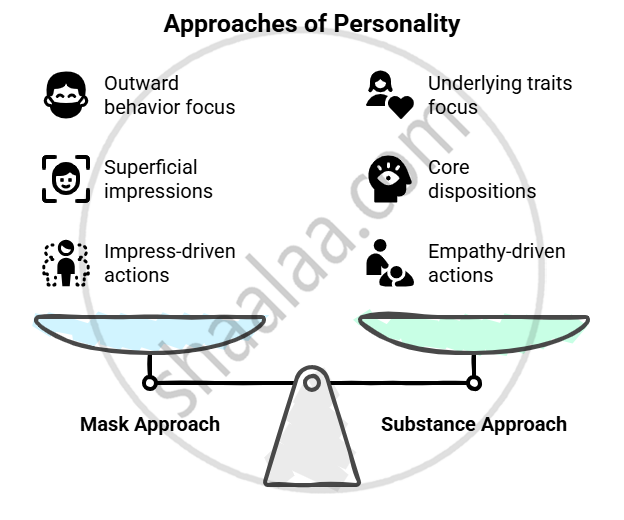
CISCE: Class 12
Features of Personality
| Feature | Explanation | Example |
|---|---|---|
| Physical & Psychological | Involves both outward appearance and internal dispositions | Calm facial expression (physical) and patient outlook (psychological) |
| Uniqueness | Each individual exhibits a distinct pattern of traits | Two students may both be shy, but only one volunteers in class |
| Stability | Core traits remain consistent over time | Honest behavior at home and at school over several years |
| Dynamism (Adaptivity) | Traits can adjust to meet changing internal or external demands | A generally quiet student becomes assertive in emergencies |
| Consistency | Stable patterns of behaviour across time and contexts | An honest student remains honest at home and school |
| Uniqueness | Individual trait combinations that differentiate people | Each student’s interests and reactions vary |
| Adaptability | Flexibility to adjust behaviour to context | A shy student contributes more in a friendly group |
CISCE: Class 12
Major Dimensions: The Big Five
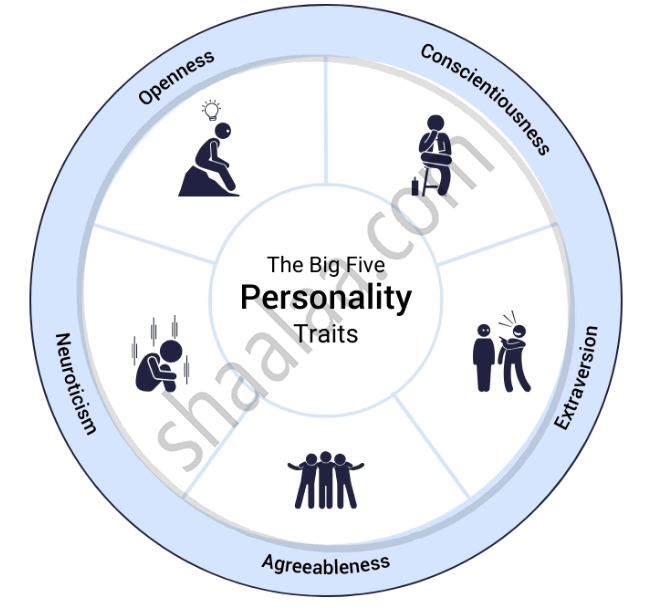
CISCE: Class 12
Common Misconceptions
| Layperson View | Psychological View |
|---|---|
| Focus on external traits (looks, dress). | Focus on characteristic responses to events and people. |
| “Good-looking implies charming.” | Traits like shy, warm, and impulsive denote consistent behavior patterns. |
CBSE: Class 12
Maharashtra State Board: Class 12
CISCE: Class 12
Maharashtra State Board: Class 12
CISCE: Class 12
Key Point: Concept of Personality
- Personality is the stable pattern of thinking, feeling, and behaving over time.
- The word comes from the Latin "persona", meaning mask, showing how people present themselves.
- Munn emphasized inborn traits, while Allport described personality as a dynamic system.
- It includes biological, psychological, and social elements.
- Personality stays fairly consistent but changes with experience.
- Understanding personality helps predict behaviour and improve relationships.
