Topics
Psychology : A Scientific Discipline
- Science of Psychology
- Key Features of Science
- History of Psychology as a Science
- Research Methods in Psychology> Experimental Method
- Research Methods in Psychology> Survey Method
- Research Methods in Psychology> Observation Method
- Research Methods in Psychology> Case Study Method
- Research Methods in Psychology> Correlation Studies
- Challenges in Establishing Psychology as a Science
- Importance of Rationality
Intelligence
- Concept of Intelligence
- Perspectives on Intelligence
- Intelligence as a Single, General Ability
- Theories of Intelligence
- E. L. Thorndike's Theory
- Louis Thurstone’s Multifactor Theory
- Charles Spearman's Two Factor Theory
- Theory of Intelligence by Cattell
- Howard Gardner's Multiple Intelligence Theory
- Measurement of Intelligence
- History of Measurement of Intelligence
- Mental Age
- Intelligence Quotient
- Types of Intelligence Tests
- Individual Test
- Group Test
- Verbal Test
- Non-Verbal Test
- Applications of Intelligence Testing
- New Trends in Intelligence> Social Intelligence
- New Trends in Intelligence> Emotional Intelligence
- New Trends in Intelligence> Artificial Intelligence
Personality
Cognitive Processes
Emotions
- Concept of Emotions
- History of Emotions
- Basic Emotions
- Plutchik’s Model
- Physiological Changes During Emotions
- Emotional Well-Being
- Achieving Emotional Well Being
- Benefits of Emotional Well-Being
- Emotional Abuse
- Managing Emotions
- Anger Management
- Anticipating and Managing Anger
- The 3 R's: Relax, Reassess, and Respond
Psychological Disorders
- Concept of Abnormal Behaviour
- Nature of Psychological Disorders
- Criteria for Psychological Disorders
- Concept of Mental Wellness
- Mental Disorders - Its Classification
- Major Psychological Disorder> Anxiety Disorders
- Depressive Disorders
- Major Psychological Disorder> Bipolar Disorder
- Major Psychological Disorder> Trauma and Stress Related Disorders
- Major Psychological Disorder> Substance-Related and Addictive Disorders
- Major Psychological Disorder> Schizophrenia
- Identifying and Treating Psychological Disorders
First Aid in Mental Health
Positive Psychology
Estimated time: 18 minutes
- Introduction
- Historical Framework
- Calculation of Mental Age
- Example
- Interpretation of Mental Age
- Growth Pattern of Mental Age
- Real-Life Application
- Key Points: Mental Age
CISCE: Class 12
Introduction
Mental age (MA) denotes the age level at which an individual successfully completes all intelligence-test items designated for that age. Introduced by Alfred Binet in the 1908 Binet–Simon scale, MA assesses intellectual development relative to chronological age (CA), which is the actual age in years since birth.
CISCE: Class 12
Historical Framework
The Binet–Simon scale pioneered age-specific test items to identify students requiring educational assistance. Early classifications featured hierarchical levels of mental development.
CISCE: Class 12
Calculation of Mental Age
- Determine Basal Age: Highest age level at which all items are answered correctly.
- Ceiling Adjustment: Convert partially correct performance at the next age level into months (e.g., half of items = 6 months).
- Compute Total MA: Sum the basal years and the added months.
CISCE: Class 12
Example
A 16-year-old completes all items for age 14, half for age 15, and none for age 16.
- Basal age = 14 years
- Additional = ½ × 12 months = 6 months
- MA = 14 years + 6 months = 14.5 years
CISCE: Class 12
Interpretation of Mental Age
CISCE: Class 12
Growth Pattern of Mental Age
- Early Adolescence: Rapid MA gains (e.g., ages 11→14).
- Late Adolescence to Adulthood: MA growth decelerates, approaching an adult cognitive plateau.
CISCE: Class 12
Real-Life Application
Imagine two 12-year-olds:
- Aarav completes tasks designed for age 12 (MA = 12).
- Neha solves puzzles intended for age 14 (MA = 14).
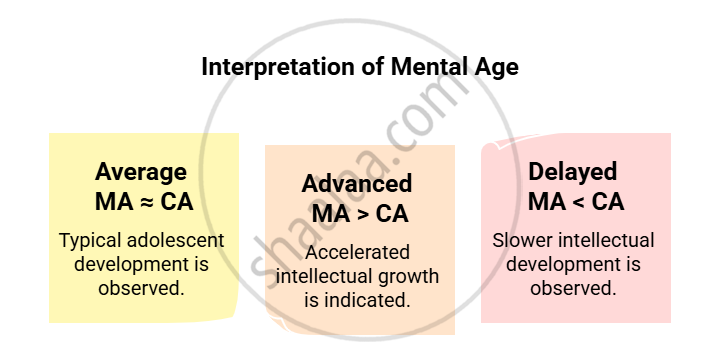
Neha’s MA exceeds CA, indicating advanced cognitive ability in problem-solving contexts common in accelerated learning programs.
CBSE: Class 12
Maharashtra State Board: Class 12
CISCE: Class 12
Maharashtra State Board: Class 12
CISCE: Class 12
Key Points: Mental Age
- Mental Age (MA) is the level of intellectual development at which a person performs on an intelligence test, compared to their Chronological Age (CA).
- The concept was introduced by Alfred Binet in 1908 through the Binet–Simon scale to identify children needing educational help.
- MA is calculated by finding the highest age level fully passed (basal age) and adding extra months for partially correct answers.
- If MA equals CA, development is average; if MA is higher than CA, intelligence is advanced; if MA is lower than CA, development is delayed.
- Mental age increases rapidly in childhood, slows in adolescence, and reaches a plateau in adulthood.
- It is useful for comparing children’s intellectual development and identifying those who need special support or advanced learning.
