Topics
Laws of Motion
- Force
- Inertia and Mass
- Types of Inertia
- Linear Momentum
- Newton's First Law of Motion
- Translational and Rotational Motions
- Moment (Turning Effect) of a Force or Torque
- Principle of Moments
- Couple
- Newton’s Second Law of Motion
- Impulse of a Force
- Newton's Third Law of Motion
- Conservation of Linear Momentum and Its Principle
- Rocket Propulsion
- Newton's Universal Law of Gravitation
- Acceleration Due to Gravity (Earth’s Gravitational Acceleration)
- Apparent Weight
Optics
- Climatic Factors > Light
- Refraction of Light
- Law of Reflection of Light
- Prism
- Dispersion of Light Through a Prism
- Scattering of Light-Rayleigh's Law
- Concept of Lenses
- Spherical Lens
- Position and Nature of Image Formed by Spherical Mirrors
- Technical Terms Related to a Lens
- Convex Lens
- Images Formed by Convex Lenses
- Concave Lens
- Images Formed by Concave Lenses
- Lens Formula and Magnification
- Sign Convention
- Magnification
- Lens Maker's Formula
- Power of a Lens
- Defects of Vision and Their Corrections > Myopia
- Defects of Vision and Their Corrections > Hypermetropia
- Defects of Vision and Their Corrections > Presbyopia
- Eye Defect and Its Correction: Astigmatism
- Microscope and it’s types
- Fundamentals of Telescope
- Types of Telescope: Optical Telescope
- Types of Telescope: Radio Telescope
- Types of Telescope: Telescopes Used in Space
Thermal Physics
- Heat
- The Temperature and a Thermometer
- Scales of Thermometers
- Flow of Heat
- Transfer of Heat
- Thermal Expansion
- Expansion of Solids
- Expansion of Liquids
- Expansion of Gases
- Fundamental Laws of Gases
- Pressure and Volume Relationship or Bolye's Law
- Temperature - Volume Relationship or Charles's Law
- Avogadro's Law
- Gases and Its Characteristics
- Classification of Gases: Real Gases and Ideal Gases
- Gas Equation
Electricity
- Electricity
- Electric Current
- Electric Circuit
- Symbols and Functions of Various Components of an Electric Circuits
- Potential Difference
- Ohm's Law
- Electric Resistance
- Specific Resistance or Electrical Resistivity
- Resistance of a System of Resistors
- Resistors in Series
- Resistors in Parallel
- Series Connection of Parallel Resistors
- Parallel Connection of Series Resistors
- Heating Effect of Electric Current
- Joule’s Law of Heating
- Electrical Power
- Household Electrical Circuits
- Earthing
- Led Bulb
- Led Television
Acoustics
- Sound Waves
- Light Waves vs Sound Waves
- Audibility and Range
- Speed of Sound (Velocity of Sound)
- Factors Affecting Speed of Sound
- Speed of Sound in Different Media
- Reflection of Sound Waves
- Law of Reflection of Light
- Reflection of Sound Waves
- Echo
- Application of Reflection of Sound
- Doppler Effect
- Expression for Apparent Frequency Due to Doppler Effect
- Applications of Doppler Effect
Nuclear Physics
- Radioactivity
- Types of Radioactivity
- Radioactivity as emission of Alpha, Beta, and Gamma Radiations
- Properties of Alpha Particles
- Properties of Beta Particles
- Properties of Gamma Radiations
- Changes Within the Nucleus in Alpha, Beta and Gamma Emission
- Alpha Decay (Alpha Emission)
- Beta Decay (Beta Emission)
- Gamma Decay (Gamma Emission)
- Nuclear Fission
- Nuclear Fusion
- Uses of Radioactive Isotopes
- Nuclear Reactor
- Safety Precautions While Using Nuclear Energy
- Power Plants Based on Nuclear Energy
Atoms and Molecules
- Atoms: Building Blocks of Matter
- Atomic Mass
- Molecules
- Classification of Molecules
- Classification of Molecules
- Classification of Molecules
- Molecular Mass
- Difference Between Atoms and Molecules
- Mole Concept
- Percentage Composition, Empirical and Molecular Formula
- Avogadro's Law
- Vapour Density and Its Relation to Relative Molecular Mass
Periodic Classification of Elements
- Classification of Elements
- Modern Periodic Law
- Modern Periodic Table
- Periods and Electronic Configuration
- Atomic Size
- Ionic Radii
- Ionisation Potential (Ionisation Energy)
- Electron Affinity
- Electronegativity
- Metallurgy
- Types of Separation or Concentration of an Ore
- Occurrence of Ores in Tamil Nadu
- Earth and Elements
- Metallurgy of Aluminium
- Basic Principles of Metallurgy > Extraction of Metals
- Metallurgy of Copper
- Extraction of Copper
- Metallurgy of Iron
- Extraction of Iron
- Alloy
- Methods of Making Alloys
- Corrosion of Metals
- Pamban Bridge
Solutions
- Introduction to Solutions
- Composition of a Solution
- Types of Solutions
- Solubility
- Concentration of a Solution
- Hydrated and Anhydrous Substances
- Efflorescence, Hygroscopic, and Deliquescence Substances
- Problems Based on Solubility and Percentage by Mass and Volume
Types of Chemical Reactions
- Effects of Chemical Changes: Biological Effects
- Effects of Chemical Changes: Environmental Effects
- Balancing Chemical Equation
- Types of Chemical Reactions > Combination Reaction
- Types of Chemical Reactions > Decomposition Reaction
- Types of Chemical Reactions > Single Displacement Reaction
- Types of Chemical Reactions > Double Displacement Reaction
- Chemical Properties of Carbon Compounds > Combustion
- Classification of Change: Reversible and Irreversible Changes
- Rate of Chemical Reaction
- State of Equilibrium
- Ionic Product of Water
- Strength of Acid and Base Solutions : pH Scale
- Indicators
- Ph Calculation
- Problems on Ph
Carbon and Its Compounds
- Carbon: A Versatile Element
- Classification of Compounds of Carbon
- Organic Compounds
- Classification of Organic Compounds Based on the Pattern of Carbon Chain
- Classification of Organic Compound Based on the Kind of Atoms
- Hydrocarbons
- Functional Groups in Carbon Compounds
- Homologous Series
- IUPAC Nomenclature of Hydrocarbons
- IUPAC Nomenclature of other classes
- Ethanol
- Laboratory Preparation of Ethanol
- Ethanoic Acid
- Organic Compounds in Daily Life
- Soap
- Detergents
- Cleansing Action of Soap
Plant Anatomy and Plant Physiology
- Tissues - “The Teams of Workers”
- Tissue System
- Internal Structure of Dicot Root (Bean)
- Internal Structure of Monocot Root (Maize)
- Internal Structure of Dicot Stem (Sunflower)
- Internal Structure of Monocot Stem (Maize)
- Internal Structure of Dicot Leaf (Dorsiventral Leaf) Ex. Mango Leaf
- Internal Structure of Monocot Leaf (Isobilateral Leaf) Ex.Grass Leaf
- Plastids
- Concept of Photosynthesis
- Process of Photosynthesis
- Chlorophyll: The Vital Plant Pigment
- Process of Photosynthesis
- Light Reaction
- Light-Independent Phase of Photosynthesis
- Factors Affecting Photosynthesis
- Mitochondria - “Power House of the Cell”
- Glycolysis
- Electron Transport System (Ets) and Oxidative Phosphorylation
- Phases of Respiration: Pyruvate Oxidation (Link Reaction)
- Tricarboxylic Acid Cycle (Citric Acid Cycle or Kreb’s Cycle)
- Fermentation
- Phases of Respiration: Electron Transport Chain (Electron Transfer System)
- Respiratory Quotient
Structural Organisation of Animals
- The Indian Cattle Leech (Hirudinaria Granulosa)
- External Morphology of Leech
- Digestive System of Leech
- Respiratory System of Leech
- Circulatory System of Leech
- Nervous System of Leech
- Excretory System of Leech
- Reproductive System of Leech
- Parasitic Adaptations of Leech
- Rabbit (Oryctolagus Cuniculus)
- External Morphology of Rabbit
- Coelom (Body Cavity) of Rabbit
- Digestive System of Rabbit
- Respiratory System of Rabbit
- Circulatory System of Rabbit
- Nervous System of Rabbit
- Urinogenital System of Rabbit
Transportation in Plants and Circulation in Animals
- Transport System in Plants
- Diffusion
- Active Transport
- Imbibition
- Factors Affecting the Rate of Transpiration
- Root Pressure
- Uptake of Minerals
- Forces Contributing to Ascent of Sap
- Blood
- Functions of Blood
- Blood Circulatory System
- Circulation of Blood in the Heart (Functioning of Heart)
- Types of Closed Circulation
- Heart Beat
Nervous System
- Nerve Fibres
- Major Division of the Nervous System
- Cerebrospinal Fluid
Plant and Animal Hormones
Reproduction in Plants and Animals
- Reproduction
- Sexual Reproduction in Plants
- Pollination
- Self-pollination
- Cross-pollination
- Menstrual Cycle (Ovarian Cycle)
- Fertilization to Foetal Development
- Concept of Reproductive Health
- Family Planning
- Types of Hygiene: Personal Hygiene
Genetics
Origin and Evolution of Life
- The Universe
- Origin of Life on Earth
- Paleobotany
- Ethnobotany
- Astrobiology/Exobiology
Breeding and Biotechnology
- Breeding and Biotechnology
- Modern Agricultural Practices and Crop Improvement
- Green Revolution
- Methods of Plant Breeding for Crop Improvement
- Animal Husbandry (Livestock) > Animal Breeding
- Genetic Engineering
- Biotechnology in Medicine
- DNA Fingerprinting
Health and Diseases
- Abuse and Types of Abuse
- Approaches for Protection of an Abused Child
- Drug Abuse
- Tobacco Abuse
- Alcohol Abuse
- Diseases and Disorders Due to Lifestyle Modifications
- Diabetes Mellitus
- Obesity and Its Prevention
- Heart Disease
- Cancer
Environmental Management
- Environmental Management
- Protecting our environment
- Forests: Our Lifeline
- Deforestation and Its Causes
- Conservation of Forests
- Wildlife
- Conservation of Wildlife
- Soil Erosion
- Soil Conservation
- Energy Resources > Conventional energy resources or non-renewable energy resources
- Fossil Fuels
- Conservation of Coal, Petroleum, and Natural Resources
- Electricity Generation using Solar Energy
- Solar Energy Devices
- Bio-energy
- Shale Gas
- Electricity Generation using Hydroelectric Energy
- Energy from the Sea
- Fresh Water Management
- Conservation of Electrical Energy
- E-waste Management
- Sewage Management
- Waste Water Management
- Five R’s of Waste Management
Visual Communication
- Visual Communication Devices
- File and Folder
- Scratch
- Introduction
- Basic Lens Terminology
- Principal Focus (F) and Focal Length (f)
- Experiment
Introduction
A spherical mirror is a curved mirror that forms part of a hollow sphere. It is of two types:
- Concave Mirror (Converging) – Reflects light inward, forming real or virtual images. Used in telescopes, headlights, and shaving mirrors.
- Convex Mirror (Diverging) – Reflects light outward, always forming a virtual image. Used in vehicle rearview mirrors and security mirrors.

Spherical mirror
Spherical mirrors follow the laws of reflection and are essential in optical devices and imaging systems.
Basic Lens Terminology
- Pole (P): The centre of the spherical surface of the lens where the principal axis meets the surface.
- Optical Centre (O): The point at the centre of the lens through which light rays pass without deviation.
- Centre of Curvature (C₁, C₂): The centres of the spheres whose parts form the surfaces of the lens. A lens has two centres of curvature.
- Radius of Curvature (R₁, R₂): The radii of the spheres whose parts form the lens surfaces.
- Principal Axis: An imaginary straight line passing through both centres of curvature and the pole.
- Aperture: The effective diameter of the lens that allows light refraction.
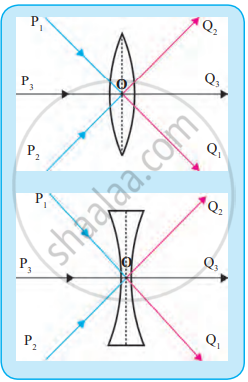
Optical centre of a lens
Principal Focus (F) and Focal Length (f)
1. Convex Lens (Converging Lens)
As seen in Figure (a), parallel light rays converge at a point (F₂) on the principal axis after refraction. This principal focus helps in focusing light, used in magnifying glasses and cameras.
2. Concave Lens (Diverging Lens)
As seen in Figure (b), parallel light rays diverge after refraction, appearing to come from a virtual focus (F₁). It is used in corrective glasses for myopia and optical instruments.
3. Focal Length (f)
Distance between the optical centre (O) and the principal focus (F).
- Convex lens → Positive focal length (+f) (light converges).
- Concave lens → Negative focal length (-f) (light diverges).

Principal focus of a lens
Experiment
1. Aim: To determine the focal length of a convex lens by obtaining the image of a distant object on a screen.
2. Requirements: convex lens, screen, metre scale, and lens stand.
3. Procedure
- Fix the screen in position.
- Hold the convex lens in front of a distant object (such as a tree or building).
- Adjust the position of the lens until a sharp image of the object appears on the screen.
- Measure the distance between the lens and the screen using a metre scale.
- Reverse the lens and repeat the process to obtain another clear image.
- Measure the distance between the screen and the lens again.
- This distance represents the focal length (f) of the convex lens.
4. Conclusion
- The distance between the screen and the lens is the focal length of the convex lens. The image of a distant object forms near the focus (F) of the lens.
- If a concave lens is used instead, a real image cannot be obtained on the screen, as concave lenses form only virtual and diminished images.
- This experiment helps in understanding the focal length and image formation properties of convex and concave lenses.
