Please select a subject first
Advertisements
Advertisements
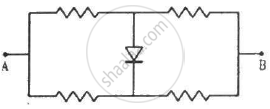
Each of the resistance shown in figure has a value of 20 Ω. Find the equivalent resistance between A and B. Does it depend on whether the point A or B is at higher potential?
Concept: undefined >> undefined
Find the currents through the resistance in the circuits shown in figure.
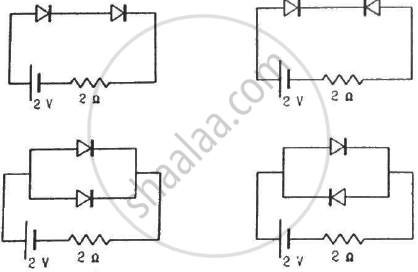
(Assume that the resistance of each diode is zero in forward bias and is infinity in reverse bias.)
Concept: undefined >> undefined
Advertisements
What are the readings of the ammeters A1 and A2 shown in figure. Neglect the resistance of the meters.
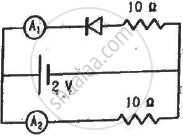
(Assume that the resistance of each diode is zero in forward bias and is infinity in reverse bias.)
Concept: undefined >> undefined
Find the current through the battery in each of the circuits shown in figure.
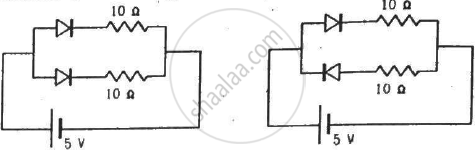
(Assume that the resistance of each diode is zero in forward bias and is infinity in reverse bias.)
Concept: undefined >> undefined
Find the current through the resistance R in figure if (a) R = 12Ω (b) R = 48Ω.
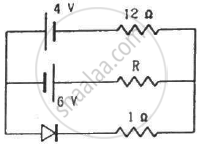
(Assume that the resistance of each diode is zero in forward bias and is infinity in reverse bias.)
Concept: undefined >> undefined
Draw the current-voltage characteristics for the device show in figure between the terminals A and B.
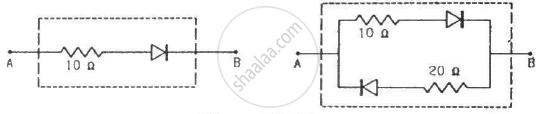
(Assume that the resistance of each diode is zero in forward bias and is infinity in reverse bias.)
Concept: undefined >> undefined
Find the equivalent resistance of the network shown in figure between the points A and B.
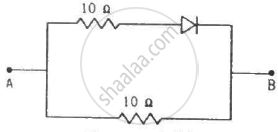
(Assume that the resistance of each diode is zero in forward bias and is infinity in reverse bias.)
Concept: undefined >> undefined
When the base current in a transistor is changed from 30µA to 80µA, the collector current is changed from 1.0 mA to 3.5 mA. Find the current gain β.
Concept: undefined >> undefined
A load resistor of 2kΩ is connected in the collector branch of an amplifier circuit using a transistor in common-emitter mode. The current gain β = 50. The input resistance of the transistor is 0.50 kΩ. If the input current is changed by 50µA. (a) by what amount does the output voltage change, (b) by what amount does the input voltage change and (c) what is the power gain?
Concept: undefined >> undefined
A hydrogen atom in ground state absorbs a photon of ultraviolet radiation of wavelength 50 nm. Assuming that the entire photon energy is taken up by the electron with what kinetic energy will the electron be ejected?
Concept: undefined >> undefined
Electrons are emitted from an electron gun at almost zero velocity and are accelerated by an electric field E through a distance of 1.0 m. The electrons are now scattered by an atomic hydrogen sample in ground state. What should be the minimum value of E so that red light of wavelength 656.3 nm may be emitted by the hydrogen?
Concept: undefined >> undefined
A hydrogen atom moving at speed υ collides with another hydrogen atom kept at rest. Find the minimum value of υ for which one of the atoms may get ionized.
The mass of a hydrogen atom = 1.67 × 10⁻²⁷ kg.
Concept: undefined >> undefined
Mass of a particle depends on its speed. Does the attraction of the earth on the particle also depend on the particle's speed?
Concept: undefined >> undefined
The magnitude of linear momentum of a particle moving at a relativistic speed v is proportional to ______________ .
Concept: undefined >> undefined
If the speed of a particle moving at a relativistic speed is doubled, its linear momentum will _____________ .
Concept: undefined >> undefined
When a photon is emitted from an atom, the atom recoils. The kinetic energy of recoil and the energy of the photon come from the difference in energies between the states involved in the transition. Suppose, a hydrogen atom changes its state from n = 3 to n = 2. Calculate the fractional change in the wavelength of light emitted, due to the recoil.
Concept: undefined >> undefined
Mark the correct statements:-
(a) Equations of special relativity are not applicable for small speeds.
(b) Equations of special relativity are applicable for all speeds.
(c) Nonrelativistic equations give exact result for small speeds.
(d) Nonrelativistic equations never give exact result.
Concept: undefined >> undefined
If the speed of a rod moving at a relativistic speed parallel to its length is doubled,
(a) the length will become half of the original value
(b) the mass will become double of the original value
(c) the length will decrease
(d) the mass will increase
Concept: undefined >> undefined
Which of the following quantities related to an electron has a finite upper limit?
Concept: undefined >> undefined
A rod of rest length L moves at a relativistic speed. Let L' = L/γ. Its length
(a) must be equal to L'
(b) may be equal to L
(c) may be more than L' but less than L
(d) may be more than L
Concept: undefined >> undefined
