Advertisements
Advertisements
प्रश्न
A hydrogen atom moving at speed υ collides with another hydrogen atom kept at rest. Find the minimum value of υ for which one of the atoms may get ionized.
The mass of a hydrogen atom = 1.67 × 10⁻²⁷ kg.
Advertisements
उत्तर
Given:
Mass of the hydrogen atom, M = 1.67 × 10⁻²⁷ kg
Let v be the velocity with which hydrogen atom is moving before collision.
Let v1 and v2 be the velocities of hydrogen atoms after the collision.
Energy used for the ionisation of one atom of hydrogen, ΔE = 13.6 eV = 13.6×(1.6×10−19)J
Applying the conservation of momentum, we get
mv = mv1 + mυ2 ...(1)
Applying the conservation of mechanical energy, we get
`1/2 mv^2=1/2mv_1^2+ 1/2mv_2^2+DeltaE//m` .......(2)
Using equation (1), we get
`V^2 = (V_1 + V_2)^2`
`V^2 = v_1^2 +v_2^2 + 2v_1v_2` ...(3)
In equation(2), on multiplying both the sides by 2 and dividing both the sides by m.
`v^2 = v_1^2 + v_1^2+ 2Delta E//m .......(4)`
On comparing (4) and (3), we get
`[therefore 2v_1v_2 = (2DeltaE)/m]`
`(U_1 - U_2)^2 = (U_1 + U_2)^2 -4U_1U_2`
`(v_1 - v_2)^2 = v^2 - (4DeltaE)/m`
For minimum value of υ,
`V_1 = V_2 = 0 `
`Also, V^2 - (4Delta)/m`
`∴ v^2 = (4DeltaE)/m`
= `(4xx13.6xx1.6xx10^-19)/(1.67xx10^-27)`
`v =sqrt(4xx13.6xx1.6xx10^-19)/(1.67xx10^-27)`
= `10^4 sqrt((4xx13.6xx1.6)/(1.67))`
= 7.2 × 10⁴ m/s
APPEARS IN
संबंधित प्रश्न
A 12.5 eV electron beam is used to bombard gaseous hydrogen at room temperature. What series of wavelengths will be emitted?
Which of the following curves may represent the speed of the electron in a hydrogen atom as a function of trincipal quantum number n?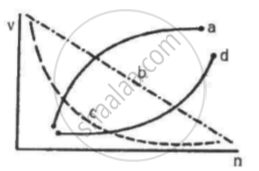
As one considers orbits with higher values of n in a hydrogen atom, the electric potential energy of the atom
A hydrogen atom in ground state absorbs 10.2 eV of energy. The orbital angular momentum of the electron is increased by
Which of the following products in a hydrogen atom are independent of the principal quantum number n? The symbols have their usual meanings.
(a) vn
(b) Er
(c) En
(d) vr
Find the radius and energy of a He+ ion in the states (a) n = 1, (b) n = 4 and (c) n = 10.
A hydrogen atom emits ultraviolet radiation of wavelength 102.5 nm. What are the quantum numbers of the states involved in the transition?
A group of hydrogen atoms are prepared in n = 4 states. List the wavelength that are emitted as the atoms make transitions and return to n = 2 states.
Whenever a photon is emitted by hydrogen in Balmer series, it is followed by another photon in Lyman series. What wavelength does this latter photon correspond to?
What is the energy of a hydrogen atom in the first excited state if the potential energy is taken to be zero in the ground state?
A gas of hydrogen-like ions is prepared in a particular excited state A. It emits photons having wavelength equal to the wavelength of the first line of the Lyman series together with photons of five other wavelengths. Identify the gas and find the principal quantum number of the state A.
Find the maximum angular speed of the electron of a hydrogen atom in a stationary orbit.
Suppose, in certain conditions only those transitions are allowed to hydrogen atoms in which the principal quantum number n changes by 2. (a) Find the smallest wavelength emitted by hydrogen. (b) List the wavelength emitted by hydrogen in the visible range (380 nm to 780 nm).
The average kinetic energy of molecules in a gas at temperature T is 1.5 kT. Find the temperature at which the average kinetic energy of the molecules of hydrogen equals the binding energy of its atoms. Will hydrogen remain in molecular from at this temperature? Take k = 8.62 × 10⁻⁵ eV K−1.
Show that the ratio of the magnetic dipole moment to the angular momentum (l = mvr) is a universal constant for hydrogen-like atoms and ions. Find its value.
A hydrogen atom in ground state absorbs a photon of ultraviolet radiation of wavelength 50 nm. Assuming that the entire photon energy is taken up by the electron with what kinetic energy will the electron be ejected?
When a photon is emitted from an atom, the atom recoils. The kinetic energy of recoil and the energy of the photon come from the difference in energies between the states involved in the transition. Suppose, a hydrogen atom changes its state from n = 3 to n = 2. Calculate the fractional change in the wavelength of light emitted, due to the recoil.
Consider an excited hydrogen atom in state n moving with a velocity υ(ν<<c). It emits a photon in the direction of its motion and changes its state to a lower state m. Apply momentum and energy conservation principles to calculate the frequency ν of the emitted radiation. Compare this with the frequency ν0 emitted if the atom were at rest.
In a hydrogen atom the electron moves in an orbit of radius 0.5 A° making 10 revolutions per second, the magnetic moment associated with the orbital motion of the electron will be ______.
