Advertisements
Advertisements
प्रश्न
Show that the ratio of the magnetic dipole moment to the angular momentum (l = mvr) is a universal constant for hydrogen-like atoms and ions. Find its value.
Advertisements
उत्तर
Mass of the electron, m = 9.1×10⁻³¹kg
Radius of the ground state, r = 0.53×10 -10 m
Let f be the frequency of revolution of the electron moving in the ground state and A be the area of orbit.
Dipole moment of the hydrogen like elements (μ) is given by
μ = niA = qfA
`= e xx m/(4∈_0^2 h^3n^3 )xx(pir_0^2n^2)`
`= (me^5xx(pir_0^2n^2))/(4∈_0^2h^3n^3)`
Here,
h = Planck's constant
e = Charge on the electron
ε0 = Permittivity of free space
n = Principal quantum number
Angular momentum of the electron in the hydrogen like atoms and ions (L) is given by
`L = mvr = (nh)/(2pi)`
Ratio of the dipole moment and the angular momentum is given by
`mu/L =( e^5xxmxxpir^2n^2)/(4∈_0h^3n^3)xx (2pi)/(nh)`
`mu/L =((1.6xx10^-19)^5xx(9.10xx10^-31)(3.14)^2xx(0.53xx10xx^-10)^2)/(2(8.85xx10^-12)^2xx(6.63xx10^-34)^3xx1^2`
`mu/L = 3.73 xx 10^10 C // kg`
Ratio of the magnetic dipole moment and the angular momentum do not depends on the atomic number 'Z'.
Hence, it is a universal constant.
APPEARS IN
संबंधित प्रश्न
What will be the energy corresponding to the first excited state of a hydrogen atom if the potential energy of the atom is taken to be 10 eV when the electron is widely separated from the proton? Can we still write En = E1/n2, or rn = a0 n2?
Which of the following curves may represent the speed of the electron in a hydrogen atom as a function of trincipal quantum number n?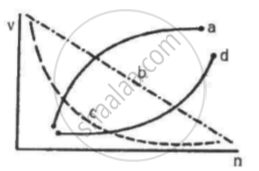
As one considers orbits with higher values of n in a hydrogen atom, the electric potential energy of the atom
Which of the following products in a hydrogen atom are independent of the principal quantum number n? The symbols have their usual meanings.
(a) vn
(b) Er
(c) En
(d) vr
Ionization energy of a hydrogen-like ion A is greater than that of another hydrogen-like ion B. Let r, u, E and L represent the radius of the orbit, speed of the electron, energy of the atom and orbital angular momentum of the electron respectively. In ground state
Find the binding energy of a hydrogen atom in the state n = 2.
A hydrogen atom emits ultraviolet radiation of wavelength 102.5 nm. What are the quantum numbers of the states involved in the transition?
Find the maximum Coulomb force that can act on the electron due to the nucleus in a hydrogen atom.
A hydrogen atom in a state having a binding energy of 0.85 eV makes transition to a state with excitation energy 10.2 e.V (a) Identify the quantum numbers n of the upper and the lower energy states involved in the transition. (b) Find the wavelength of the emitted radiation.
Whenever a photon is emitted by hydrogen in Balmer series, it is followed by another photon in Lyman series. What wavelength does this latter photon correspond to?
Find the maximum angular speed of the electron of a hydrogen atom in a stationary orbit.
Electrons are emitted from an electron gun at almost zero velocity and are accelerated by an electric field E through a distance of 1.0 m. The electrons are now scattered by an atomic hydrogen sample in ground state. What should be the minimum value of E so that red light of wavelength 656.3 nm may be emitted by the hydrogen?
When a photon is emitted from an atom, the atom recoils. The kinetic energy of recoil and the energy of the photon come from the difference in energies between the states involved in the transition. Suppose, a hydrogen atom changes its state from n = 3 to n = 2. Calculate the fractional change in the wavelength of light emitted, due to the recoil.
Consider an excited hydrogen atom in state n moving with a velocity υ(ν<<c). It emits a photon in the direction of its motion and changes its state to a lower state m. Apply momentum and energy conservation principles to calculate the frequency ν of the emitted radiation. Compare this with the frequency ν0 emitted if the atom were at rest.
Let En = `(-1)/(8ε_0^2) (me^4)/(n^2h^2)` be the energy of the nth level of H-atom. If all the H-atoms are in the ground state and radiation of frequency (E2 - E1)/h falls on it ______.
- it will not be absorbed at all.
- some of atoms will move to the first excited state.
- all atoms will be excited to the n = 2 state.
- no atoms will make a transition to the n = 3 state.
Why do only discrete frequencies appear in atomic emission spectra?
In what year was Niels Bohr awarded the Nobel Prize in Physics for his explanation of the hydrogen atom spectrum?
