Advertisements
Advertisements
प्रश्न
Find the wavelength of the electron orbiting in the first excited state in hydrogen atom.
Advertisements
उत्तर
For first excited state hydrogen atom is n = 2
Energy of the electron in nth orbit = `−13.6/n^2 eV`
`=13.6/2^2=3.4 eV`
`"Energy" =(hc)/λ=1240/λ`
`3.4 = 1240/λ`
`⇒λ = 364.7 nm`
APPEARS IN
संबंधित प्रश्न
Which wavelengths will be emitted by a sample of atomic hydrogen gas (in ground state) if electrons of energy 12.2 eV collide with the atoms of the gas?
Which of the following curves may represent the speed of the electron in a hydrogen atom as a function of trincipal quantum number n?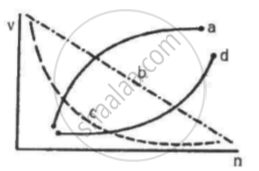
As one considers orbits with higher values of n in a hydrogen atom, the electric potential energy of the atom
Let An be the area enclosed by the nth orbit in a hydrogen atom. The graph of ln (An/A1) against ln(n)
(a) will pass through the origin
(b) will be a straight line with slope 4
(c) will be a monotonically increasing nonlinear curve
(d) will be a circle
Calculate the smallest wavelength of radiation that may be emitted by (a) hydrogen, (b) He+ and (c) Li++.
Find the maximum Coulomb force that can act on the electron due to the nucleus in a hydrogen atom.
A gas of hydrogen-like ions is prepared in a particular excited state A. It emits photons having wavelength equal to the wavelength of the first line of the Lyman series together with photons of five other wavelengths. Identify the gas and find the principal quantum number of the state A.
A hydrogen atom in ground state absorbs a photon of ultraviolet radiation of wavelength 50 nm. Assuming that the entire photon energy is taken up by the electron with what kinetic energy will the electron be ejected?
Let En = `(-1)/(8ε_0^2) (me^4)/(n^2h^2)` be the energy of the nth level of H-atom. If all the H-atoms are in the ground state and radiation of frequency (E2 - E1)/h falls on it ______.
- it will not be absorbed at all.
- some of atoms will move to the first excited state.
- all atoms will be excited to the n = 2 state.
- no atoms will make a transition to the n = 3 state.
Which mathematical relation represents the energy of a photon emitted during an electronic transition from state ni to state nf?
