Advertisements
Advertisements
प्रश्न
The minimum orbital angular momentum of the electron in a hydrogen atom is
विकल्प
h
h/2
h/2π
h/λ
Advertisements
उत्तर
h/2π
According to Bohr's atomic theory, the orbital angular momentum of an electron is an integral multiplt of h/2π.
∴ `L_u = (nh)/(2pi)`
Here,
n = Principal quantum number
The minimum value of n is 1.
Thus, the minimum value of the orbital angular momentum of the electron in a hydrogen atom is given by
`L = h/(2pi)`
APPEARS IN
संबंधित प्रश्न
If Bohr’s quantisation postulate (angular momentum = nh/2π) is a basic law of nature, it should be equally valid for the case of planetary motion also. Why then do we never speak of quantisation of orbits of planets around the sun?
The first excited energy of a He+ ion is the same as the ground state energy of hydrogen. Is it always true that one of the energies of any hydrogen-like ion will be the same as the ground state energy of a hydrogen atom?
Which wavelengths will be emitted by a sample of atomic hydrogen gas (in ground state) if electrons of energy 12.2 eV collide with the atoms of the gas?
In which of the following transitions will the wavelength be minimum?
Which of the following curves may represent the speed of the electron in a hydrogen atom as a function of trincipal quantum number n?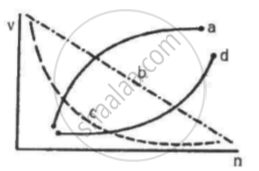
Calculate the smallest wavelength of radiation that may be emitted by (a) hydrogen, (b) He+ and (c) Li++.
(a) Find the first excitation potential of He+ ion. (b) Find the ionization potential of Li++ion.
Find the maximum angular speed of the electron of a hydrogen atom in a stationary orbit.
Suppose, in certain conditions only those transitions are allowed to hydrogen atoms in which the principal quantum number n changes by 2. (a) Find the smallest wavelength emitted by hydrogen. (b) List the wavelength emitted by hydrogen in the visible range (380 nm to 780 nm).
A hydrogen atom in ground state absorbs a photon of ultraviolet radiation of wavelength 50 nm. Assuming that the entire photon energy is taken up by the electron with what kinetic energy will the electron be ejected?
Electrons are emitted from an electron gun at almost zero velocity and are accelerated by an electric field E through a distance of 1.0 m. The electrons are now scattered by an atomic hydrogen sample in ground state. What should be the minimum value of E so that red light of wavelength 656.3 nm may be emitted by the hydrogen?
A hydrogen atom moving at speed υ collides with another hydrogen atom kept at rest. Find the minimum value of υ for which one of the atoms may get ionized.
The mass of a hydrogen atom = 1.67 × 10⁻²⁷ kg.
When a photon is emitted from an atom, the atom recoils. The kinetic energy of recoil and the energy of the photon come from the difference in energies between the states involved in the transition. Suppose, a hydrogen atom changes its state from n = 3 to n = 2. Calculate the fractional change in the wavelength of light emitted, due to the recoil.
In a hydrogen atom the electron moves in an orbit of radius 0.5 A° making 10 revolutions per second, the magnetic moment associated with the orbital motion of the electron will be ______.
A hydrogen atom makes a transition from n = 5 to n = 1 orbit. The wavelength of photon emitted is λ. The wavelength of photon emitted when it makes a transition from n = 5 to n = 2 orbit is ______.
Which mathematical relation represents the energy of a photon emitted during an electronic transition from state ni to state nf?
What is the process called when an atom absorbs a photon whose energy exactly matches the energy required for an electronic transition?
When an electron in a rarefied gas atom absorbs a photon, from which energy state to which energy state does the electron transition?
What is a key limitation of continuous spectra that is resolved by the observation of discrete emission lines?
