Please select a subject first
Advertisements
Advertisements
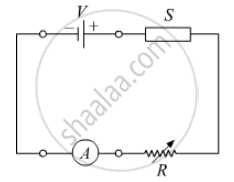
In the following diagram 'S' is a semiconductor. Would you increase or decrease the value of R to keep the reading of the ammeter A constant when S is heated? Give reason for your answer.
Concept: undefined >> undefined
Draw its I – V characteristics of photodiode
Concept: undefined >> undefined
Advertisements
Find the wavelength of the electron orbiting in the first excited state in hydrogen atom.
Concept: undefined >> undefined
In the following diagram, is the junction diode forward biased or reverse biased ?
Concept: undefined >> undefined
A pair of adjacent coils has a mutual inductance of 1.5 H. If the current in one coil changes from 0 to 20 A in 0.5 s, what is the change of flux linkage with the other coil?
Concept: undefined >> undefined
Consider two concentric circular coils, one of radius r1 and the other of radius r2 (r1 < r2) placed coaxially with centers coinciding with each other. Obtain the expression for the mutual inductance of the arrangement.
Concept: undefined >> undefined
Four point charges Q, q, Q and q are placed at the corners of a square of side 'a' as shown in the figure.
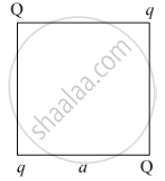
Find the
1) resultant electric force on a charge Q, and
2) potential energy of this system.
Concept: undefined >> undefined
Find out the amount of the work done to separate the charges at infinite distance.
Concept: undefined >> undefined
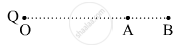
A point charge Q is placed at point 'O' as shown in the figure. Is the potential at point A, i.e. VA, greater, smaller or equal to potential, VB, at point B, when Q is (i) positive, and (ii) negative charge?
Concept: undefined >> undefined
The figure shows three infinitely long straight parallel current carrying conductors. Find the
- magnitude and direction of the net magnetic field at point A lying on conductor 1,
- magnetic force on conductor 2.

Concept: undefined >> undefined
A point charge Q is placed at point O as shown in the figure. The potential difference VA – VB positive. Is the charge Q negative or positive?
Concept: undefined >> undefined
Show variation of resistivity of Si with temperature in a graph ?
Concept: undefined >> undefined
Plot a graph showing variation of current versus voltage for the material GaAs ?
Concept: undefined >> undefined
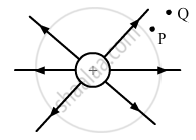
Figure shows the field lines due to a positive point charge. Give the sign of potential energy difference of a small negative charge between the points Q and P.
Concept: undefined >> undefined
Plot a graph showing the variation of photoelectric current with collector plate potential at a given frequency but for two different intensities I1 and I2, where I2 > I1.
Concept: undefined >> undefined
Give two points to distinguish between a paramagnetic and a diamagnetic substance ?
Concept: undefined >> undefined
Two long straight parallel conductors 'a' and 'b', carrying steady currents Ia and Ib are separated by a distance d. Write the magnitude and direction of the magnetic field produced by the conductor 'a' at the points along the conductor 'b'. If the currents are flowing in the same direction, what is the nature and magnitude of the force between the two conductors?
Concept: undefined >> undefined
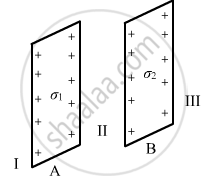
Two infinitely large plane thin parallel sheets having surface charge densities σ1 and σ2 (σ1 > σ2) are shown in the figure. Write the magnitudes and directions of the net fields in the regions marked II and III.
Concept: undefined >> undefined
The graph shown in the figure represents a plot of current versus voltage for a given semiconductor. Identify the region, if any, over which the semiconductor has a negative resistance.

Concept: undefined >> undefined
Write Einstein’s photoelectric equation?
Concept: undefined >> undefined
