Advertisements
Advertisements
प्रश्न
Four point charges Q, q, Q and q are placed at the corners of a square of side 'a' as shown in the figure.
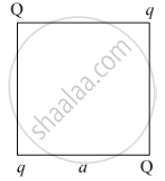
Find the
1) resultant electric force on a charge Q, and
2) potential energy of this system.
Advertisements
उत्तर
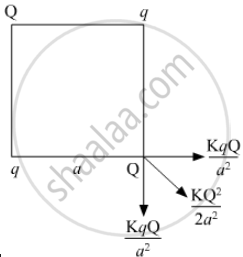
1) `F_"net" = "KQ"^2/(2a^2) + (sqrt2KQq)/a^2`
2) Potential energy of the system = `(4KQq)/a + "KQ"^2/(sqrt2a) + (Kq^2)/(sqrt2a)`
APPEARS IN
संबंधित प्रश्न
If one of the two electrons of a H2 molecule is removed, we get a hydrogen molecular ion `"H"_2^+`. In the ground state of an `"H"_2^+`, the two protons are separated by roughly 1.5 Å, and the electron is roughly 1 Å from each proton. Determine the potential energy of the system. Specify your choice of zero potential energy.
Consider a uniform electric field in the z-direction. The potential is a constant ______.
- Assertion (A): An electron has a high potential energy when it is at a location associated with a more negative value of potential, and a low potential energy when at a location associated with a more positive potential.
- Reason (R): Electrons move from a region of higher potential to region of lower potential.
Select the most appropriate answer from the options given below:
In the circuit shown in figure initially, key K1 is closed and key K2 is open. Then K1 is opened and K2 is closed (order is important). [Take Q1′ and Q2′ as charges on C1 and C2 and V1 and V2 as voltage respectively.]

Then
- charge on C1 gets redistributed such that V1 = V2
- charge on C1 gets redistributed such that Q1′ = Q2′
- charge on C1 gets redistributed such that C1V1 + C2V2 = C1E
- charge on C1 gets redistributed such that Q1′ + Q2′ = Q
Justify your answers for each case.
State the significance of the negative value of electrostatic potential energy of a system of charges.
Three charges are placed at the corners of an equilateral triangle ABC of side 2.0 m as shown in the figure. Calculate the electric potential energy of the system of three charges.

The electrostatic potential energy of a charge configuration is well-defined because the electrostatic force is a conservative force, which means:
For a system of unlike charges (attractive force), an external agent must do work to separate them because the system:
While assembling a system of charges, the work done in bringing the first charge \[q_1\] from infinity to its Position 1 is:
Four charges +q, -q, +q, -q are arranged alternately at corners A, B, C, D of a square of side d. With +q already at A, the work done in bringing -q from infinity to corner B is:
For the symmetrical arrangement of charges +q, -q, +q, -q at the corners of a square, the electric potential at the centre E due to the four charges is:
