Advertisements
Advertisements
प्रश्न
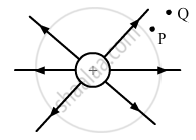
Figure shows the field lines due to a positive point charge. Give the sign of potential energy difference of a small negative charge between the points Q and P.
Advertisements
उत्तर
The electric potential at a point distant r due to the field created by a positive charge Q is given by
\[v = \frac{1}{4\pi \epsilon_0}\frac{q}{r}\]
Since rQ > rP, we have:
VQ < VP
∴ The potential energy difference VP − VQ is positive between Q and P.
APPEARS IN
संबंधित प्रश्न
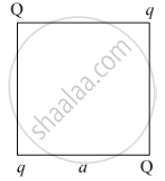
Four point charges Q, q, Q and q are placed at the corners of a square of side 'a' as shown in the figure.
Find the
1) resultant electric force on a charge Q, and
2) potential energy of this system.
A point charge Q is placed at point 'O' as shown in the figure. Is the potential at point A, i.e. VA, greater, smaller or equal to potential, VB, at point B, when Q is (i) positive, and (ii) negative charge?
1 volt is equivalent to ______.
In the circuit shown in figure initially, key K1 is closed and key K2 is open. Then K1 is opened and K2 is closed (order is important). [Take Q1′ and Q2′ as charges on C1 and C2 and V1 and V2 as voltage respectively.]

Then
- charge on C1 gets redistributed such that V1 = V2
- charge on C1 gets redistributed such that Q1′ = Q2′
- charge on C1 gets redistributed such that C1V1 + C2V2 = C1E
- charge on C1 gets redistributed such that Q1′ + Q2′ = Q
- Assertion (A): Work done in moving a charge around a closed path, in an electric field is always zero.
- Reason (R): Electrostatic force is a conservative force.
Charges (+q) and (–q) are placed at points A and B respectively which are a distance 2L apart. C is the midpoint between A and B. What is the work done in moving a charge +Q along the semicircle CRD?

The total electrostatic potential energy of a three-charge system is:
For a system of n charges, the total number of unique charge pairs whose potential energies must be summed is:
For two like charges (both positive or both negative), the sign of \[(q_1 q_2)\] and the resulting sign of the potential energy U are:
Four charges +q, -q, +q, -q are arranged alternately at corners A, B, C, D of a square of side d. With +q already at A, the work done in bringing -q from infinity to corner B is:
