Advertisements
Advertisements
प्रश्न
What is polymerase chain reaction (PCR)?
Advertisements
उत्तर १
Polymerase chain reaction (PCR) is another device used for gene cloning or gene multiplication in vitro.
उत्तर २
Polymerase Chain Reaction (PCR) is an in vitro technique used to generate millions of copies of a specific DNA segment rapidly. PCR involves three main steps repeated in cycles: denaturation (heating DNA to separate strands), annealing (binding of primers to target DNA), and extension (DNA polymerase synthesizes new DNA). The enzyme used is Taq polymerase, which is heat-stable and derived from Thermus aquaticus. PCR amplifies DNA to make numerous copies from a small initial sample, facilitating genetic research and diagnostics.
संबंधित प्रश्न
Rearrange the following in the correct sequence to accomplish an important biological reaction:
(a) In vitro synthesis of copies of DNA of interest
(b) Chemically synthesized oligonucleotides
(c) Enzyme DNA-polymerase
(d) Complementary region of DNA
(e) Genomic DNA template
(f) Nucleotides provided
(g) Primers
(h) Thermostable DNA-polymerase (from Thermus aquaticus)
(i) Denaturation of ds-DNA
State the role of DNA ligase in biotechnology.
Distinguish between plasmid DNA and chromosomal DNA.
Distinguish between RNA and DNA.
Give an account of the Blue-White Method of selection of recombinants.
Give a reason why :
Proteases are added during the isolation of DNA for genetic engineering.
From the following which one is NOT a feature of the plasmids?
Vectors are ____________ molecules that carry a foreign gene and replicate inside the host cell.
Which of the following DNA sequence is recognised and cut by EcoR I?
The following identifies the major features of technology that differentiate modem biotechnology from classical biotechnology.
i. Capability of science to change the genetic material for getting new specific products through rDNA technology, polymerase chain reaction (PCR), microarrays, cell culture and fusion, and bioprocessing.
ii. Ownership of technology and its sociopolitical impact.
iii. Modem biotechnology makes use of only fermentation technology.
iv. Classical biotechnology relies only on principles of plant and animal tissue culture.
______ is a Type I restriction enzyme.
Following are the four statements regarding separation of DNA fragments using Gel electrophoresis. Identify the INCORRECT statements.
i. DNA is negatively charged molecule and so it is loaded on gel towards the Anode terminal.
ii. DNA fragments travel along the surface of the gel whose concentration does not affect movement of DNA.
iii. Smaller the size of DNA fragment, larger is the distance it travels through it.
iv. Pure DNA can be visualized directly by exposing to UV radiation.
A hind of biotechnology involving manipulation of DNA is ______.
Name a recombinant vaccine that is currently being used in vaccination programme.
Suneeta is planning an experiment to clone a gene in a vector. So, she has to choose a good cloning vector.
Which one of the vectors shown below should she choose? Justify your answer by giving two reasons.
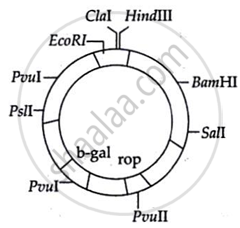 |
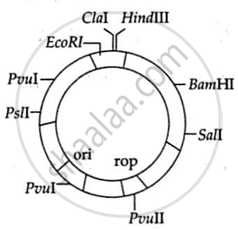 |
 |
| Vector A | Vector B | Vector C |
David is a molecular biologist. He uses a technique to know the amino acids occupy the first and the last positions in the Chain - A and Chain - B of insulin. Name the scientist whose contribution made it possible for David to use this technique.
Modern biotechnology is based on two core techniques. Which of the following correctly identifies both of these techniques?
What is the primary focus of genetic engineering?
Restriction enzymes are referred to as 'molecular scissors' because they:
