Advertisements
Advertisements
Question
What is polymerase chain reaction (PCR)?
Advertisements
Solution 1
Polymerase chain reaction (PCR) is another device used for gene cloning or gene multiplication in vitro.
Solution 2
Polymerase Chain Reaction (PCR) is an in vitro technique used to generate millions of copies of a specific DNA segment rapidly. PCR involves three main steps repeated in cycles: denaturation (heating DNA to separate strands), annealing (binding of primers to target DNA), and extension (DNA polymerase synthesizes new DNA). The enzyme used is Taq polymerase, which is heat-stable and derived from Thermus aquaticus. PCR amplifies DNA to make numerous copies from a small initial sample, facilitating genetic research and diagnostics.
RELATED QUESTIONS
What are plasmids?
The biological scissor is ______.
Why are bio-fertilizers preferred over chemical fertilizers?
ECoRI is obtained from ______.
What is plasmid?
Which of the following is an INCORRECT match?
______ is the soil bacterium that causes crown gall characterized by tumors in plants.
Following are the four statements regarding separation of DNA fragments using Gel electrophoresis. Identify the INCORRECT statements.
i. DNA is negatively charged molecule and so it is loaded on gel towards the Anode terminal.
ii. DNA fragments travel along the surface of the gel whose concentration does not affect movement of DNA.
iii. Smaller the size of DNA fragment, larger is the distance it travels through it.
iv. Pure DNA can be visualized directly by exposing to UV radiation.
Polymerase Chain Reaction is made possible by ____________.
The vector Baculovirus is used for gene transfer in ____________.
Which of the following statements is correct with respect to cellular respiration?
Which of the following is not required in the preparation of a recombinant DNA molecule?
Expand the following acronym:
BAC
Identify the desirable characteristics for a plasmid used in rDNA technology from the following.
- Ability to multiply and express outside the host in a bioreactor.
- A highly active promoter.
- A site at which replication can be initiated.
- One or more identifiable marker genes.
- One or more unique restriction sites.
Which of these are most widely used in genetic engineering?
The plasmid of Agrobacterium tumefaciens that is now modified as a cloning vector is ______.
To be a cloning vector, a plasmid require ______.
What is EcoRI?
Give a reason for the following:
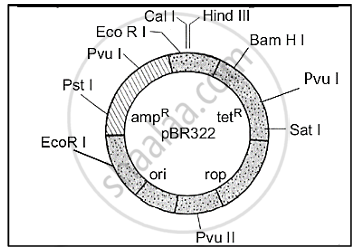
The diagram given below represents vector pBr322 which was modified by a research scholar Dr. Rayon, but the vector was rejected by his guide.
When the phage DNA enters the host bacterium, the host cell protects itself from the viral DNA attacks with the help of ______ enzyme.
