Advertisements
Advertisements
प्रश्न
Visit the library and collect at least five poems of any Nature poet. Write the poems along with their summary.
Advertisements
उत्तर
1. My Heart Leaps Up
My heart leaps up when I behold
A rainbow in the sky:
So was it when my life began;
So is it now I am a man;
So be it when I shall grow old,
Or let me die!
The Child is father of the Man;
And I could wish my days to be
Bound each to each by natural piety.
Summary:
The poet feels great joy whenever he sees a rainbow. He says that his love for nature began in childhood and he wishes it to continue throughout his life. The poem shows the poet’s deep and lasting connection with nature.
2. I Wandered Lonely as a Cloud
I wandered lonely as a cloud
That floats on high o’er vales and hills,
When all at once I saw a crowd,
A host, of golden daffodils;
Beside the lake, beneath the trees,
Fluttering and dancing in the breeze.
Continuous as the stars that shine
And twinkle on the milky way,
They stretched in never-ending line
Along the margin of a bay:
Ten thousand saw I at a glance,
Tossing their heads in sprightly dance.
The waves beside them danced; but they
Out-did the sparkling waves in glee:
A poet could not but be gay,
In such a jocund company:
I gazed and gazed but little thought
What wealth the show to me had brought:
For oft, when on my couch I lie
In vacant or in pensive mood,
They flash upon that inward eye
Which is the bliss of solitude;
And then my heart with pleasure fills,
And dances with the daffodils.
Summary:
The poet sees a large number of golden daffodils dancing beside a lake. Their beauty fills him with happiness. Later, whenever he feels lonely or thoughtful, the memory of the daffodils returns and fills his heart with joy.
3. Written in March
The cock is crowing,
The stream is flowing,
The small birds twitter,
The lake doth glitter,
The green field sleeps in the sun;
The oldest and youngest
Are at work with the strongest;
The cattle are grazing,
Their heads never raising;
There are forty feeding like one!
Like an army defeated
The Snow hath retreated,
And now doth fare ill
On the top of the bare hill;
The Plough-boy is whooping anon anon;
There's joy in the mountains;
There's life in the fountains;
Small clouds are sailing,
Blue sky prevailing;
The rain is over and gone!
Summary:
The poem describes the arrival of spring after winter. The birds sing, streams flow, cattle graze and the snow disappears. Everything in nature appears fresh, lively and joyful.
4. To a Butterfly
Stay near me do not take thy flight!
A little longer stay in sight!
Much converse do I find in Thee,
Historian of my Infancy!
Float near me; do not yet depart!
Dead times revive in thee:
Thou bring’st, gay Creature as thou art!
A solemn image to my heart,
My Father’s Family!
Oh! pleasant, pleasant were the days,
The time, when in our childish plays
My sister Emmeline and I
Together chased the Butterfly!
A very hunter did I rush
Upon the prey: with leaps and springs
I follow’d on from brake to bush;
But She, God love her! feared to brush
The dust from off its wings.
Summary:
The sight of a butterfly reminds the poet of his childhood. He remembers the happy days when he and his sister chased butterflies together. Thus, the butterfly connects the poet with pleasant memories of the past.
5. The Tables Turned
Up! up! my Friend, and quit your books;
Or surely you'll grow double:
Up! up! my Friend, and clear your looks;
Why all this toil and trouble?
The sun above the mountain’s head,
A freshening lustre mellow
Through all the long green fields has spread,
His first sweet evening yellow.
Books! 'tis a dull and endless strife:
Come, hear the woodland linnet,
How sweet his music! on my life,
There’s more of wisdom in it.
And hark! how blithe the throstle sings!
He, too, is no mean preacher:
Come forth into the light of things,
Let Nature be your teacher.
She has a world of ready wealth,
Our minds and hearts to bless
Spontaneous wisdom breathed by health,
Truth breathed by cheerfulness.
One impulse from a vernal wood
May teach you more of man,
Of moral evil and of good,
Than all the sages can.
Sweet is the lore which Nature brings;
Our meddling intellect
Mis-shapes the beauteous forms of things:
We murder to dissect.
Enough of Science and of Art;
Close up those barren leaves;
Come forth, and bring with you a heart
That watches and receives.
Summary:
The poet asks his friend to leave his books for some time and come outside to enjoy nature. He believes that birds, woods and other natural objects can teach valuable lessons about life. The poem presents nature as a great teacher.
APPEARS IN
संबंधित प्रश्न
Read the following extract carefully and present the information in the form of notes with the help of the given clues :
Sarvepalli Radhakrishnan was the first Vice President and second President of India.
He was a teacher, a philosopher and 'an author. He had introduced the thinking of Western idealist philosophers like Plato, Plontinus, Bergson into Indian thought.
He was born on 5th of September, 1888 in a poor Brahmin family. As his father could not afford his education expenses, Radhakrishnan supported most of his education
through scholarships. He completed his B.A. and M.A. with majors in philosophy. He went on to become a professor of philosophy. He showed that Indian Philosophy, once translated into standard academic jargon, is worthy of being called philosophy by Western standards.
He thus, placed Indian Philosophy on world map.
Sarvepalli Radhakrishnan had established a strong relationship with the Soviet Union when he w Is appointed as the ambassador to the Soviet Union.
He has been honoured with many awards for his achievements nationally and internationally. He was honoured with the Bharat Ratna in 1954. He is also acknowledged with the Templeton Prize, Peace Prize of German Book Trade, Order of Merit and many other honours.
Title : Sarvepalli Radhakrishnan
Birth : 5th September, 1888
Qualifications : B.A. ___________
Introduced thinking of : _________,_________and ____ into Indian thought.
Work : Translated_____________ into standard____________
Ambassador : __________________________________
Honours : National___________
International Order of Merit
Analyse the use of imagery in the poem ‘The Bangle sellers’.
What rhyme scheme is followed in the poem?
Which literary device is used in the last two lines:
Tinkling, luminous, tender, and clear, Like her bridal laughter and bridal tear.
There are two pauses when Kaspar tells Wilhelmine in the last stanza that it was a famous victory. Nay … nay…my little girl, quoth he.What do these pauses show?
How does the poet describe the flowers by using personification?
Thus I entered, and thus I go!
In triumphs, people have dropped down dead,
"Paid by the world, what dost thou owe
Me?"....God might question; now instead,
'Tis God shall repay: I am safer so.
Read the above lines and answer the question that follow.
What does the rain imagery signify?
How does the seemingly small incident described in the story reveal a significant truth about life?
Show how the story demonstrates that a good deed begets good.
I was laid________for three weeks with a broken leg.
The Principal said, “All the prizes will be distributed tomorrow.”
(Begin : The Principal said that ……………. )
Re-write the following sentence according to the instruction given. Make other changes that may be necessary, but do not change the meaning of the sentence.
Arun gave Ramesh some excellent advice.
(Begin: Ramesh was……)
The tree grew at a dangerous slant and had to be cut ________
Since her childhood, Meera has been good in Mathematics.
(End: ............................ childhood)
‘Catamaran’ is a kind of a boat. Do you know which Indian language this word is derived from? Check the dictionary.
The following are the meaning listed in the dictionary against the phrase `take on’. In which meaning is it used in the third paragraph of the account:
|
Take on sth: |
to begin to have a particular quality or appearance; to assume sth |
|
take sb on: |
to employ sb; to engage sb |
|
Take sb/sth on: |
to decide to do sth; to allow sth/sb to enter e.g. a bus, plane or ship; to take sth/sb on board |
Discuss the following in groups of two pairs, each pair in a group taking opposite points of view.
Scientific intervention is necessary to unearth buried mysteries.
Below is a topic for essay writing. Follow the steps listed above to write on this topic.
Public Health In Transition
The words ‘grip’, ‘dawn’. ‘usher’, ‘coin’, ‘passport’ have a literal as well as a figurative meaning. Write pairs of sentences using each word in the literal as well as figurative sense.
What was the underlying reason for John Ipe's disgust with the world?
Examine the pieces of conversation in the story. How do they reflect the world view of each of the speakers?
Describe the cycle of events in Satyajit's life that brought him back to where he began.
Find out the information about the qualification and eligibility required in the profession related to wildlife such as:
Tour Manager
There are certain words that are repeated in the poem. For example, ‘no more’ (Line 7).
Find out other similar expressions.
Explain the effect they have created in the poem.
Go to your college library and collect and read the poems written by Sarojini Naidu.
Collect information of the NGOs working for the underprivileged section of the society.
Multiple Choice Question:
What does the phrase in the extract ‘turned black’ mean here?
We add ‘un-’ to make opposites. For example, true — untrue. Add ‘un’– to the word below to make its opposite. Then look up the meaning of the word you have formed in the dictionary.
interesting: ____________
Re-word the line from the story:
“We cannot bandage the children’s mouths, so they really have to exercise their will-power.”
Narrate in 100 words an incident, that illustrates the way a friend of yours ‘made you feel happy and accepted’, at some point in your life.
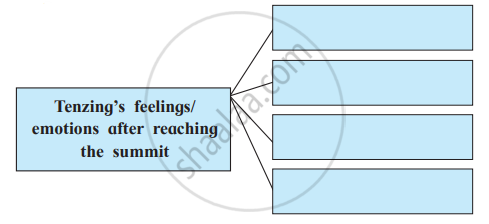
Complete the web highlighting the feelings/emotions of Tenzing after reaching the summit.
Discuss with your partner and complete the web of different activities related to climbing.

Wars are not fought only on the battlefield. Comment.
Rewrite the given statements in their order of occurrence.
The most difficult task of maintaining the hold on Tiger Hill was achieved in this way:
- 8 Sikh was ordered to attack and capture Helmet and India Gate.
- Bodies of the Pakistani soldiers were collected and buried appropriately.
- During the ferocious artillery duels, the Grenadiers hung on their precarious perch with grit and determination.
- Sikh fought back successfully two counterattacks with forty to fifty personnel.
- An ad-hoc column of 8 Sikh climbed the steep rock and captured India Gate.
- In spite of heavy casualties, 8 Sikh captured Helmet on 5 July.
If you could change the end of the story i.e. after the Swallow refused to fly to Egypt, how would you change it? Summarise your idea in 10 to 12 lines.
‘Earth has not anything to show more fair.’
This line expresses the poet’s feelings. The sight he saw from the bridge is beautiful. There are a few more lines similar to the above. With the help of your partner find them and discuss what they express.
Given below are a few famous bridges in India. Find out more information about them and write in your notebook.
- The Howrah Bridge.
- Laxman Zhula
- Pambum Bridge
- Worli Sea Link
Prepare a poster on the need for the conservation of the Great Indian Bustard.
Say ‘WHY’?
The writer grew less dogmatic and more open-minded.
Expand the theme in a write-up of about 20 lines.
‘Books are our real friends’

Prepare attractive advertisement using the hints given below.
Mobile Galaxy – Smartphones – accessories – SIM cards – Recharge – Free Power banks on Mobile purchase – No.1, Toll gate, Trichy
Answer the following questions in a paragraph about 80 -100 words
It is said, “The choices made by one, shape one’s destiny”. Ponder on the thought and write a paragraph.
Draft Letter for the following.
You are Sadasivam. You recently visited your native town in Vellore. You happened to accompany your grandmother to your family temple. You were shocked to notice the poor condition and maintenance of the temple. Write a letter to the Editor of the local newspaper highlighting the poor condition of the temple. Also, give some suggestions and request the HRC to take steps to improve the situation.
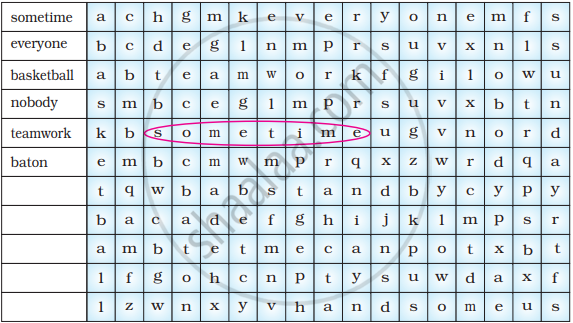
In the puzzle find the words given in the column. Notice that these words are formed by joining two words. One is done for you.
Find some more such words.
Let's write a poem.
I have a kite but need a friend to fly it with,
I know a song but need someone to hear it,
I have a ball but need someone to catch it,
I ______
I ______
I ______
I ______
______ is your birthday?
Can we try to complete another dialogue now?
Rathi is visiting a shop to buy a pen. Let us try and complete the dialogues between her and the shopkeeper.
| Rathi | Hi Akka! |
| Shopkeeper | Hi! How can I help? |
| Rathi | I need a______. |
| Shopkeeper | Sure. Which colour? |
| Rathi | Give a______ pen. |
| Shopkeeper | Do you need a ten rupee pen or a five rupee pen? |
| Rathi | Give me the ______rupee pen. |
| Shopkeeper | Do you want anything else? |
| Rathi | ______. |
| Shopkeeper | Thank you. Goodbye. |
| Rathi | ______ |
Malu lived with Malu’s parents in the North Pole. Malu had great fun with Malu’s seagull friends.
One day Malu’s father told Malu that the hunters had come to trap Malu and Malu’s family. Malu knew how to hide very well. Malu shut Malu’s eyes and curled up like a ball of snow.
The hunter searched for Malu and Malu's family everywhere but in vain.
We can avoid repeating the names by using certain other words in their place. Study the table below.
| Singular | Plural | |
| person speaking | I, me | we, us |
| person spoken to | you | you |
| other persons | he, him, she, her. | they, |
| places, things | it | them. |
Now rewrite the above paragraph using words from the above table.
Some words have similar sound, but different meaning. Choose the correct word from the option and fill in the blank.
The bird sits on a______.
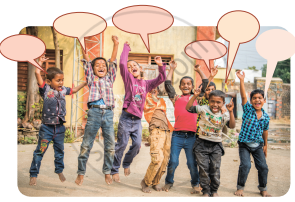
The children in the picture are watching an exciting sporting event, where their school team is winning. Suggest suitable utterances reflecting their feelings:
Why was Mary Kom named the ‘Queen of Boxing’ and ‘Magnificent Mary'?
Describe Honario Saltpen-Jago.
‘Seeing is believing’. How is this humorously disproved in this story? Bring out the irony in the situation.
Write conversation on the following situation.
Between two friends on an exciting cricket match
He left the studio saying ______.
Respond to the following advertisements.
Classified Advertisement
| WANTED 100 part-time Graphic Artists Experienced in Photoshop and InDesignSalary negotiable. Apply to: MM Graphics, Triplicane, Chennai - 5 or Mail your Resume to [email protected] |
Block Advertisement
|
Female IELTS Teachers Required Postgraduates in English with a minimum of 3 years experience Must be bold and confident Good salary, transport and food allowance provided Apply to: ARV Institute of Languages 149B, Bose Road, Coimbatore Ph: 98400 xxxxx Email: [email protected] |
Now write a short story to explain these proverb.
Despair gives courage to a Coward
Write a paragraph of about 150 word, on the following topic.
The importance of Good Health
Why according to Maya Angelou, does the caged bird sing?
