Advertisements
Advertisements
प्रश्न
There are ample career opportunities in film making and producing films.
The following professions which require different professional skills, and write them accordingly.
| Professions | Professional skills |
| 1. Actor-Male or Female | Acting, voice modulation, Body language, facial expressions, etc. |
| 2. Director | |
| 3. Producer | |
| 4. Music-director | |
| 5. Script-writer | |
| 6. Lyrist | |
| 7. Cameramen | |
| 8. Cinematographer | |
| 9. Set-designer | |
| 10. Costume-designer |
Advertisements
उत्तर
| Professions | Professional skills |
| 1. Actor-Male or Female | Acting, voice modulation, Body language, facial expressions, etc. |
| 2. Director | Technological expertise, storytelling skill, problem-solving, immense creativity. |
| 3. Producer | Coordination, attention to detail, financial strength. |
| 4. Music-director | Good understanding of music, knowledge of various musical instruments, an interest in various music genres, experimental. |
| 5. Script-writer | Strong writing skills, command over the language, visualization, keen observation, storytelling skills. |
| 6. Lyrist | Interest in a language and its nuances, good writing skills, considerable knowledge of music and rhythm, strong vocabulary. |
| 7. Cameramen | Acute knowledge of camera usage techniques, knowledge of camera lenses, and their appropriate uses. |
| 8. Cinematographer | Strong knowledge of motion picture graphics and technology, creativity, a deep understanding of camera technologies and related equipment. |
| 9. Set-designer | Strong visualization skills, problem-solving skills, technical knowledge of design. |
| 10. Costume-designer | Strong sense of fashion, an understanding of global trends, understanding the need of the character in the film/play. |
APPEARS IN
संबंधित प्रश्न
A1. Choose two sentences that appropriately mention the theme of the passage :
(1) The extract deals with the writer’s concern over Chaitanya's handicap.
(2) The extract depicts the writer’s proud feelings towards her son’s achievement.
(3) The extract deals with how Chaitanya made the writer see positively towards life.
(4) The extract deals with how the writer helps Chaitanya to buy the bus ticket.
Early in 1997-98, when he returned from state-level inter-school sports, he had two prizes to his credit and a silver medal. He had won his laurels in athletic events and the silver medal in a running race.
When I saw the prizes and read the citation Chaitanya had received, I was stupefied, in total disbelief, then–hugged him, kissed him and cried unabashedly to my heart’s content. That day, I cried for the first time out of joy and a sense of being vindicated. Without practice, he had competed with approximately 1,800 children drawn from various schools all over the state. He was subsequently selected for the marathon race, but he could not participate due to a health problem. “Maybe next year, he would”, I assured myself. And I, as his proud mother, would proudly chronicle his future achievements and success to inspire other - mothers of the world.
Looking back at my own life, I feel that it is the spirit with which we can accept our life gracefully is what
matters ultimately; and it is love that nourishes us. All other things are unimportant. Chaitanya has made me look inwards. His handicap doesn’t disturb me any longer. He and I shall live with it and still be happy. The mental strength which he has given to me is inexhaustible.
One day, as both of us got onto a public transport bus, Chaitanya offered to buy the tickets for us.
“One full, one half ”, he said to the conductor beaming with joy.
Looking at him, I wondered whether he was really only a half? An incomplete person? Was I really full?
Complete in all respects? Why do then normal people feel that they are ‘full’ and others like Chaitanya are ‘half’ or incomplete? Chaitanya’s world is complete in itself, pure and innocent while our lives are full of deceit, jealousies, ill-feelings.
A2. Point out -
Point out two instances where you find Chaitanya's victory over his disability.
A3. Give reasons -
Chaitanya’s silver medal in a running race was very special for the writer, because :
(i) __________________
(ii) __________________
A4. Vocabulary -
Match the pairs of the words in column ‘A’ with their meanings in column ‘B’:
| Column ‘A’ | Column ‘B’ | ||
| (1) | stupefied | (a) | official statement about the special act of courage |
| (2) | chronicle | (b) | record events in the order they happened |
| (3) | vindicated | (c) | surprised or shocked |
| (4) | citation | (d) | justified |
A5. Personal response -
Explain, your views about the ill-treatment the special children receive in society.
A6. Grammar -
Rewrite the following sentences in the ways instructed :
(i) He had won his laurels in athletic events and the silver medal in a running race.
(Rewrite the sentence using ‘not only...but also’.)
(ii) When I saw the prizes, I was stupefied.
(Rewrite the sentence using ‘No sooner.... than’.)
What does the tree symbolise in the poem?
Later, too, the old man uses the expression famous victory? Why?
Comment on the contrasted viewpoints in the poem.
Can it be argued that this is an anti- war poem?
How is he affected by the experience of seeing the daffodils?
There's nobody on the house-tops now...
Just a palsied few at the windows set;
For the best of the sight is, all allow,
At the Shambles' Gate-or, better yet,
By the very scaffold's foot, I trow.
Read the above lines and answer the question that follow.
What is ‘scaffold’?
Explain briefly how Abou Ben Adhem demonstrated his love for God.
The eight other runners pulled up on their heels
The ones who had trained for so long to complete
one by one they all turned around and went back to help him
And brought the young boy to his feet.
Then all the nine runners joined hands and continued
The hundred-yard dash now reduced to a walk
And a banner above that said (Special Olympics)
Could not have been more on the mark.
That's how the race ended, with nine gold medals
They came to the finish line holding hands still
And a standing ovation and nine beaming faces
Said more than these words ever will.
Read the lines given above and answer the following question:
Explain with reference to context.
Sergius tells Bluntschli in the play "you're not a man, you're a machine." Do you agree with Sergius' assessment of Blunts ii? Give your views.
If Mary catches the first bus, she will be on time for school.
(Begin : Unless …………….)
Fill in the blanks with an appropriate word:
- The teacher spoke for Raju when he was wrongly accused of stealing money.
- We can visit her at the hostel at 3 pm and 6 pm on Saturdays.
- The Sinha's have lived in New Delhi 1943.
- Little children are often afraid of the dark.
- Sneha has applied for a scholarship.
- It took Ahmed many months to get the loss of his friend.
- She turned the generous offer made by the manager.
- We were asked to take our footwear as we were entering a place of worship.
There has been heavy rain in your city/town. You went to school but found that it was closed because of the rain. Describe the sights and sounds near the school and narrate how you finally reached home and spent the rest of the day.
Do you think it is important to preserve languages?
Locate the lines in the text that support the title. 'The Ailing Planet'.
Why does the author aver that the growth of the world population is one of the strongest factors distorting the future of human society?
The words ‘grip’, ‘dawn’. ‘usher’, ‘coin’, ‘passport’ have a literal as well as a figurative meaning. Write pairs of sentences using each word in the literal as well as figurative sense.
Write a letter to the Editor of a magazine describing a dance performance you have seen or an art gallery you have visited.
What do you gather about Crocker-Harris from the play?
Distinguish between the following pairs of sentences.
The team played the two matches successfully.
Surf the net and obtain more information about the conservation work done by Shaaz. Prepare posters to inspire others and display them on your college noticeboard.
The use of personal pronoun ‘I’ is evident and prominent in this poem. Give reasons.
We add ‘un-’ to make opposites. For example, true — untrue. Add ‘un’– to the word below to make its opposite. Then look up the meaning of the word you have formed in the dictionary.
successful: ____________
What did the myna do finally?
Find five words in the following paragraph, which are generally associated with trees. But here, they have been used differently. Underline the words.
Hari leaves for work at nine every morning. He works in the local branch of the firm of which his uncle is the owner. Hari’s success is really the fruit of his own labour. He is happy, but he has a small problem. The root cause of his problem is a stray dog near his office. The dog welcomes Hari with a loud bark every day.
Find words in the story, which show things striking violently against each other.
The crow and the myna c_ll____in mid-air.
Your teacher will speak the words listed below. Write against each a word of opposite meaning.
Examples:
liquid-solid
hard-soft
1. old —————
2. wet —————
3. open —————
4. blunt —————
5. forget —————
Fill in the blanks in the paragraph below with words from the box.
| huge | big | foolish | interesting | tiny | unlucky | last |
There was a ___________ Eid fair in our village. We could buy anything from a
____________ toy to a ____________ camel. I went to the fair on its ___________ day with Uncle and Bhaiya. We went to the Lucky Shop. It was
very____________ . I tried my luck but did not win any prize. Later, Uncle told me that I was more ___________ than___________ .
Discuss the following with your partner and complete the following sentence.
Organic food is grown by using __________________.
Agricultural is the principal occupation in Maharashtra that has many career opportunities.
| (a) | Agriculture Correspondent |
| (b) | Marketing Communications Manager |
| (c) | Agricultural Policy Analyst |
| (d) | Farm Management |
| (e) | Soil Conservationist |
| (f) | Scientist- Krishi Vigyan Kendra |
| (g) | Machine Design Engineer |
| (h) | Zoologist |
| (i) | Veterinarian |
| (j) | Food Microbiologist |
| (k) | Horticulturist |
| (l) | Agricultural Economics |
Write in brief about the various career opportunities given above. You can collect the information from the following universities.
- Indian Institute of Technology, Kharagpur
- Mahatma Phule Krishi Vidyapeeth, Pune.
- Dr. Panjabrao Deshmukh Krishi Vidyapeeth, Akola.
Imagine your younger sister is not paying attention to her studies and is seen wasting time playing games on her cell-phone. Suggest some ways that will help her to concentrate on her studies and overcome her bad habit.
Given below are a few famous bridges in India. Find out more information about them and write in your notebook.
- The Howrah Bridge.
- Laxman Zhula
- Pambum Bridge
- Worli Sea Link
Convert the stories into dialogues and read the dialogues aloud in the class.
Browse on the net and gather a variety of templates to write a 'Curriculum Vitae'.
'Narnia' (part 1,2,3 and 4) is a film about 4 children who find a path to Narnia. Discuss in your class, the special effects, and direction. Write a review with the help of the following points in about 100 to 150 words.
- Storyline
- Producer
- Director
- Music Director
- Characters/ casting (major and minor)
- Setting / location
- Conflict
- Message
- Significance of the title.
Write a letter from Abdul to the Emperor, requesting the Emperor to give Abdul a suitable job.
Form pairs. List the things on which you have the same opinion and also the ones on which you have different opinions. Prepare a list of ten things in all and see how far you agree or disagree with your friend. Some useful phrases are given alongside. You could talk about:
- Clothes, latest fashion.
- Performance of sportsmen and women.
- Traffic/Transport in your area.
- Cleanliness and hygiene in your area.
- Future occupations/Careers.
- Latest news items.
- TV programs
- Mobile Apps
- Any subject of your choice.
| Agreement | Ask for your friend’s opinion: | Disagreement |
| I totally agree with you. | Do you think ...? | No, I don’t think so. |
| Exactly/Absolutely! | Do you agree ...? | I totally disagree. |
| You are right. | What do you think? | Not necessarily. |
| I don’t know, I need to think about it. (partial agreement) | What is your opinion? | I’m not sure about that. |
| I suppose so. | How do you feel about that? | Let’s agree to disagree! |
Write an informal letter from a teenager to his/her parent, expressing a few thoughts from the poem.
(My dear ______/Dearest ______./Hi! ______ Are you surprised to see this letter? I wanted to talk to you about this, but then I thought I will be able to express myself better in a letter. Love,/Yours lovingly/Yours ______).
‘There is no short-cut to success’.
Expand this maxim with a suitable introduction, body with examples, and conclusion. Write it in your notebook in about 20 lines.
What is the name of her diary?
Write a four-line poem with rhyming words describing your family.
Local Historians
- Ask students to collect stories about their town from older people.
- Ask them to find out how the streets were named.
- Are there any interesting people or legends to which the street names refer?
- Are there any local places in town about which people tell stories?
- Any haunted houses?
- Let students find out when the town was founded and by whom.
- Visit a local historical society to see old photographs or artifacts.
Let students create an original historical fiction:
Describe the town from the point of view of a fictitious citizen who might have lived in the town long ago. Include local issues of the time in the story. Write the story of the town from the fictionalized point of view of a resident who actually lived.
Describe Hiawatha, his home and friends in ten lines.
Match with and write the complete sentences below.
| A | B |
| Whenever | I go, I have friends. |
| Whoever | I am hungry, I eat. |
| Wherever | comes first, wins. |
Complete the following stories by using an appropriate word from the box given below –
| my, his, he, your |
Ram was a farmer. wanted to sell ______ ______ goats and sheep. So he went to the market. There sold all ______ animals to a rich man and got a lot of money. When he was going back to village, three thieves
stopped him. “Stop! Give us all ______ money.” Ram was very clever. He said, “I'll give ______ money to the strongest of you.” On hearing this, the thieves started fighting amongst themselves. Ram slipped away quietly.
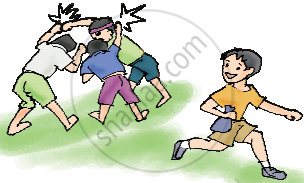
Here is a report on Uncle Lal’s farm.
Father took me to visit Uncle Lal’s dairy farm. I saw all of Uncle Lal's cows. He has fifty cows. They eat grass in the big green farms. In the evening the farmers bring them to the barn to be milked. Uncle Lal sells his milk in the city.
When writing a report, remember to do these things
|
In groups of four, write a report on different brands of ice creams available in your area.
You may use the following clues.
- Start with a short introduction that contains the topic.
- Then list the ice cream brands available in your area.
- Next, say which are the common flavors of ice cream in each of the brands.
- Under each brand, find out which flavors are being sold the most. Also, find out their prices.
- Finally, write which do you think is the most popular ice cream.
I can do the sum ________. [easy}
What story did the man standing near the hardware store tell the passing cop?
State whether the following statement are true or false
The friends could not keep in touch because they lost each other’s phone numbers.
How was she felicitated on her return to India?
Why did the photographer take a long time to photograph Leacock?
What brought agony to the girls during the music lessons?
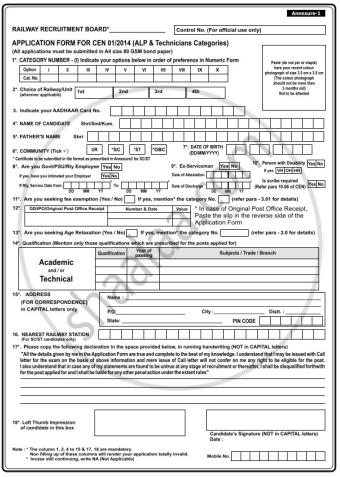
Fill in the following forms with imaginary details.
Answer the following question as briefly as possible and with close reference to the relevant text.
Referring closely to the short story, B. Wordsworth relate two important lessons that the young narrator learnt from his friend, B. Wordsworth. How were these lessons relevant?
Prepare a tourist leaflet for a historical place or a hill station using the following points.
- Place
- Special features
- Distance
- How to go there
- Accommodation
- Food
- Climate
Suppose a foreigner comes to visit your place and you have to accompany him for sightseeing. Prepare a dialogue between you and the foreigner.
What strategies do you use when you study on your own?
Complete the dialogue.
| Anil: | Which is your favourite book? |
| Sunil: | ______________________ |
| Anil: | What type of book is it? |
| Sunil: | _____________________ |
Write a review of a film that you watched recently, using the points given below. The reveiw is to be published in your school newsletter and should not exceed 300 words.
Name of the film and director - lead actors and their performances - plot - setting - description of a scene that you particularly liked - rating and recommendation.
Miss Meadows’ need for societal acceptance makes her overlook Basil’s insensitivity and shortcomings. Discuss with reference to the short story. The Singing Lesson is about 200-250 words.
