Advertisements
Advertisements
प्रश्न
It is easy to advise others not to worry, but difficult for oneself to follow the same. Narrate an experience which made you realise the truth of this statement.
Advertisements
उत्तर
adivse – always easy – friends or relatives – personal life, professional life or educational life – personal life of friends – love, betrayed, robbery etc- professional life of friends – colleagues harrassment, no promotion, no increment, more workload etc – difficult to follow the same – we personally experience the pain – it difficult to follow – understand but can’t follow – my personal example – once my friends colleague harrassed her a lot – convinced her – told her – asked her to ignore by giving different examples she suddenl agreed – but when my colleague harrassed me for a few days I asked the reason with a strong note – harrrassed her - finally she apologised – I forgive – She realised – I made her realise – finally I realised convincing others is easy but following the same is difficult.
APPEARS IN
संबंधित प्रश्न
Transform the following sentence as per the given instruction.
The old woman said to Arun, “Can you help me to cross the street?”
(Begin: The old woman asked Arun……………….)
In the following items, sentence A is complete, while sentence B is not. Complete sentence B, making it as similar as possible to sentence A. Write sentence B.
(A) When she heard the news of her daughter’s result, she was very happy.
(B) On ........................................................................................
Who was talking to the old man?
Discuss with reference to the story An Angel in Disguise how love has the power to transform.
Read the extract given below and answer the questions that follow:
Mabel: [Utterly surprised] Ronny! Do they want me in Court?
Dancy: No.
Mabel: What is it, then? Why are you back?
Dancy: Spun.
Mabel: [Blank] Spun? What do you mean? What’s spun?
Dancy: The case. They’ve found out through those notes.
Mabel: Oh [Staring at his face] Who?
(i) Where are Mabel and Dancy at this time? What was Mabel doing just before this conversation?
(ii) Why did Mabel say, “Do they want me in court?” Explain the meaning of spun in the extract?
(iii) What ‘notes’ is Dancy talking about now?. How does Mabel react immediately after the extract”:
(iv) Dancy leaves a note for his best friend towards the end of the play. What is the name of his best friend? What is written in the note?
(v) What does Dancy do at the end? Why does he do that? What is your opinion of Mabel and Dancy?
Give an account of how lies were against Snowball after his expulsion, in order to paint him as a traitor.
The following are the meaning listed in the dictionary against the phrase `take on’. In which meaning is it used in the third paragraph of the account:
|
Take on sth: |
to begin to have a particular quality or appearance; to assume sth |
|
take sb on: |
to employ sb; to engage sb |
|
Take sb/sth on: |
to decide to do sth; to allow sth/sb to enter e.g. a bus, plane or ship; to take sth/sb on board |
What according to the poem is involved in the process of growing up?
Look at the highlighted expressions in the following sentences from the text and explain their figurative meaning.
- 'I went through it, sir, with a fine-toothed comb and never a Garrideb could I catch.'
-
'They are my favourite covert for putting up a bird, and I would never have overlooked a cock pheasant as that.'
-
'There is no bolt-hole for you in this country.'
-
'When his castle in the air fell down, it burred him beneath the ruins.'
There are certain words that are repeated in the poem. For example, ‘no more’ (Line 7).
Find out other similar expressions.
Explain the effect they have created in the poem.
Planting and growing more crops a year seems to be progressed by normal standards, but the chapter makes a case against it. Give reasons.
There are a number of challenges a farmer in India faces. Discuss with your friend, how it is possible to improve the condition of farmers.
| Sr. No. | Challenges | Solutions |
| 1. | Water Scarcity | Rain Water Harvesting |
| 2. | Credit and In-debtedness | |
| 3. | Land Issues | |
| 4. | Climatic changes | |
| 5. | Social Groups | |
| 6. | Lack of advanced technology | |
| 7. | Diversification | |
| 8. | Market Risks |
Write a summary of the poem with the help of the points given below:
- Title
- Introductory paragraph (about the poem/type/nature/tone)
- Main body (central idea/gist of the poem)
- Conclusion/opinions/views/appeal.
Read the following Headline and write the dateline, intro and a short continuing paragraph.
| Achievers narrate their success stories at career counselling events. |
Prepare a set of questions to interview:
a person who has recently scaled Mt. Everest.
Imagine yourself as the writer. Narrate the story of your visit to your ancestral house.
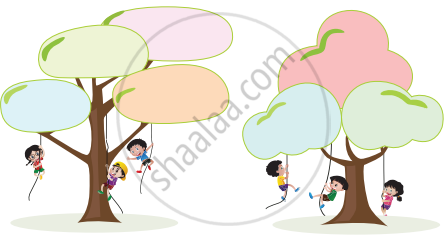
Fill in the value trees with the best qualities you like to follow in your life from the given list. Write a few lines about your favourite quality in the box.
| Best qualities in life | ||||
| Affectionate | Cooperative | Gratitude | Loving | Responsible |
| Ambitious | Courageous | Happiness | Loyal | Self-confident |
| Brave | Dependability | Helpfulness | Good manners | Self-control |
| Calm | Diligence | Honest | Patriotic | Self-esteem |
| Caring | Enthusiastic | Humble | Peaceful | Sensitive |
| Cheerful | Fairness | Imaginative | Perseverance | Sincerity |
| Committed | Faithfulness | Intelligent | Polite | Successful |
| Compassionate | Flexible | Joyful | Positive | Tolerant |
| Concerned | Forgiveness | Kind | Rational | Truthful |
| Confident | Generosity | Leader | Resourceful | Versatile |
| Contented | Giving | Logical | Respect | Witty |
| My favourite quality is... __________________________________________________________________________________ __________________________________________________________________________________ |
||||
You have prepared some eco-friendly craft materials like paper mache dolls, greeting cards, book marks, festoons, garlands, quilling jewellery etc for an Art Mela to be conducted in your school premises. Describe in a few sentences how you made the craft work. Include the following details in your writing.
- Name of the craftwork
- Materials used
- Nature (handy / eco-friendly / longlasting / affordable price )
- Use (place / person / time)
Bio - Poem
A Bio - Poem is an essay about oneself in the form of poetry.
Line 1: Your name.
Line 2: Four adjectives that describe you.
Line 3: Son of / daughter of … brother of / sister of…
Line 4: Lover of three people, things or idea.
Line 5: Who feels (three sensations or emotion)
Line 6: Who needs (three things)
Line 7: Who gives (three things)
Line 8: Who fears (three things)
Line 9: Who would like to see (three persons or places)
Line 10: Who lives …
Line 11: Your last name.
|
Anne Friendly, kind, smart and obedient Daughter of Sam and Diana, sister of Jack Lover of pets, sports and reading Who feels cheerful, comfortable and excited Who needs education, peace and friends Who gives smiles, support and courage Who fears spiders, the dark and stray dogs Who would like to see Mt. Everest Lives in Cape Sara |
Work in small groups. Pick out the adjectives and nouns that suit you using a dictionary. Read the steps given. Arrange adjectives and nouns like the given sample to construct your Bio-Poem. Present in the class.
What does the poet say about the crocodile? Write in your own words. (in about fifty words)
______ do you play?
The hunter shot at the ______of birds.
What does each of the following mean in the story? Choose the right option.
plainclothes man:
Why are photographs taken?
| e.g. to freeze our favourite moments | |
Expand EMI -
Installing a computer
The description of installing a computer in your study room is given in the form of jumbled sentences. Rearrange the sentences in the right order and form a coherent paragraph.
| 1. | Once you connect the CPU, connect the keyboard and mouse. |
| 2. | Before turning on the power, check that all parts are connected to the CPU. |
| 3. | First, open the box and take out the computer parts. |
| 4. | Plug both the computer and the monitor with a power cord. |
| 5. | Set the computer on a table or flat surface. |
| 6. | Finally, turn on the power. |
Answer the following question as briefly as possible and with close reference to the relevant text.
Referring closely to the short story, The Sound Machine, describe the encounter between Klausner and Mrs. Saunders. How did it affirm his belief in his own invention?
Read the given sentence and underline the no word.
There is nothing to do.
Using the given informal letter as a model, write a letter on the topic given below.
Write a letter to your father asking permission to go on an educational tour.
Write a letter to your father asking permission to go on an educational tour.
