Advertisements
Advertisements
प्रश्न
State the order of filling atomic orbitals following Aufbau principle.
Advertisements
उत्तर
Aufbau principle:
- The Aufbau principle gives the sequence in which various orbitals are filled with electrons.
- In the ground state of an atom, the orbitals are filled with electrons based on the increasing order of energies of orbitals, Pauli’s exclusion principle, and Hund’s rule of maximum multiplicity.
- Increasing order of energies of orbitals:
a. Orbitals are filled in order of increasing value of (n + 1)
b. In cases where the two orbitals have the same value of (n + 1), the orbital with a lower value of n is filled first. - The increasing order of energy of different orbitals in a multi-electron atom is:
1s < 2s < 2p < 3s < 3p < 4s < 3d < 4p < 5s < 4d < 5p < 6s < 4f < 5d < 6p < 7s and so on.
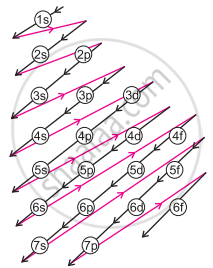
Increasing order of orbital energy
APPEARS IN
संबंधित प्रश्न
Using s, p, d notations, describe the orbital with the following quantum numbers n = 4; l =3.
Choose the correct option.
p-orbitals are _________ in shape.
Choose the correct option.
“No two electrons in the same atoms can have identical set of four quantum numbers”. This statement is known as -
Choose the correct option.
Principal Quantum number describes -
Write orbital notations for the electron in orbitals with the following quantum numbers.
n = 3, l = 2
Write condensed orbital notation of electronic configuration of the following element:
Lithium (Z = 3)
Write condensed orbital notation of electronic configuration of the following element:
Silicon (Z = 14)
Write condensed orbital notation of electronic configuration of the following element:
Chlorine (Z = 17)
Draw shapes of 2p orbitals.
Using the concept of quantum numbers, calculate the maximum numbers of electrons present in the ‘M’ shell. Give their distribution in shells, subshells, and orbitals.
Which mineral among the following contains vanadium in it?
Which one of the following orders is CORRECT in case of energy of the given subshells?
P: n = 4; l = 3
Q: n = 5; I = 1
R: n = 5; l = 0
S: n = 4; l = 2
How many electrons in 19K have n = 3, l = 1?
How many electrons can fit in the orbital for which n = 4 and l = 2?
Which of the following options does not represent ground state electronic configuration of an atom?
Orbital angular momentum depends on ______.
Which of the following orbitals are degenerate?
3dxy, 4dxy 3dz2, 3dyz, 4dyz, 4dz2
The arrangement of orbitals on the basis of energy is based upon their (n + l) value. Lower the value of (n + l), lower is the energy. For orbitals having same values of (n + l), the orbital with lower value of n will have lower energy.
Based upon the above information, arrange the following orbitals in the increasing order of energy.
4s, 3s, 3p, 4d
The arrangement of orbitals on the basis of energy is based upon their (n + l) value. Lower the value of (n + l), lower is the energy. For orbitals having same values of (n + l), the orbital with lower value of n will have lower energy.
Based upon the above information, arrange the following orbitals in the increasing order of energy.
5p, 4d, 5d, 4f, 6s
The arrangement of orbitals on the basis of energy is based upon their (n + l) value. Lower the value of (n + l), lower is the energy. For orbitals having same values of (n + l), the orbital with lower value of n will have lower energy.
Based upon the above information, solve the questions given below:
Which of the following orbitals has the lowest energy?
5p, 5d, 5f, 6s, 6p
The electronic configuration of valence shell of Cu is 3d104s1 and not 3d94s2. How is this configuration explained?
What is the difference between the terms orbit and orbital?
Match the following
| (i) Photon | (a) Value is 4 for N shell |
| (ii) Electron | (b) Probability density |
| (iii) ψ2 | (c) Always positive value |
| (iv) Principal quantum number n | (d) Exhibits both momentum and wavelength |
In the case of R, S configuration the group having the highest priority is ______.
