Advertisements
Advertisements
Question
State the order of filling atomic orbitals following Aufbau principle.
Advertisements
Solution
Aufbau principle:
- The Aufbau principle gives the sequence in which various orbitals are filled with electrons.
- In the ground state of an atom, the orbitals are filled with electrons based on the increasing order of energies of orbitals, Pauli’s exclusion principle, and Hund’s rule of maximum multiplicity.
- Increasing order of energies of orbitals:
a. Orbitals are filled in order of increasing value of (n + 1)
b. In cases where the two orbitals have the same value of (n + 1), the orbital with a lower value of n is filled first. - The increasing order of energy of different orbitals in a multi-electron atom is:
1s < 2s < 2p < 3s < 3p < 4s < 3d < 4p < 5s < 4d < 5p < 6s < 4f < 5d < 6p < 7s and so on.
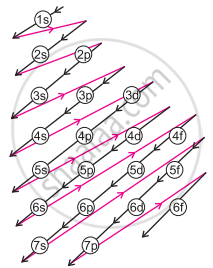
Increasing order of orbital energy
APPEARS IN
RELATED QUESTIONS
Using s, p, d notations, describe the orbital with the following quantum numbers n = 3; l =1.
Using s, p, d notations, describe the orbital with the following quantum numbers n = 4; l =3.
State Hund’s rule of maximum multiplicity with a suitable example.
Explain the anomalous behaviour of copper.
Write electronic configurations of \[\ce{Fe, Fe2+, Fe3+}\].
Write condensed orbital notation of electronic configuration of the following element:
Lithium (Z = 3)
Write condensed orbital notation of electronic configuration of the following element:
Silicon (Z = 14)
Write condensed orbital notation of electronic configuration of the following element:
Calcium (Z = 20)
Explain in brief, the significance of the azimuthal quantum number.
If n = 3, what are the quantum number l and m?
The electronic configuration of oxygen is written as 1s2 2s2 \[\ce{2p^2_{{x}}}\] \[\ce{2p^1_{{y}}}\] \[\ce{2p^1_{{z}}}\] and not as 1s2 2s2 \[\ce{2p^2_{{x}}}\], \[\ce{2p^2_{{y}}}\] \[\ce{2p^0_{{z}}}\], Explain.
Write a note on ‘Principal Quantum number.
Indicate the number of unpaired electrons in \[\ce{Si}\] (Z = 14).
Indicate the number of unpaired electron in:
Cr (Z = 24)
Which mineral among the following contains vanadium in it?
Total number of orbitals associated with third shell will be ______.
Out of the following pairs of electrons, identify the pairs of electrons present in degenerate orbitals:
| (i) | (a) `n = 3, l = 2, m_l = -2, m_s = - 1/2` |
| (b) `n = 3, l = 2, m_l = -1, m_s = - 1/2` | |
| (ii) | (a) `n = 3, l = 1, m_l = 1, m_s = + 1/2` |
| (b) `n = 3, l = 2, m_l = 1, m_s = + 1/2` | |
| (iii) | (a) `n = 4, l = 1, m_l = 1, m_s = + 1/2` |
| (b) `n = 3, l = 2, m_l = 1, m_s = + 1/2` | |
| (iv) | (a) `n = 3, l = 2, m_l = +2, m_s = - 1/2` |
| (b) `n = 3, l = 2, m_l = +2, m_s = + 1/2` |
Which of the following statements concerning the quantum numbers are correct?
(i) Angular quantum number determines the three dimensional shape of the orbital.
(ii) The principal quantum number determines the orientation and energy of the orbital.
(iii) Magnetic quantum number determines the size of the orbital.
(iv) Spin quantum number of an electron determines the orientation of the spin of electron relative to the chosen axis.
Nickel atom can lose two electrons to form \[\ce{Ni^{2+}}\] ion. The atomic number of nickel is 28. From which orbital will nickel lose two electrons.
Calculate the total number of angular nodes and radial nodes present in 3p orbital.
The arrangement of orbitals on the basis of energy is based upon their (n + l) value. Lower the value of (n + l), lower is the energy. For orbitals having same values of (n + l), the orbital with lower value of n will have lower energy.
Based upon the above information, arrange the following orbitals in the increasing order of energy.
1s, 2s, 3s, 2p
The arrangement of orbitals on the basis of energy is based upon their (n + l) value. Lower the value of (n + l), lower is the energy. For orbitals having same values of (n + l), the orbital with lower value of n will have lower energy.
Based upon the above information, arrange the following orbitals in the increasing order of energy.
5f, 6d, 7s, 7p
The arrangement of orbitals on the basis of energy is based upon their (n + l) value. Lower the value of (n + l), lower is the energy. For orbitals having same values of (n + l), the orbital with lower value of n will have lower energy.
Based upon the above information, solve the questions given below:
Which of the following orbitals has the lowest energy?
4d, 4f, 5s, 5p
What is the difference between the terms orbit and orbital?
Which of the following is not the permissible arrangement of electrons in an atom?
