Advertisements
Advertisements
प्रश्न
Speaking Activity
Based on your understanding of the play ‘The Never – Never Nest’, organise a classroom debate on the topic: ‘Is Equated Monthly Instalment Scheme - a boon or bane to middle-class families?’
Advertisements
उत्तर
| A | Equated Monthly Installment scheme is a boon. Middle-class people who can’t dream of owning a home or even buying a two-wheeler get the benefit. |
| B | How do you prove it? |
| A | Well, a person who earns 15,000 rupees a month is able to take a house loan. Shri Ram, Finance Investment company of Bajaj Fin Serve offers scooter, car loans on as low as 7% interest. So a man can avail of the benefits first but pay later. |
| B | My dear friend, you present the matter as if it is just easy. What happens if a medical emergency happens and if the person is unable to pay back EMI for a housing loan or vehicle loan. Don’t you know a farmer was beaten by “Collection agents” for not? being able to pay back EMI arrears of just 50,000 rupees? The farmer, unable to face the disgrace committed suicide. Didn’t you read it in the newspapers? EMI scheme is a bane. |
| A | My dear friends, such a rare occurrence should not be blown out of proportion. For a health emergency, one can join Prime Minister’s health insurance scheme by just paying 12 rupees a month. Besides, there are also Health insurance schemes by the Tamil Nadu state Government that cover the cost of critical Health care up to 60%. I assert EMI scheme is a boon for all middle-class people who keep EMI to less than 50% of their total earnings and have 10% for other unforeseen expenses. If one leads a planned life, the EMI scheme, I reiterate is a bane. |
| Judge | Now both the teams have argued their case very well. Now team A has almost justified that the EMI scheme is a boon. |
| B | Sir, I would like you to take a look at the notice released by all leading banks containing the list of housing property confiscated due to non – payment of EMIs. |
| A | Every middle-class Indian has dreamed of owning a house. If one saves money say for twenty years to purchase land or a house the cost would definitely go up by 10 times. Save now and buy later doesn’t suit modem lifestyle. It is true that we should not speculate much. At the same time, one can calculate earnings, future pay hikes and keep the EMIs within payable limits – such judicious spending will really make EMI schemes a great boon. |
| Judge | Listening to the arguments of both the team, I conclude EMI scheme is both a bane and a boon. For those who are always on a spending spree irrespective of their limited income, the EMI scheme is a bane. For those who think twice before making a hasty purchase and narrow down their choice only to vital needs, definitely EMI scheme is a boon. Use the EMI scheme wisely. Good luck. |
APPEARS IN
संबंधित प्रश्न
Form groups and use the following topic for discussion. Take the help of your college library and your teacher.
Features of the Constitution of India
What type of tree fits in your hand?
A ____________ tree.
Identify the character or speaker of the following line.
Greetings, traveller. You looked tired and cold.
Identify the character or speaker of the following line.
‘I done it out of pity for him.’
You are the President of GO GREEN, the Environment Club of your school. On the occasion of World Environment Day, you have been asked to address the school on the topic, ‘The Nature of Our Future Depends on the Future of Our Nature’.
Imagine you are interviewing an astronaut about his/her experiences in space. Select a partner to be an astronaut and present the interview as a role-play in front of the class.
Last year at this time I ______.
Ms. Pavithra Rao, the squash player who won the gold medal at the recent Asian Games, is holding a press conference. Let the discussion focus more on the strategies that helped her to win.
Have you ever been scared? What happened? How did you feel? Talk about it in one or two sentences with your friend. Repeat it to the class.
Read the different verb form where they remain the same in the direct and indirect speech in the following case. Fill in the blank with missing indirect speech.
With modal verbs would, might, could, should, ought to, used to.
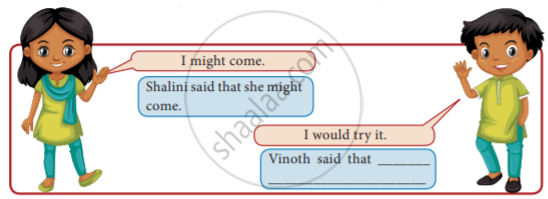
Read the different verb form where they remain the same in the direct and indirect speech in the following case. Fill in the blank with missing indirect speech.
We do not usually change the modal verbs must and needn’t. But must can become had to or would have to and needn’t can become didn’t have to or wouldn’t have to if we want to express an obligation. Would/wouldn’t have to are used to talk about future obligations.
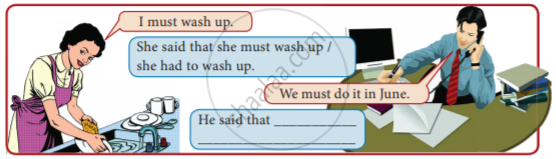
Change the following into Indirect Speech.
“Halt!” shouted the officer to his men.
Change the following into Indirect Speech.
“Hurry up,” he said to his servant, “do not waste time.”
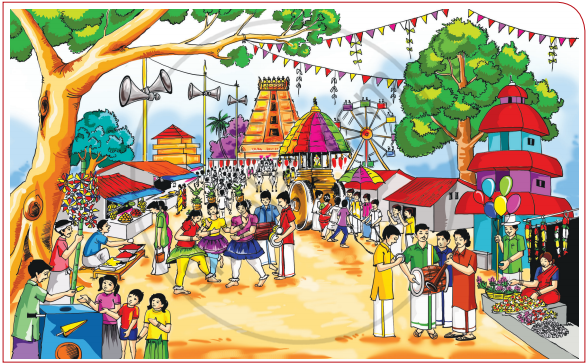
Look at the picture of a village festival carefully. Talk about the activities that are going on by using the hints given in the help box.
About the place and the people — what is happening: what do the children and the adults do? – kind of shops – performances
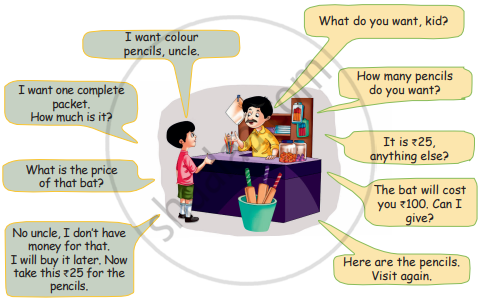
See how they speak at this situation and practise as if you were in that situation.
Read the passage three times and colour a hen for each time.

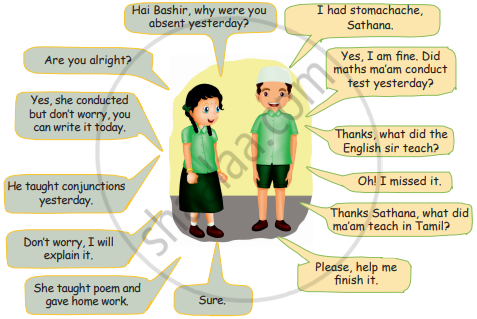
What did the teacher teach?
In groups of five discuss what you would do if you were caught in the following situations.
- Your friend falls in the playfield and is hurt…

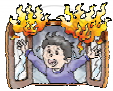
- You are trapped in a fire...
- You are stuck in a traffic jam…
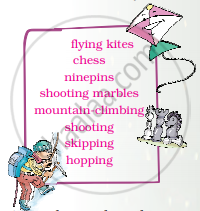
Pick out the names of the games mentioned in the story.
What does ‘features’ mean? Look up the dictionary. What are the different kinds of features of people we come across in the world? Discuss.
Did you hear what your tongue did?
Spell these words through hand signs
- Helen
- was
Make a story of the poem and share it with your friends. You can change Hiawatha’s name and give the name of your classmate. Start the story which other children can continue. Happy Hiawatha, hungry hippopotamus, high horse, heavy hand.
You could begin like this –
Once upon a time there was a boy called
Do you know any other language? Do you know a joke in English? Tell your friends.
Your friend competes with you in academics and sports. Think of the situation wherein you would not be affected by his/her victory and the ways in which you would encourage your friend to succeed.
Build a conversation for the following situation with a minimum of five exchange.
Two friends about the NSS camp which they are going to attend.
Build a conversation for the following situation with a minimum of five exchange.
A salesman and a customer at an electronic shop.
Imagine you are Baldwin and your partner is Gresham. Try your best to persuade your partner to confess the truth. Build a conversation describing how both of you would react in such a situation. Work in pairs.
‘ A friend in need is a friend indeed’. Does this hold good in all situations? Share your views with your class.
Conduct a debate for and against the motion.“Mobile phone - a big boon”
