Advertisements
Advertisements
प्रश्न
Make a story of the poem and share it with your friends. You can change Hiawatha’s name and give the name of your classmate. Start the story which other children can continue. Happy Hiawatha, hungry hippopotamus, high horse, heavy hand.
You could begin like this –
Once upon a time there was a boy called
Advertisements
उत्तर
Once upon a time there was a boy called… Suraj. He loved all birds and animals. He learnt their languages, their names and all their secrets. He used to talk to them whenever he met them. He called the birds ‘Suraj’s Chickens’ and animals ‘Suraj’s Brothers’.
APPEARS IN
संबंधित प्रश्न
Form groups and use the following topic for discussion. Take the help of your college library and your teacher.
Equality before law
Share your opinions/ feelings with your partner about a stranger who has a villainous look/appearance.
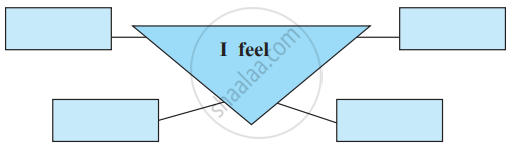
You are visiting the primary school where you studied classes I to IV, after six years. You get a chance to go to your standard two classrooms and you are permitted to sit at the same place where you used to sit.
What would you remember?
While I was ______.
I have never visited ______.
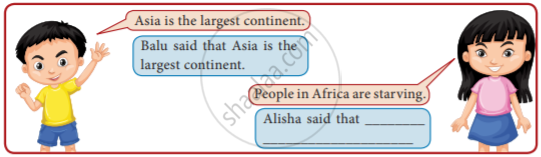
Read the different verb form where they remain the same in the direct and indirect speech in the following case. Fill in the blank with missing indirect speech.
When we report a universal truth (something that is always true)
Put students into groups of three and let them act as Jane.
Student A: You are Jane. You live with the Reeds. Tell the other students about your life there.
Student B: You are Jane. You have been at Lowood School for a few months. Tell the other students about your life there.
Student C: You are Jane. You are eighteen. You are going to work at Thornfield Hall as a teacher. Tell the other students about your hopes for your life.
After this, decide who is the unhappiest of the three ‘Janes’.
Change the following into Indirect Speech.
He said, “How's your father?”
Change the following into Indirect Speech.
The teacher said to him, “Do not read so fast.”
Name the character or speaker.
“Are you alright?”
Name the character or speaker.
“I am fine. We must wear the space suit.”
Speak and win.
Join in one of the two groups. Speak 4 to 5 sentences supporting and opposing the intelligence of the saparrow.
| I support the sparrow for her intelligence. | I oppose the sparrow for using her intelligence to cheat others. |
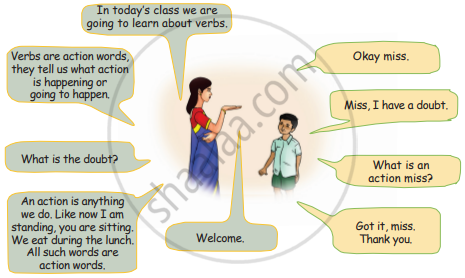
See how they speak at this situation and practise as if you were in that situation. A teacher is teaching the class.
When you run fast, what do you feel is happening to your body?
Using sign language make these letters with your hand
‘C’, ‘H’, ‘E’, ‘K’
Use words beginning with 'h' sound like -
hat, house, hen, hide, horse, heart, hand etc.
Make a pair of words, one a ‘describing word’ and one a ‘naming word’.
Happy Hiawatha, hungry hippopotamus, high horse, heavy hand.
Do you know any other language? Do you know a joke in English? Tell your friends.
Work with a partner. Your friend has lost her books just before the annual examination and she is upset. How will you help her? Take up roles and enact the situation.
Build a conversation for the following situation with a minimum of five exchange.
A passenger and a railway staff regarding the cancellation of the reserved tickets.
Assertion: The SI system of units is the suitable for measurement.
Reason: The SI unit of temperature is kelvin.
