Advertisements
Advertisements
प्रश्न
Some letter are missing in each word.
tr __ __ s
विकल्प
ee
ea
Advertisements
उत्तर
trees
APPEARS IN
संबंधित प्रश्न
Figures of speech
Consonance: Repetition of similar consonant sounds in the neighbouring words.
(e.g.) It's the prettiest little parlour that ever you did spy; Pick out one more instance of consonance from the poem.
Mr. Anand Tony, director of the award-winning movie ‘Poo’, is meeting the press. Take turns to be the director and media person. Conduct a perfect discussion.
Collect images of some electronic gadgets and play a JAM (just a minute) game by picking one image and talking for a minute about it in your classroom.
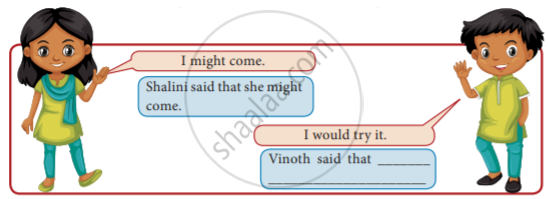
Read the different verb form where they remain the same in the direct and indirect speech in the following case. Fill in the blank with missing indirect speech.
With modal verbs would, might, could, should, ought to, used to.
Answer the following:
|
A Tiny Little Plant Deep in the heart of a little seed, Out came the bright Sunshine, A little plant woke up to see, |
List the rhyming words in the first three lines.
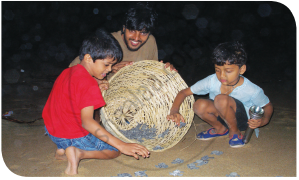
Look at the picture. Work in groups and give a short talk about it using the words given below.
- sand
- waves
- when
- as soon as
- collect
- enjoy
- hatchlings
- basket
- boys
- night
- rough sea
- many
- eggs
- incubate
- hatchery
- after
|
Volunteers of the Students Sea Turtle Conservation Network (SSTCN) release Olive Ridley hatchlings into the sea. |
Change the following into Direct Speech.
I wrote that I would visit him next day.
Present your sport to the class in four to five sentences.
These phrases will help you.
- I like to play ______.
- I play______ regularly with my friends.
- ______is an indoor/outdoor game.
- ______game requires______ players.
- ______has ______these equipments.
- ______ generally played in a court/ground.
- I enjoy playing______ game.
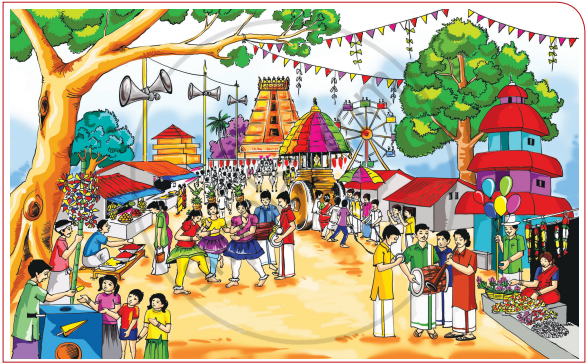
Look at the picture of a village festival carefully. Talk about the activities that are going on by using the hints given in the help box.
About the place and the people — what is happening: what do the children and the adults do? – kind of shops – performances
Join in either of the following groups and say some valid points to win.
| Group A. | I like to live in the Earth because ______ | |
| Group B. | I like to live in the Mars because ______ |
Join in one of the two groups. Choose one character, speak two sentences for and against it.
| I support Kaliyan because ______ |
| I oppose the rich man because ______ |
Write the full form for the following.
she’ll - ______
Sometimes we join two words to make a describing word. For example, Rip was a good-natured man, everybody liked him. Here are some more describing words. Use them to complete the given paragraph.
| long-sleeved | high-heeled | well-dressed | open-mouthed |
| sweet-looking | odd-looking | part-time |
Mrs. Das has a _______ job in a clothes shop. Yesterday, an _______ woman walked into the shop. She was wearing _______ . shoes. A _______ dog was with her. “I want a _______ shirt for my dog, please,” she said. “For your dog?” asked Mrs. Das, _______ in surprise. “Yes,” replied the woman. “I want him to be for my next party.”
When you run fast, what do you feel is happening to your body?
At the end of the play, only the stump of the tree is left. Find out if it will grow into a tree again.
Do you like reading story books?
There are many reasons why something happens.
For example
| Event | Reasons |
|
|
Compose your own limericks on an elephant, a peacock and a butterfly. Read it out to your class.
Prepare a formal five minute speech on the topic ‘The Importance of Education’ and deliver it at your School Assembly.
