Advertisements
Advertisements
प्रश्न
Have you seen
- a hippopotamus in a hat?
- a hen in a beehive?
- a helicopter with hair?
- a horse drink honey?
Advertisements
उत्तर
Do it yourself.
APPEARS IN
संबंधित प्रश्न
Form groups and use the following topic for discussion. Take the help of your college library and your teacher.
Freedom of speech
Find and discuss some examples of reports related to the given topic.
Award distribution
You are visiting the primary school where you studied classes I to IV, after six years. You get a chance to go to your standard two classroom and you are permitted to sit at the same place where you used to sit.
Who do you miss very badly, your friends or teachers?
You are visiting the primary school where you studied classes I to IV, after six years. You get a chance to go to your standard two classroom and you are permitted to sit at the same place where you used to sit.
Share your thoughts with the class.
Deliver a short speech for about five minutes on the following.
Think of a situation where all the trees can speak. What will they talk about?
Identify the character or speaker of the following line.
She stood petrified with astonishment peering over her glasses.
Identify the character or speaker of the following line.
‘What has that got to do that with it?’
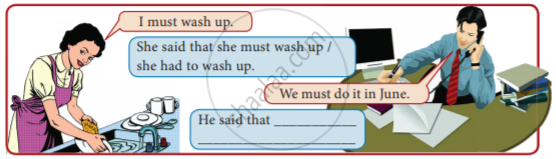
Read the different verb form where they remain the same in the direct and indirect speech in the following case. Fill in the blank with missing indirect speech.
With modal verbs would, might, could, should, ought to, used to.
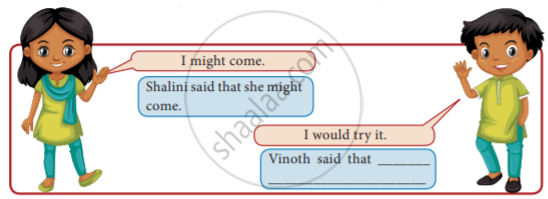
Read the different verb form where they remain the same in the direct and indirect speech in the following case. Fill in the blank with missing indirect speech.
We do not usually change the modal verbs must and needn’t. But must can become had to or would have to and needn’t can become didn’t have to or wouldn’t have to if we want to express an obligation. Would/wouldn’t have to are used to talk about future obligations.
Read the conversation of the simple machines. Take roles to play. Then discuss in pairs to describe any simple machine. Create your own storyboard and take roles to play.
Jack: Don't you know how simple machines make your life easy?
Jimmy: Um... I don't know what simple machines are.
Jack: Simple machines are mechanical devices for applying force like a wedge or ramp.
Jimmy: Oh! wow! How I did not know this!
Jack: Like the wheels on hospital bed and IV pole. They help you move people faster by reducing the friction.
Jimmy: Is the stick over there that the TV is attached to, is that a simple machine too?
Jack: Yes it is, it's a lever. The wheels on the bus are simple machines, they make the bus move.
Jimmy: What about the doors?
Jack: 'Yeah' the driver pulls a lever and the doors open and you climb up the inclined plane aka the stairs. The cable in the elevator is wrapped around a groove in the wheel and axle, an electric motor pulls the cable, lifting the car between floors.
Jimmy: So the wheels on the rolling chair are too by rolling the chair back instead of lifting the chair back.
Jack: 'Yes' they are, they move the chair and reduce the friction.
Do you have art / craft session in your school?
Change the following into Indirect Speech.
“Bring me a glass of milk,” said the swami to the villagers.
The Maharaja was a wise man and ordered the cook to use the vegetable scraps instead of throwing them away.
- Name some of the things which are thrown away at home or in school.
- Sit in groups of four and think of interesting ways in which they can be made useful.
- Put up your findings on the class board.
Read the following passage carefully.
One day Meena plucks a mango and brings it home. Her grandmother gives the larger piece to Raju because he is a boy. Meena protests. After all, she brought the mango and she is the elder of the two. She insists she has a greater right over her share. Her father comes to her help and divides the mango equally.
Now answer the questions.
- Who brought the mango home?
- Why did Meena’s grandmother give a larger piece to Raju?
- Who do you think should have got the larger piece?
Some letter are missing in each word.
sl ______ p
Some letter are missing in each word.
b ______ p
Listen and repeat Ca -t
Don’t Give Up
If you keep on going
And never stop,
You can keep on going,
You can make it to the top.
Life is full of mountains,
Some are big and some are small,
But if you don’t give up
You can overcome them all.
So keep on going
Try not to stop,
When you keep on going
You can make it to the top.
Look at the picture and describe it. Why do you think the boy is happy?

Pick out the silent letters from these words
| silent letter | |
| hour | |
| knit | |
| wrong | |
| doubt | |
| often | |
| know | |
| night | |
| could | |
| write | |
| knife | |
| high | |
| walk |
Work in pairs and arrive at five points that bring out the benefits and challenges of living in either a nuclear family or a joint family. Share your views with your class.
