Advertisements
Advertisements
Question
Speaking Activity
Based on your understanding of the play ‘The Never – Never Nest’, organise a classroom debate on the topic: ‘Is Equated Monthly Instalment Scheme - a boon or bane to middle-class families?’
Advertisements
Solution
| A | Equated Monthly Installment scheme is a boon. Middle-class people who can’t dream of owning a home or even buying a two-wheeler get the benefit. |
| B | How do you prove it? |
| A | Well, a person who earns 15,000 rupees a month is able to take a house loan. Shri Ram, Finance Investment company of Bajaj Fin Serve offers scooter, car loans on as low as 7% interest. So a man can avail of the benefits first but pay later. |
| B | My dear friend, you present the matter as if it is just easy. What happens if a medical emergency happens and if the person is unable to pay back EMI for a housing loan or vehicle loan. Don’t you know a farmer was beaten by “Collection agents” for not? being able to pay back EMI arrears of just 50,000 rupees? The farmer, unable to face the disgrace committed suicide. Didn’t you read it in the newspapers? EMI scheme is a bane. |
| A | My dear friends, such a rare occurrence should not be blown out of proportion. For a health emergency, one can join Prime Minister’s health insurance scheme by just paying 12 rupees a month. Besides, there are also Health insurance schemes by the Tamil Nadu state Government that cover the cost of critical Health care up to 60%. I assert EMI scheme is a boon for all middle-class people who keep EMI to less than 50% of their total earnings and have 10% for other unforeseen expenses. If one leads a planned life, the EMI scheme, I reiterate is a bane. |
| Judge | Now both the teams have argued their case very well. Now team A has almost justified that the EMI scheme is a boon. |
| B | Sir, I would like you to take a look at the notice released by all leading banks containing the list of housing property confiscated due to non – payment of EMIs. |
| A | Every middle-class Indian has dreamed of owning a house. If one saves money say for twenty years to purchase land or a house the cost would definitely go up by 10 times. Save now and buy later doesn’t suit modem lifestyle. It is true that we should not speculate much. At the same time, one can calculate earnings, future pay hikes and keep the EMIs within payable limits – such judicious spending will really make EMI schemes a great boon. |
| Judge | Listening to the arguments of both the team, I conclude EMI scheme is both a bane and a boon. For those who are always on a spending spree irrespective of their limited income, the EMI scheme is a bane. For those who think twice before making a hasty purchase and narrow down their choice only to vital needs, definitely EMI scheme is a boon. Use the EMI scheme wisely. Good luck. |
APPEARS IN
RELATED QUESTIONS
Find and discuss some examples of reports related to the given topic.
Award distribution
Given below are five main qualities for true sportsmanship.
| i. | Determination |
| ii. | Optimisation |
| iii. | Stamina |
| iv. | Perseverance |
| v. | Decisiveness |
Get into groups of four. Each group will choose one quality to talk about to the whole class for about one minute. But before you talk, you have two minutes to think about it. You can make notes if you wish.
Deliver a short speech for about five minutes on the following.
Imagine what will happen if all the trees in the earth disappear. Discuss with your friends and share it with your classmates.
While I was ______.
Mr. Anand Tony, director of the award-winning movie ‘Poo’, is meeting the press. Take turns to be the director and media person. Conduct a perfect discussion.
“Who took my English book?”
He was curious to know who ______.
“Where does Helen live?”
Jim wants to know where ______.
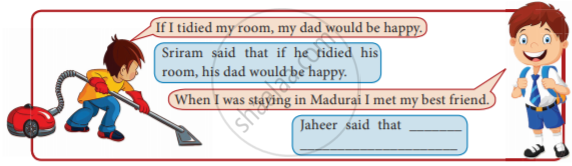
Read the different verb form where they remain the same in the direct and indirect speech in the following case. Fill in the blank with missing indirect speech.
In if-clauses and time-clauses.
A road map is given below. Answer the questions that follow with the help of the road map. Work in pairs and discuss to give directions to get to one place from another.

- You are at the market. You need directions to go to the pharmacy.
- You are in a book shop. Ask your partner to direct you to the Art Gallery.
- Give your partner the directions to go from the Bank to the hotel.
- Direct your partner from the post office to the market.
- Your partner wants to go to the library from school. Give suitable directions.
Answer the following:
|
A Tiny Little Plant Deep in the heart of a little seed, Out came the bright Sunshine, A little plant woke up to see, |
List the rhyming words in the first three lines.
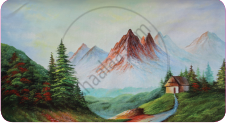
Imagine that below are some of the paintings of Jane Eyre. Discuss with your partner and describe the paintings.



Work in pairs. Take turns and speak about spices.
| Saritha | Saritha: Hi Divya, how are you? |
| Divya | Hi, I’m fine Saritha. |
| Saritha | What did you have for breakfast? |
| Divya | ______ with onion chutney. |
| Saritha | Do ______ onions ______? |
| Divya | ______ Central Asia. |
| Saritha | Do you know chilli too has come from somewhere else? |
| Divya | Is it from______? |
| Saritha | Yes______right. |
| Divya | Many of the ______ came ______. |
Change the following into Indirect Speech.
“What do you want?” he said to her.
Change the following into Indirect Speech.
“Run away, children,” said their mother.
Change the following into Direct Speech.
I told them to be quiet.
Change the following into Direct Speech.
Lakshan asked me if I had anything to say.
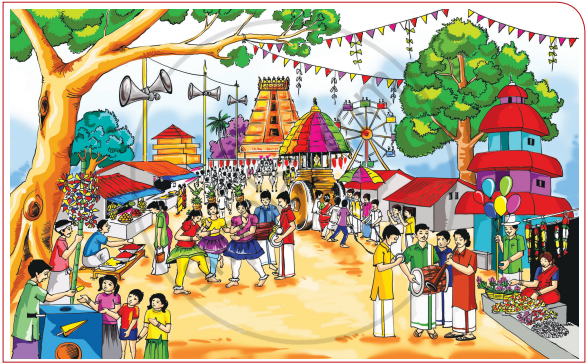
Look at the picture of a village festival carefully. Talk about the activities that are going on by using the hints given in the help box.
About the place and the people — what is happening: what do the children and the adults do? – kind of shops – performances
Imagine a world with no books, but only e-books. How would you find such a world? Deliver a two-minute talk.
What happened to the hole in the ground after the rain?
The people who live in cities often wish they could live in quiet towns. Do you like the place you live in?
Tell your partner two things you like and don't like about the place you live in.
Running is very good exercise. Name any three games that you play, in which you have to run.
Some letter are missing in each word.
m ______ t
Ram is a curious little boy. He is always asking questions. One day he came home and asked his grandfather questions like –
- Why can’t we look at the sun during a solar eclipse?
- Why can’t we touch the sun?
- Why can’t we go out to play in the dark?
Discuss these questions with your teacher and class. Do you know the answers?
Say these words and feel what your tongue does when you say –
toe, top, tie, ten
Don’t Give Up
If you keep on going
And never stop,
You can keep on going,
You can make it to the top.
Life is full of mountains,
Some are big and some are small,
But if you don’t give up
You can overcome them all.
So keep on going
Try not to stop,
When you keep on going
You can make it to the top.
Look at the picture and describe it. Why do you think the boy is happy?

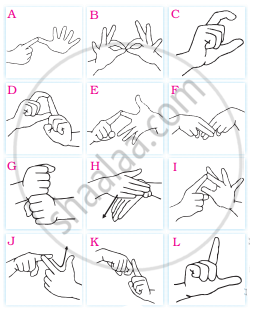
Look at the signs for the letters of the alphabet.

Do you like reading story books?
Build a conversation of eight to ten sets of exchanges , with your grandmother, discussing the incidents that happened in your school that day.
You have recently shifted to a new locality. You cannot find your way back, after school. Your uncle spots you and takes you home. Narrate the incident to the class.
Now it’s your turn to speak against the motion “Wars create more problem than they solve.” Express your views with valid points.
