English

Read the speech bubbles. Who walks to school most often? Put them in order.

Advertisements
Advertisements

Question

Read the speech bubbles. Who walks to school most often? Put them in order.
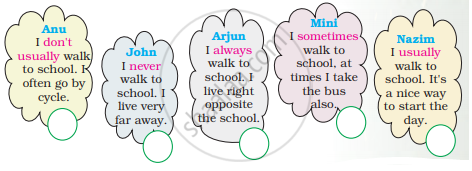
Diagram
Advertisements

Solution
I always walk to school. I live right opposite to the school.
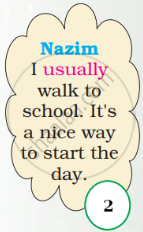
I usually walk to school. It’s a nice way to start the day.
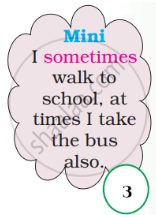
I sometimes walk to school, at times I take the bus also.
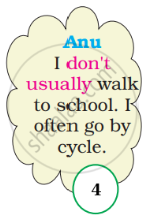
 I don’t usually walk to school. I often go by cycle. 
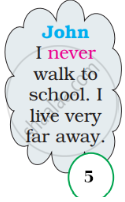
I never walk to school. I live very far away.
shaalaa.com
Speaking Skills
  Is there an error in this question or solution?
Chapter 5.2: Rip Van Winkle - Let's talk [Page 91]

APPEARS IN

NCERT English - Marigold Class 5
Chapter 5.2 Rip Van Winkle
Let's talk | Q 2 | Page 91

RELATED QUESTIONS

Form groups and use the following topic for discussion. Take the help of your college library and your teacher.

Features of the Constitution of India


Work in groups of four. Discuss how the story would have been different if.

Pongo had pardoned the narrator after scolding him.


Figures of speech

Anaphora: Repetition of a word or a phrase at the beginning of a sequence of sentences, paragraphs, and lines.

(e.g.) How handsome are your gauzy wings, how brilliant are your eyes!

Identify the figures of speech.

”Your eyes are like the diamond bright, but mine are dull as lead!”


Divide the students into groups of five and conduct a group discussion on the topic "Importance of Mathematics in Our Everyday Life". The teacher will act as a moderator.


“Where does Helen live?”

Jim wants to know where ______.


“Why do volcanoes erupt?”

She wondered why ______.


Which session do you like – art/craft?


Imagine that below are some of the paintings of Jane Eyre. Discuss with your partner and describe the paintings.


Change the following into Indirect Speech.

“Don't you know the way home?” asked I.


I have a robot______ and tall.


Join in one of the two groups. Choose one character, speak two sentences for and against it.

I support Kaliyan because ______


I oppose the rich man because ______

The Maharaja was a wise man and ordered the cook to use the vegetable scraps instead of throwing them away.

  • Name some of the things which are thrown away at home or in school.
  • Sit in groups of four and think of interesting ways in which they can be made useful.
  • Put up your findings on the class board.

Write the full form for the following.

she’ll - ______


When you run fast, what do you feel is happening to your body?


Some letter are missing in each word.

b ______ p


Say these words and feel what your tongue does when you say –

toe, top, tie, ten


Make a story of the poem and share it with your friends. You can change Hiawatha’s name and give the name of your classmate. Start the story which other children can continue. Happy Hiawatha, hungry hippopotamus, high horse, heavy hand.

You could begin like this –

Once upon a time there was a boy called 


Build a dialogue of 8–10 exchanges between your friend and yourself, on the following situation:

You were to board a train to Delhi. By mistake, you got into the wrong train and fought for your seat there. On realising your mistake, you left the train shamefaced, after creating a commotion there. Role-play this situation before the class.


Speaking Activity

Based on your understanding of the play ‘The Never – Never Nest’, organise a classroom debate on the topic: ‘Is Equated Monthly Instalment Scheme - a boon or bane to middle-class families?’


Pair work: Practise the dialogue with another student. Then write a similar dialogue between a student and the class teacher regarding an educational trip.


Share
Notifications

Englishहिंदीमराठी


      Forgot password?
Use app×