Advertisements
Advertisements
प्रश्न
Ms. Pavithra Rao, the squash player who won the gold medal at the recent Asian Games, is holding a press conference. Let the discussion focus more on the strategies that helped her to win.
Advertisements
उत्तर
| Media Person 1 | Congratulations Pavithra Rao mam on your Asian Gold title |
| Pavithra Rao | Thank you |
| Media Person 2 | What is your advice to girls who want to shine like you in international Squash? |
| Pavithra Rao | They must practice hitting to a good length. Stroke the ball to the front wall with sufficient judgment to make it bounce at the back of the court behind the service box. The ball should never hit the back wall on the full or fail to hit the back wall, ideally after one bounce and die. Develop it, as a reflex action with practice, by hitting hard below the front wall service line, or soft above the service line. The objective is to confine your opponent to the back of the court, moving him out of the dominating position at the T. |
| Media Person 2 | Which area should the player focus more? |
| Pavithra Rao | Aim for the back comers. Your opponent’s options are reduced when you play in the back comer. Thirty feet away he can’t attack, and his swing is restricted. While playing a cross-court, you should hit wide so that he cannot reply with a volley |
| Media Person 3 | What can we do to drive the opponent player crazy and insecure? |
| Pavithra Rao | Keep it close to the sidewall. As a routine, keep the ball straight, in the comers, along the sidewall (easier said than done). This will cause your opponent to move away from the T and hinder him from attacking or volleying. He will be on the defensive and there may be a possibility of a weak return. |
| Media Person 4 | What kind of practice keeps you alert on the game? |
| Pavithra Rao |
Move to the ‘T’ after playing your shot. This will allow you to move and pick up your opponent’s shot, be it a drop to a front court or a shot to the backcourt. Generally, take long strides to the ball, so the body is in the recommended position when playing the stroke, and can also recover quickly for the next rally. The player controlling the Twill invariably controls the point. Even after playing a drop or front wall boast you should move back to the T, to await your opponents' stroke. Practice correct movements by on-court shadow (ghosting) routines and shot-specific drills. Watch the ball. Some players find it hard to watch the ball, especially when the ball is hit behind the player, they just watch the front wall. Players also tend to lift their head to see their opponent’s position, before playing their own stroke. Make it a practice to watch the ball until impact your and your opponent’s racket. This will give you the extra milliseconds to respond and can also avoid injuries of being accidentally hit by your opponent, their racket, or ball. |
| Media Person 1 |
What kind of food do you recommend for a Squash player? |
| Pavithra Rao |
Eat smart. There is no perfect diet, as everyone has different needs and |
| Media Person 2 |
What kind of training do you recommend for promising Squash players to stay in the game for long? |
| Pavithra Rao |
Balance your on and off-season training with a mixture of flexibility, aerobic, anaerobic, and strength training and conditioning. Training must be combined with an appropriate diet and also provide adequate recovery periods for your body to rebuild and develop. Stick to your training schedule, avoid short, hectic training, and concentrate on longer and systematic training to avoid injury and build up your body’s reserves. Everyone needs a specific training program, dependent on genetics, physical shape, and training history. This will determine how much training you can do now and your body’s response to the training. There are some top junior squash players in South Africa. |
| Media Person 2 |
Thank you, ma’am. |
APPEARS IN
संबंधित प्रश्न
What will the tree do, if the banks are closed?
It will start its own ____________.
Work in groups of four. Discuss how the story would have been different if.
Pongo had forgotten to lock the door properly but the narrator only discovered it just before Pongo returned.
GL Home Appliances have introduced a product to purify salt water. The CEO of the company has agreed to meet the press to launch their new product.
Read the different verb form where they remain the same in the direct and indirect speech in the following case. Fill in the blank with missing indirect speech.
In if-clauses and time-clauses.

Sherlyn receives a postcard from her friend Pushpa who is holidaying in Sri Lanka. She calls her friend Galen and tells him what Pushpa has written. Help her by filling in the blanks, using reported speech.
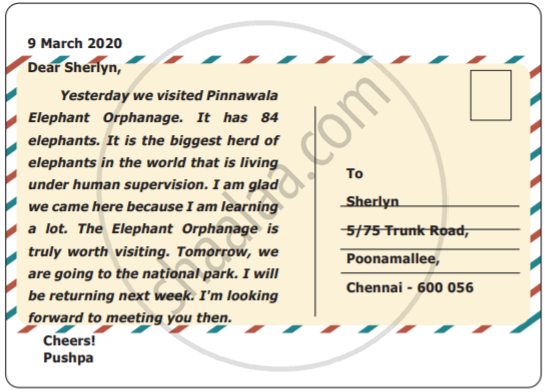
Hello, Galen Today I received a postcard from Pushpa. Remember I had told you that She has gone to Sri Lanka on a holiday? Well, she has written from Colombo. She has written that ____________ Orphanage. It ____________ elephants. She said that it is the biggest herd of elephants in the world that is living under human supervision. She also added that she ____________ because ____________. The Elephant Orphanage ____________ . She said that ____________ national park. She ____________ next week and added that ____________ then.
What happened to the hole in the ground after the rain?
The people who live in cities often wish they could live in quiet towns. Do you like the place you live in?
Tell your partner two things you like and don't like about the place you live in.
Describe a few funny things you have seen. Do they make you laugh?
Use words beginning with 'h' sound like -
hat, house, hen, hide, horse, heart, hand etc.
Make a pair of words, one a ‘describing word’ and one a ‘naming word’.
Happy Hiawatha, hungry hippopotamus, high horse, heavy hand.
Now use these ideas and prepare a speech on the topic ‘The importance of developing a positive attitude’ and deliver the speech in the school assembly
