Advertisements
Advertisements
प्रश्न
Discuss the following in pairs or in groups of four:
'It is time to realise that unless we modify the established notion of literature as something written, we will silently witness the decline of various Indian oral traditions'
Advertisements
उत्तर
Literature is usually thought of including those compositions like poetry and prose which are written. But going by this notion, one may miss the aesthetic beauty of the compositions as prevalent in many oral traditions. There is another stream of literature containing compositions which are rich both thematically and aesthetically. But as we have a rigid criteria of regarding compositions as literature only when these are written so these do not get the status of literature. This is the case with many Indian oral traditions. Unless we modify our notions of literature there is every possibility that we will silently witness the decline of various Indian oral traditions.
Another perspective
Oral literary tradition is not a unique phenomenon in India. Oral traditions have been in existence in all parts of the world. Oral traditions do not die out because of their very nature of being transmitted
orally. So it hardly matters whether we modify our notion about literature or not , the oral traditions will continue to exist. What needs to be done is promotion of oral literary tradition through patronage of the state.
APPEARS IN
संबंधित प्रश्न
Answer any four of the following questions in 30-40 words each :
(a) Why was Franz not scolded for reaching the school late that day?
(b) Sophie was dreaming of so many things in her life. What were they?
(c) Why are the youngsters described as springing? (My Mother at Sixty-six)
(d) In the hot season, how do man and beast get comfort? (A Thing of Beauty)
(e) How did the Maharaja deal with a high ranking British officer who wanted to shoot a tiger?
(f) Having got rid of his stink, what problem did Roger Skunk face?
Read the following extract carefully and complete the activities given below :
A1 Complete the following :
(i) Books were found on the _____________ and ____________.
(ii) The tales are described as ______________ and __________.
|
Have you forgotten? Don't you know?
We'll say it very loud and slow:
THEY ... USED ... TO ... READ! They'd READ and READ,
AND READ and READ, and then proceed
To READ some more. Great Scott! Gadzooks!
One-half of their lives was reading books!
The nursery shelves held books galore!
Books cluttered up the nursery floor!
And in the bedroom, by the bed,
More books were waiting to be read!
Such wondrous, fine, fantastic tales
Of dragons, gypsies, queens, and whales
And treasure isles, and distant shores
Where smugglers rowed with muffled oars,
And pirates wearing purple pants,
And sailing ships and elephants,
And cannibals crouching 'round the pot,
Stirring away at something hot.
(It smells so good, what can it be?
Good gracious, it's Penelope.)
|
How does Shelley's attitude to science differ from that of Wordsworth and Keats?
The text is an excerpt from Sesame and Lilies which consists of two essays, primarily, written for delivery as public lectures in 1864. Identify the features that fit the speech mode. Notice the sentence patterns.
Make groups and discuss the following:
Did they themselves suffer from those problems/setbacks?
Write down any two Slogans on 'Gender Equality'.
Find from the lesson word/phrase that mean the following.
colours .............
Breeding worms to use them to convert organic waste into fertilizer is called Vermiculture or vermicomposting.
Find out more about Vermiculture and how you can carry out the same in your garden/backyard, to fertilize your plants at home.
Using a dictionary/internet note down the main difference between self-reliant and self-assured.
Answer the given question in your own words.
What message do you get from this story?
Compare and contrast the two opposing human feelings as expressed by the poet.
Form groups and discuss the following question:
The events described in the poem take place at a certain place, at a certain period of the year, under specific weather conditions. Describe the place, the time, and the weather conditions.
Describe in your own words the incident when Hovstad's real intention to help Dr. Stockmann is exposed.
Expand the following ideas in a paragraph or two:-
Where there is a will, there is a way.
The merchant ships brought spices and other treasures from India and other countries to Italy.
Who is the speaker in the poem?
What time is being described in the poem?
An activity:
Speak fast, think faster! Form groups of 4-6. Discuss each of the following topics. Then each person in the group should choose a topic and speak about it for one minute. Try to say as many sentences as you can in that time
What is not likely to happen or will never happen...
‘It won’t rain in the classroom... I won’t ever see a live dinosaur... The sun will never set in the east...’ etc.
Write a short note on the following:
The message in the vision.
Use the following expressions in your own sentences:
- We all agree that
- It is he/she who
- Don’t you see
- None of us
Make a time table of your daily routine
- On a school day
- On a holiday, and
- During examinations.
Start at the time you normally get up and list your activities
hourly: 7 am to 8 am, and so on.
Read the passage. Underline the new words. Guess their meaning from the context. Verify it from a good dictionary.
Read the passage and name the following.
She was the wife of King Menelaus.
Find one example of the following given below from the poem: Metaphor
Find from the Internet and write down.
In which century did William Shakespeare write his famous plays?
Choose a suitable heading for each announcement from those given below.
(Change in School Hours, Cleanliness, Story-telling Competition, Lost and Found, Warning, Football Match)
1.
|
6 July 2015 It has been observed by the Head Boy and Head Girl that certain classes do not clean up their classrooms before leaving. If any class is found untidy and littered after school, that class will be detained the next day after school hours up to 4 pm. Please take note of this. |
2.
| Tomorrow, that is, on the 10th of July, the school will close an hour earlier, as the teachers have to attend an important P. T. A. meeting. So please inform your parents to arrange to pick you up at 2 pm instead of 3 pm. |
3.
| On Sunday, 12th July 2015 there is a football match between classes VIII and IX, on the school ground. The match will begin at 9 am. All students are invited to come and cheer their favorite team. Please come on time, so that the players are not distracted. |
4.
|
The school has organized a Story-telling Competition for Classes V, VI, and VII from 21st to 25th of July. The competition will be held in the school hall at 10 in the morning. Children may select -
Three prizes will be given for each category. The time limit is 3-5 minutes. Those who wish to participate may contact Mrs. Sanjana Mohite for other details. They must register their names with her before the 16th of July. |
5.
|
Construction work to extend the school building will start next week. All students are cautioned not to cross over the fence at the construction site. It is dangerous and may cause you injury. Please stay away from that fence. |
6.
| A cycle key with a blue key chain has been found on the ground. Whoever has lost it can contact the clerk Mrs. Neena Pinto and see if it belongs to him/her. |
What difficulties do the people in the play face in the morning?
Form groups of four or five.
Try to find the answers to the following questions through observation and by talking to your teachers, parents and others. Discuss your answers in the group.
- How is waste generated?
- How is it removed or cleared?
- How can we help in the task of clearing or removing garbage?
What did he try to take the milk from?
Where was the well situated?
Guess the meaning of the following word.
magnificent
Title summarises the story. Each paragraph is a part of the story. Look at the following expressions and find out the paragraphs that best suit these expressions.
- Oh, No! But it happens!
- Don’t let out your travelling dates
- Anyway, people will be people
- Search begins
- Things are not that easy
- Hurry invites worry
Read the following line from the poem and answer the question given below.
Nothing goes right with the folks you meet
Down on that gloomy Complaining Street.
- What is the opinion about the folks you meet down the street?
- What does the word ‘gloomy’ mean here?
‘ If only her son were there, it would have been a different kind of Eid’! What had happened to her son?
What did Granny say about Hamid’s parents?
Look at the number pattern. Fill the blank in the middle of the series or end of the series.
FAG, GAF, HAI, IAH, ______
What did Mr. Fogg mean by, ‘it was foreseen’?
Why did the author help his Grandfather plant trees?
Name the vegetables harvested in the vegetation hab.
The boy and the girl were taken by the cavalry to explain their action.
Why did Santhosh forget to watch television or play video games?
What did the father give to all the daughters?
Jaswantgarh is named after the Indian soldier ______.
Did Tabaqui receive a warm welcome from the pack of wolves? How do you know?
Where did Anitha go?
How did the old man disguise himself?
What did the hen-pigeon whisper?
Choose what the elephant did.
Some words sound the same but their spelling and meaning are different. Such words are called homophones. There are many homophones.
Some words sound the same but their spelling and meaning are different. Such words are called homophones. There are many homophones.
The old man is _____.
Appu felt hungry and ate a______.
Robinson named the boy______.
Robinson sailed England after ______ years.
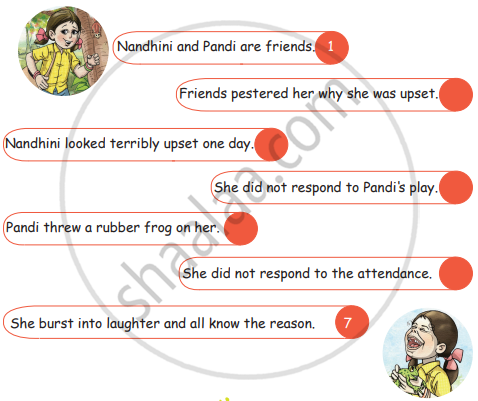
Number the actions of Pandi and Nandhini in order.
Divya loved solving _______.
The merchants sold things made of______.
The fir tree was sad ______.
What does the poem tell us to do?
Being a bachelor, the stranger had no patience with children.
