Advertisements
Advertisements
प्रश्न
Answer the following
Explain the ammonolysis of alkyl halides.
Advertisements
उत्तर
i. When alkyl halide is heated with an alcoholic solution of excess ammonia, it undergoes a nucleophilic substitution reaction in which the halogen atom is replaced by an amino (–NH2) group to form primary amine.
ii. This process of breaking of the C – X bond by ammonia is known as ammonolysis. The reaction is also known as the alkylation of ammonia. The reaction is carried out in a sealed tube at 373 K.
iii. The primary amine obtained in the1st step is stronger nucleophile than ammonia. Hence, it further reacts with an alkyl halide to form secondary and tertiary amines and finally quaternary ammonium salt if NH3 is not used in large excess.
\[\ce{\underset{\text{Alkyl halide}}{R - X} + \underset{\text{(excess)}}{NH3_{(alc.)}}->[\Delta] \underset{1^0}{R} - NH2 + HX}\]
iv. The order of reactivity of alkyl halides with ammonia is R–I > R–Br > R–Cl.
APPEARS IN
संबंधित प्रश्न
Write the chemical equation involved in the following reaction:
Hoffmann-bromamide degradation reaction
How do you convert the following: Ethanenitrile to ethanamine
Give the structures of A, B and C in the following reactions :

Accomplish the following conversion:
Nitrobenzene to benzoic acid
Accomplish the following conversion:
Benzyl chloride to 2-phenylethanamine
Give the structure of A, B and C in the following reaction:
\[\ce{C6H5N2Cl ->[CuCN] A ->[H2O/H+] B ->[NH3][\Delta] C}\]
Give the structure of A, B and C in the following reaction:
\[\ce{C6H5NO2 ->[Fe/HCl] A ->[NaNO2 + HCl][273 K] B ->[H2O/H+][\Delta] C}\]
Why cannot aromatic primary amines be prepared by Gabriel phthalimide synthesis?
Choose the most correct option.
Which of the following compounds will dissolve in aqueous NaOH after undergoing reaction with Hinsberg reagent?
Answer in one sentence.
Which amide does produce ethanamine by Hofmann bromamide degradation reaction?
Answer the following
Identify A and B in the following reactions.
\[\ce{C6H5CH2Br->[alco.][KCN]A ->[Na/ethanol]B.}\]
Mendius reaction is used to convert _____________
Write the order of reactivity of alkyl halides with ammonia.
Acetamide on reduction using Na/C2H5OH gives ____________.
Identify the product 'A' in the following reaction.
\[\ce{Aniline ->[(CH3CO)2O][Pyridine] A}\]
Alkyl cyanides on reduction by sodium and ethanol give primary amines. This reaction is called as ____________.
Identify the product obtained, when benzamide is treated with bromine and aqueous sodium hydroxide.
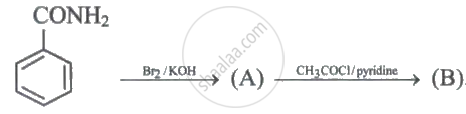
Identify the major product (B).
What product is formed when \[\ce{R - C ≡ N}\] is hydrolysed?
Which nitrogen containing compound amongst the following would undergo Mendius reduction to furnish primary amine \[\ce{(R - NH2)}\]?
Identify the INCORRECT statement regarding Hofmann bromamide reaction.
Which of the following amines cannot be prepared by Gabriel phthalimide synthesis?
Identify product B in the following reaction.
\[\ce{Aniline ->[NaNO2][HCl] A ->[KI] B}\]
Which of the following compounds is obtained when quaternary ammonium hydroxide is strongly heated?
Which of the following does NOT give carbylamine test?
For producing amines, the reaction of nitro compounds with iron scrap is preferred because:
Benzylamine may be alkylated as shown in the following equation:
\[\ce{C6H5CH2NH2 + R - X -> C6H5CH2NHR}\]
Which of the following alkylhalides is best suited for this reaction through SN1 mechanism?
The source of nitrogen in Gabriel synthesis of amines is ______.
The best reagent for converting 2–phenylpropanamide into 2-phenylpropanamine is ______.
Best method for preparing primary amines from alkyl halides without changing the number of carbon atoms in the chain is ______.
Reduction of nitrobenzene by which of the following reagent gives aniline?
(i) \[\ce{Sn/HCl}\]
(ii) \[\ce{Fe/HCl}\]
(iii) \[\ce{H2 - Pd}\]
(iv) \[\ce{Sn/NH4OH}\]
Under which of the following reaction conditions, aniline gives p-nitro derivative as the major product?
(i) Acetyl chloride/pyridine followed by reaction with conc.\[\ce{H2SO4 }\] + conc. \[\ce{HNO3}\].
(ii) Acetic anyhdride/pyridine followed by conc.\[\ce{H2SO4}\] + conc.\[\ce{HNO3}\].
(iii) Dil. HCl followed by reaction with conc.\[\ce{H2SO4}\] + conc.\[\ce{HNO3}\].
(iv) Reaction with conc.\[\ce{HNO3}\] + conc.\[\ce{H2 SO4}\].
What is the product when \[\ce{C6H5CH2NH2}\] reacts with \[\ce{HNO2}\]?
Suggest a route by which the following conversion can be accomplished.

How will you carry out the following conversions?

Match the reactions given in Column I with the statements given in Column II.
| Column I | Column II | ||
| (i) | Ammonolysis | (a) | Amine with lesser number of carbon atoms |
| (ii) | Gabriel phthalimide synthesis | (b) | Detection test for primary amines. |
| (iii) | Hoffmann Bromamide reaction | (c) | Reaction of phthalimide with \[\ce{KOH}\] and \[\ce{R-X}\] |
| (iv) | Carbylamine reaction | (d) | Reaction of alkylhalides with \[\ce{NH3}\] |
Assertion: Hoffmann’s bromamide reaction is given by primary amines.
Reason: Primary amines are more basic than secondary amines.
Assertion: Aromatic 1° amines can be prepared by Gabriel Phthalimide Synthesis.
Reason: Aryl halides undergo nucleophilic substitution with anion formed by phthalimide.
Ethylamine can be prepared by the action of bromine and caustic potash on which compound?
C6H5CONHCH3 can be converted into C6H5CH2NHCH3 by:-
Which of the following statement(s) is/are incorrect in case of Hofmann bromamide degradation?
What is the IUPAC name of \[\ce{(CH3)2 - N - CH3}\]?
Write the name of the product formed by the action of LiAlH4/ether on acetamide.
Which of the following would not be a good choice for reducing nitrobenzene to aniline?
Amides can be converted into amines by the reaction named ______.
Identify A and B in the following reaction.
\[\ce{C6H5CH2Br ->[Alco.][KCN] A ->[Na/Ethanol][reduction] B}\]
Write a short note on the following:
Ammonolysis
Write the name of reduction product formed when ethyl cyanide is treated with sodium and alcohol.
Write short note on the following:
Ammonolysis
Write a short note on the following:
Ammonolysis.
