Advertisements
Advertisements
प्रश्न
_______ forms a green colour in the water.
विकल्प
CuSO4
FeSO4
NaCl
all the above
Advertisements
उत्तर
FeSO4 forms a green colour in the water.
APPEARS IN
संबंधित प्रश्न
What is an alloy?
Tinning : Tin : : Galvanizing : _________
Explain why Iron sheets are coated with zinc during galvanization.
What special name is given to the corrosion of iron?
What type of chemical reaction is involved in the corrosion of iron?
The chemical reaction involved in the corrosion of iron metal is that of ______.
Name the metal which is used for galvanising iron.
Explain why, iron sheets are coated with zinc.
In one method of rust prevention, the iron is not coated with anything. Which is this method?
The corrosion of iron is called ______.
______ and ______ are necessary for the rusting of iron.
With the help of labelled diagrams, describe an activity to find out the conditions under which iron rusts.
Give the constituents of brass.
Name a common metal which is highly resistant to corrosion.
If copper is kept exposed to damp air for a considerable time, it gets a green coating on its surface. This is due to the formation of ______.
Four metals P, Q, R and S are all obtained by the reduction of their oxides with carbon. Metal P is used to form a thin layer over the sheets of metal S to prevent its corrosion. Metal Q is used for electroplating tiffin boxes made of metal S whereas metal R is used in making car batteries. Metals Q and R form an alloy called solder. What are metals P, Q, R and S? How have you arrived at this conclusion?
Bronze is an alloy of ______.
State under what conditions corrosion is faster ?
Complete the process of iron rusting by filling the blanks. Suggest a way to prohibit the process.
The iron rust is formed due to........................... reaction. Different
regions on iron surface become anode and cathode.
Reaction on anode region :
`F_e(s) → Fe^(2+) (aq) +2e^-`
Reaction on anode region :
`O_2(g) + 4H^+(aq) +............................ → 2H_2 O (l) `
When Fe2+ ions migrate from anode region they react with ................... to form Fe3+ ions.
A reddish coloured hydrated oxide is formed from ............... ions. It is called rust.
`2Fe_(3+) (aq) + 4H_2O(l) → ................. + 6H_+(aq) `
A way to prevent rusting ..................................................................
Answer the following question.
a) What is meant by corrosion?
b) Write names of any two methods of prevention of corrosion.
c) In which method, metal like copper, aluminium are coated with a thin layer of their oxides by means of electrolysis.
d) Explain this method with diagram.
Choose the correct alternative and rewrite the following:
Iron is _____________________.
State whether the statement given below is true or false. If false write the correct statement.
Graphite is a lustrous non-metal which conducts electricity.
Corrosion of silver causes a black layer of _______.
Find the correlation:
Bronze : ______ :: Tin : Cu+Zn.
Find the odd one out and give its explanation.
Write scientific reason.
Coins are made from metals and alloys.
Observe the following diagram and write answers.
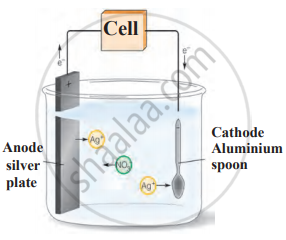
- Name the method.
- Explain the method.
- Give two examples of this method.
Observe the following figure and write the answer of the question.
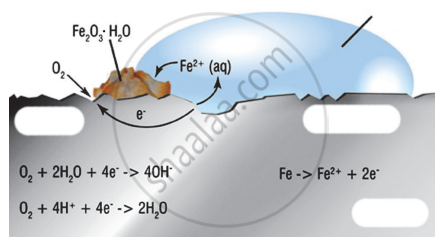
- Which process is shown in the figure?
- Explain the chemical reaction shown in the figure.
- Write the reactions on anode and cathode.
What is rust?
The diagram shows the reaction between metal and dil. acid.

What is the reason for different behaviour of Mg in test tube B?
Identify the correct statement from the following:
Iron pillar near the Qutub Minar in Delhi is famous for the following facts. Which of these facts is responsible for its long stability?
State whether the following statement is true or false:
Ships suffer a lot of damage though they are painted.
Explain the following:
Bubbles are produced when acetic acid is added to a solution of sodium hydrogencarbonate.
Describe two changes that are harmful. Explain why you consider them harmful. How can you prevent them?
