Topics
Natural Resources – Air, Water and Land
The Living World
Diversity in Living Things and Their Classification
Disaster Management
Substances in the Surroundings –Their States and Properties
Substances in Daily Use
Nutrition and Diet
- Nutrients and Nutrition
- Component of Food
- Carbohydrates
- Diseases Due to Deficiency of Carbohydrates
- Fats (Lipids)
- Diseases Due to Deficiency of Fats
- Proteins
- Diseases Due to Deficiency of Proteins
- Vitamin and Minerals
- Diseases Due to Deficiency of Vitamin
- Diseases Due to Deficiency of Minerals
- Fibre
- Diseases Due to Deficiency of Fibre
- Water
- Diseases Due to Deficiency of Water
- A Balanced Diet
- Nourishment and Malnutrition
- Food Adulteration
Our Skeletal System and the Skin
Motion and Types of Motion
Force and Types of Force
Work and Energy
- Force, displacement and work
- Energy
- The relationship between work and energy
- Forms of Energy > Solar Energy
- Forms of Energy > Mechanical Energy
- Forms of Energy > Geo Thermal Energy
- Forms of Energy > Light Energy
- Forms of Energy > Sound Energy
- Forms of Energy > Chemical Energy
- Conversion of Energies
- Energy Resources
- Energy Resources > Conventional energy resources or non-renewable energy resources
- Energy Resources > Non-conventional energy resources or renewable energy resources
- Energy saving and green energy
Simple Machines
Sound
Light and the Formation of Shadows
Fun with Magnets
The Universe
- Paper Manufacturing Process
- The Importance of Using Paper Wisely
Maharashtra State Board: Class 6
Paper Manufacturing Process:
Paper is a material that’s made from cellulose fibres, which come from plants like grass, wood, or recycled waste paper. These fibres intertwine to form a network, creating the sheets of paper we use.
- Coniferous trees like pine are often used to make paper because their wood is suitable for forming pulp.
- First, the bark is removed from the logs. The wood is then broken into small pieces.
- These wood pieces are mixed with chemicals and soaked for a long time. This mixture turns into a mushy substance called pulp.
- During this soaking, a chemical reaction helps separate the fibres needed to make paper.
- Sometimes, dyes are added to the pulp to make different colours of paper.
- The pulp is spread out and passed through rollers to squeeze extra water and form thin sheets.
- These sheets are then dried, and the paper is rolled onto reels.
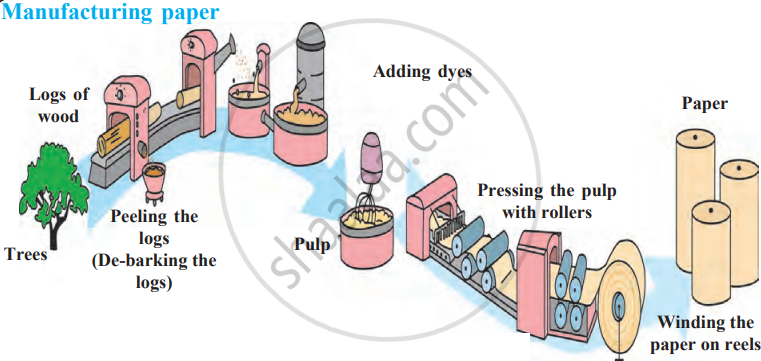
The process of manufacturing paper
Production of substances:
- Rubber
- Paper
- Synthetic fibres or threads
- Nylon
- Rayon
- Dacron, Terylene, Terene
Maharashtra State Board: Class 6
The Importance of Using Paper Wisely:
- Since paper comes from trees, using less paper means saving more trees. This is important for the environment.
- Don’t tear out blank pages in your notebooks. Use the blank sides of printed papers like advertisements, envelopes, and calendars for notes or crafts.
- Help and support those who collect and recycle paper. This process turns used paper back into usable paper again, reducing waste.
- Using a pencil and slate for practice can reduce your use of paper.
