Topics
Heredity and Evolution
- Heredity
- Transcription
- Translation
- Translocation
- Mutations
- Evolution
- Evidences of Evolution > Morphological Evidences
- Evidences of Evolution > Anatomical Evidences
- Evidences of Evolution > Vestigial Organs
- Evidences of Evolution > Palaeontological Evidences
- Evidences of Evolution > Connecting Links
- Evidences of Evolution > Embryological Evidences
- Darwin’s Theory of Natural Selection (Darwinism)
- Lamarck’s Theory of Evolution (Lamarckism)
- Speciation
- Human Evolution
- Human Ancestors
- Homo Sapiens Sapiens (Modern Man)
Life Processes in Living Organisms Part -1
- Life Processes in Living Organisms
- Living Organisms and Energy Production
- Glycolysis
- Tricarboxylic Acid Cycle (Citric Acid Cycle or Kreb’s Cycle)
- Phases of Respiration: Electron Transport Chain (Electron Transfer System)
- Production of ATP
- Cellular Respiration
- Energy From Different Food Components
- Cell Division: an Essential Life Process
- Mitosis > Karyokinesis (Division of Nucleus)
- Mitosis > Cytokinesis (Division of Cytoplasm)
- Significance of Mitosis
- Meiosis: Reduction Division
- Stages of Meiosis: Meiosis I
- Stages of Meiosis: Meiosis II
- Significance of Meiosis
- Mitosis Vs Meiosis
Life Processes in Living Organisms Part - 2
- Reproduction
- Asexual Reproduction
- Asexual Reproduction in Unicellular Organisms > Binary Fission
- Binary Fission > Simple Binary Fission
- Binary Fission > Transverse Binary Fission
- Binary Fission > Longitudinal Binary Fission
- Asexual Reproduction in Unicellular Organisms > Multiple Fission
- Asexual Reproduction in Unicellular Organisms > Budding
- Asexual Reproduction in Multicellular Organisms > Fragmentation
- Asexual Reproduction in Multicellular Organisms > Regeneration
- Asexual Reproduction in Multicellular Organisms > Budding
- Vegetative Reproduction or Vegetative Propagation
- Asexual Reproduction in Multicellular Organisms > Spore Formation
- Sexual Reproduction
- Sexual Reproduction in Plants
- Double Fertilization and Triple Fusion
- Pollination
- Seed Germination
- Human Reproduction
- The Male Reproductive System
- The Female Reproductive System
- Gametogenesis
- Fertilization in Humans
- Implantation in Human
- Pregnancy and Embryonic Development
- Parturition (Birth) in Human
- Lactation in Human
- Sex Determination in Humans
- Menstrual Cycle (Ovarian Cycle)
- Major Events of Menstrual Cycle
- In Vitro Fertilization (IVF)
- Surrogacy
- Sperm Bank/ Semen Bank
- The Twins
- Concept of Reproductive Health
- Population Explosion in India
Environmental Management
Towards Green Energy
- Energy and Use of Energy
- Generation of Electrical Energy
- Power Plant Based on Thermal Energy
- Power Plants Based on Nuclear Energy
- Power Plants Based on Natural Gas
- Electric Energy Generation and Environment
- Electricity Generation using Hydroelectric Energy
- Electricity Generation using Wind Energy
- Electricity Generation using Solar Energy
- Solar Photovoltaic Cell
- Solar Thermal Power Plant
Animal Classification
- Classification of Living Organisms
- History of Animal Classification
- Traditional Method of Animal Classification
- Conventional System of Animal Classification
- Criteria for New System of Classification > Grades of Organization
- Criteria for New System of Classification > Body Symmetry
- Criteria for New System of Classification > Germ Layers
- Criteria for New System of Classification > Body Cavity (Coelom)
- Criteria for New System of Classification > Body Segmentation
- Phylum: Porifera
- Phylum: Cnidaria/Coelenterata
- Phylum: Platyhelminthes
- Phylum: Aschelminthes
- Phylum: Annelida
- Phylum: Arthropoda
- Phylum: Mollusca
- Phylum: Echinodermata
- Phylum: Hemichordata
- Phylum: Chordata
- Subphylum: Urochordata
- Subphylum: Cephalochordata
- Subphylum: Vertebrata/Craniata
- Subphylum: Vertebrata/Craniata > Class: Cyclostomata
- Subphylum: Vertebrata/Craniata > Class: Pisces
- Subphylum: Vertebrata/Craniata > Class: Amphibia
- Subphylum: Vertebrata/Craniata > Class: Reptilia
- Subphylum: Vertebrata/Craniata > Class: Aves
- Subphylum: Vertebrata/Craniata > Class: Mammalia
Introduction to Microbiology
- Applied and Industrial Microbiology
- Microbial Role in Dairy Products
- Probiotics
- Yeast and Microbes in Bread Making
- Vinegar Production
- Microbial Enzymes
- Antibiotics
- Microbes and Fuels
- Bio-fuel
- Microbial Pollution Control
- Sewage Management
- Clean Technology
- Microbes and Farming
Cell Biology and Biotechnology
- Cell Biology (Cytology)
- Stem Cells
- Stem Cell Research
- Organ Transplantation
- Organ and Body Donation
- Concept of Biotechnology
- Crop Biotechnology > Hybrid Seeds
- Crop Biotechnology > Genetically Modified Organisms (GMOs)
- Crop Biotechnology > Biofertilizers
- Animal Husbandry (Livestock)
- Human Health
- Vaccination and Immunization
- Edible Vaccines
- Treatment
- Interferons
- Gene Therapy
- Cloning
- Industrial Products/White Biotechnology
- Environment and Biotechnology
- Food Biotechnology
- DNA Fingerprinting
- Green Revolution
- White Revolution
- Blue Revolution
- Fertilizers
- Insecticides
- Types of Farming in India > Organic Farming
- Animal Husbandry (Livestock) > Apiculture (Bee Farming)
- Cultivation of Medicinal Plants
- Processing and Preservation of Fruits
Social Health
Disaster Management
Life's Internal Secrets
- Autotrophic Plants
- Heterotrophic Plants
- Human Digestive System
- Nutrition in Plants
- Transport
The Regulators of Life
The Life Cycle
Mapping Our Genes
Understanding Metals and Non-Metals
Striving for Better Environment 2
- Use of Efficient and Eco-friendly Technology
- Sustainable Use of Resources
- Enforcement of Acts, Laws and Policies
Amazing World of Carbon Compounds
Maharashtra State Board: Class 6, 10
Definition: Disaster
A sudden event that causes large-scale damage to life, property and social aspects of a nation or society is called a disaster.
Maharashtra State Board: Class 6
Examples of Disasters:
- Landslide in Malin (July 2014): In the village of Malin, located in the Pune district, a landslide buried the entire village in a few minutes. Many people lost their lives as they were buried under soil and stones.
- Floods in Tamil Nadu (November 2015): Heavy rains caused flooding in Tamil Nadu, which resulted in many deaths and significant damage to property.
- Earthquake in Killari (1993): A powerful earthquake struck Killari in Latur district, leading to the deaths of many people.
- Mumbai Deluge (July 2005): Heavy rains caused massive flooding in Mumbai, leading to a great loss of life and property.
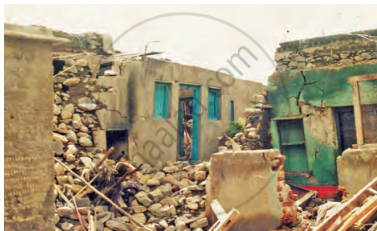
Effects of the earthquake at Killari
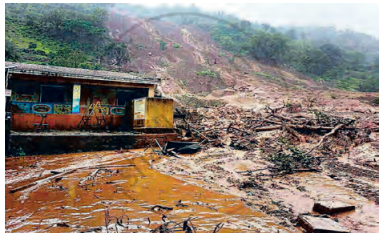
The disaster at Malin village
Maharashtra State Board: Class 6
Reasons Behind the Occurrence of Disasters:
- Floods: Heavy rains can cause rivers and lakes to overflow, leading to floods that damage homes and fields.
- Earthquakes: The shaking of the earth's surface due to movement underground can destroy buildings and roads.
- Lightning and Volcanic Eruptions: Sudden natural events, such as lightning strikes or volcanoes erupting, can cause fires and destroy areas.
- Forest Fires: Dry conditions, lightning, or human activities can cause large fires that spread rapidly and destroy forests.
- Human Activities: Human activities such as overpopulation, irregular construction, and ecological imbalance can also cause disasters.
- Terrorism and Crimes: Man-made disasters, like bomb explosions, riots, and accidents, can cause great harm to people and property.
Related QuestionsVIEW ALL [5]
Given below is a list of measures taken for disaster. Write whether they are pre-disaster or post-disaster and structural or non-structural. Also, write the name of the disaster for which they are used. Complete the table.
| Sr. No. | Measures | Pre-disaster/ Post-disaster | Structural/ Nonstructural | Disaster/(s) to which they are applicable |
| 1. | Conducting mock drills. | Pre-disaster | Non-structural | Earthquake, Landslides, Fire |
| 2. | Discussions about disaster risks and community problems and solutions. | |||
| 3. | Using art, documentaries, music, and drama to portray the impact of disasters on communities | |||
| 4. | Inviting emergency services personnel to provide lectures/ demonstrations. | |||
| 5. | Making booklets on disaster-related information. | |||
| 6. | Retrofit old buildings | |||
| 7. | Constructing shelters and evacuation chambers. | |||
| 8. | Making a change in land use policy regarding the construction of houses in low-lying areas. | |||
| 9. | Constructing buildings and houses using disaster-resistant material, designed to comply with relevant BIS (Bureau of Indian Standards) codes. | |||
| 10. | Constructing proper drains. | |||
| 11. | Carrying out plantation activities. | |||
| 12. | Regular disaster-related activities through radio, TV newspapers, etc. | |||
| 13. | Using satellites for early warning. | |||
| 14. | Evacuation routes in disaster management plans should be delineated |
Read about the following disasters which have occurred across the world and answer the following questions.
| Major Disasters |
|||
| Year | Disaster | Location | No. of deaths/loss incurred (approx.) |
| 1920 | Earthquake | China | 2,35,000 |
| 1923 | Earthquake | Japan | 1,42,000 |
| 1970 | Bhola Cyclone | India and Bangladesh | 5,00,000 |
| 1984 | Release of gas Methyl Isocyanate | Bhopal, India | 10,000; 5.5lakh affected |
| 1985 | Ruiz Volcanic Eruption | Colombia | 25,000 |
| 1994 | Landslide | Varandha Ghat, Maharashtra, India | 20; Breaching of ghat road, Konkan Coast damaged to the extent of 1 km at several places |
| 1995 | Rail accident | Firozabad, India | 400 |
| 1999 | Cyclone | Odisha, India | 10,000 |
| 2004 | Tsunami | India, Indonesia, Sri Lanka | 2,50,000 |
| 2005 | Earthquake | India and Pakistan | 80,000 |
| 2005 | Flash Floods | Mumbai, India | 1100 |
| 2014 | Hailstorm | Maharashtra, India | Affected many standing crops, 2700 farm animals dead |
| 2019 | Cyclone Fani | Odisha, India | 89 |
- Classify these disasters into natural and man-made disasters.
- Which of these disasters occurred due to climatic conditions?
- Which of these disasters occurred due to geological causes?
- Can you relate the location of a disaster with its cause?
- Besides the number of deaths, what other losses might be occurring after the disasters?
- Comparing the cyclones of 1999 and 2019, can you think of the reasons behind the reduction in the number of deaths?
- Which of these disasters can be predicted in advance?
- Of those disasters for which prediction can be made, can the people be evacuated from the area?
- Why do some people get affected by the disaster in specific regions?
