Topics
Population : Part - 1
- Distribution of Population in India
- Population Distribution in the World
- Factors Influencing the Distribution of the Population
- Geographical Factors Affecting Population Distribution - Physical Factors
- Geographical Factors Affecting Population Distribution - Human Factors
- Components of Population Change
- Trends in Population Growth
- Overview of Population : Part - 1
Population : Part - 2
- Population Composition
- Migration
- Reasons for Migration
- Impact of Migration on Population
- Overview of Population : Part - 2
Human Settlements and Land Use
- Human Settlements
- Types of Settlement
- Types of Urban Settlements
- Land Use
- Land Use Classification
- Land Use in Rural Area
- Land Use in Urban Areas
- Rural-urban Fringe
- Suburbs
- Overview of Human Settlements and Land Use
Primary Economic Activities
- Primary Occupations
- Hunting
- Gathering
- Lumbering
- Fishing
- Mining
- Agriculture
- Overview of Primary Economic Activities
Secondary Economic Activities
- Introduction to Secondary Activities
- Physical Factors Affecting Secondary Economic Activities
- Economic Factors Affecting Secondary Economic Activities
- Political Factors Affecting Secondary Economic Activities
- Other Factors Affecting Secondary Economic Activities
- Footloose Industries
- Major Industrial Regions
- Major Industrial Regions
- Classification of Industries
- Overview of Secondary Economic Activities
Tertiary Economic Activities
- Classification of Tertiary Economic Activities
- Transport
- Concept of Trade
- Importance of Transport in Trade
- Tourism
- Communication
- Overview of Tertiary Economic Activities
Region and Regional Development
- Regions
- Types of Regions
- Regional Development
- Factors Affecting Regional Development
- Physical Factors and Regional Development
- Population and Regional Development
- Land Use and Regional Development
- Primary, Secondary, and Tertiary Economic Activities and Regional Development
- Regional Imbalance
- Causes of Regional Imbalances in India
- Strategies to Reduce Regional Imbalance
- Overview of Region and Regional Development
Geography : Nature and Scope
- Nature of Geography as a Discipline
- Scope of Geography
- Latest Trends in Geography
- Overview of Geography : Nature and Scope
Notes
TRANSPORTATION IN HUMAN BEINGS:-
The process of supplying food, oxygen, carbon dioxide through out the body is performed by the circulatory system.
Blood consists of a fluid medium called plasma in which the cells are suspended. Plasma transports food, carbon dioxide and nitrogenous wastes in dissolved form.
Oxygen is carried by the red blood corpuscles. Many other substances like salts, are also transported by the blood.
We thus need a pumping organ to push blood around the body, a network of tubes to reach all the tissues and a system in place to ensure that this network can be repaired if damaged.
The circulatory system consists of:-
(i) The Heart
(ii) Arteries and Veins
(iii)Blood and Lymph
The heart:-
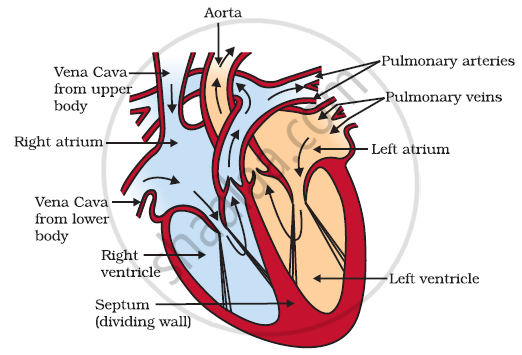
It is a muscular organ which is as big as our fist. Because both oxygen and carbon dioxide have to be transported by the blood, the heart has different chambers to prevent the oxygen-rich blood from mixing with the blood containing carbon dioxide.
The carbon dioxide-rich blood has to reach the lungs for the carbon dioxide to be removed, and the oxygenated blood from the lungs has to be brought back to the heart.
This oxygen-rich blood is then pumped to the rest of the body.
- The lungs supply oxygen-rich blood to the left atrium of the heart
- The left atrium relaxes when it is collecting the blood and contracts when blood is transferred to the left ventricle. The left ventricle expands when it receives blood.
- The blood is pumped out of the body when the muscles of the left ventricle contract.
- Deoxygenated blood comes from the body to the upper chamber on the right i.e., the right atrium when it expands
- The corresponding lower chamber i.e., the right ventricle expands when right atrium contracts. It transfers the blood to the right ventricle which in turn pumps it to the lungs for oxygenation
- Right ventricles have thicker muscular walls so that they pump blood into various organs
- Valves ensure that blood does not flow backwards when the atria or ventricles contract
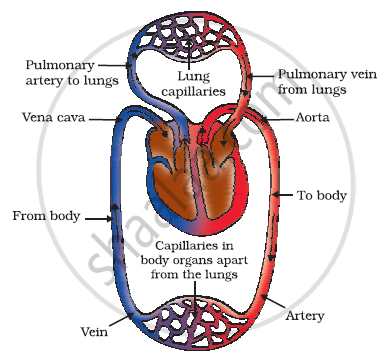
Thus, blood goes only once through the heart in the fish during one cycle of passage through the body. On the other hand, it goes through the heart twice during each cycle in other vertebrates. This is known as double circulation.
ARTERIES:-
- These are thick-walled blood vessels which carry oxygenated blood from the heart to different organs.
-
Pulmonary arteries are exceptions because they carry deoxygenated blood from the heart to lungs, where oxygenation of blood takes place.
VEINS:-
-
These are thin-walled blood vessels which carry deoxygenated blood from different organs to the heart, pulmonary veins are exceptions because they carry oxygenated blood from lungs to the heart.
-
Valves are present in veins to prevent back flow of blood.
BLOOD:-
Blood is a connective tissue which is fluid in nature. The solid components of Blood(Blood corpuscles) are:
-
RBC(Red Blood Cells) – It carries oxygen and carbon dioxide and also contains Haemoglobin which imparts red colour to the blood
-
WBC(White Blood Cells) – It provides body defence by killing the germs and produces antibodies
-
Blood Platelets – During any injury, it helps in blood clotting
Liquid components (Plasma) – It is a yellow coloured fluid which is 90% water and 10% organic substances
LYMPH:- There is another type of fluid also involved in transportation. This is called lymph or tissue fluid.
-
Through the pores present in the walls of capillaries some amount of plasma, proteins and blood cells escape into intercellular spaces in the tissues to form the tissue fluid or lymph.
-
It is similar to the plasma of blood but colourless and contains less protein.
-
Lymph carries digested and absorbed fat from intestine and drains excess fluid from extra cellular space back into the blood.
TRANSPORTATION IN PLANTS:-
- Plants take in simple compounds such as CO2 and photosynthesise energy stored in their chlorophyll containing organs, namely leaves.
- For plants, the soil is the nearest and richest source of raw materials like nitrogen, phosphorus and other minerals. The absorption of these substances therefore occurs through the roots.
- Plant transport systems will move energy stores from leaves and raw materials from roots. These two pathways are constructed as independently organised conducting tubes.
- The xylem moves water and minerals obtained from the soil. The other, phloem transports products of photosynthesis from the leaves where they are synthesised to other parts of the plant.
TRANSPORTATION OF WATER:-
- In xylem tissue, vessels and tracheids of the roots, stems and leaves are interconnected to form a continuous system of water-conducting channels reaching all parts of the plant.
- At the roots, cells in contact with the soil actively take up ions. This creates a difference in the concentration of these ions between the root and the soil. Water, therefore, moves into the root from the soil to eliminate this difference.
- Provided that the plant has an adequate supply of water, the water which is lost through the stomata is replaced by water from the xylem vessels in the leaf.
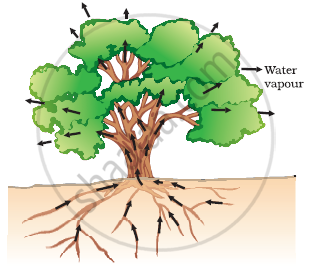
- Evaporation of water molecules from the cells of a leaf creates a suction which pulls water from the xylem cells of roots. The loss of water in the form of vapour from the aerial parts of the plant is known as transpiration.
ADVANTAGES OF TRANSPIRATION:-
- Transpiration helps in the absorption and upward movement of water and minerals dissolved in it from roots to the leaves.
-
It helps in temperature regulation.
-
The effect of root pressure in transport of water is more important at night. During the day when the stomata are open, the transpiration pull becomes the major driving force in the movement of water in the xylem.
TRANSPORTATION OF FOOD:-
- This transport of soluble products of photosynthesis is called translocation and it occurs in the part of the vascular tissue known as phloem
- The phloem transports amino acids and other substances. These substances are especially delivered to the storage organs of roots, fruits and seeds and to growing organs.
- The translocation of food and other substances takes place in the sieve tubes with the help of adjacent companion cells both in upward and downward directions.
- The translocation in phloem is achieved by utilising energy. Material like sucrose is transferred into phloem tissue using energy from ATP.
- This increases the osmotic pressure of the tissue causing water to move into it. This pressure moves the material in the phloem to tissues which have less pressure. This allows the phloem to move material according to the plant’s needs.
Introduction
Transport is the movement of people, goods, or animals from one place to another. It plays an essential role in our daily lives and is essential for connecting different parts of the world. There are three basic modes of transportation: land, water, and air. Transportation is important for the global movement of people and goods.
Mode of Transport:
A mode of transport is a system designed to transport people or goods. Human inventions have enabled us to travel by air, water, and land. Vehicles can conquer various terrains, and we have even sent men to walk on the Moon and may send them to Mars soon.
Means of Transport
According to the inventions and vehicles used to travel or carry things, modes of transport can be divided into three categories. Here are the types of transportation lists with examples.
1. Land Transport: It involves vehicles that travel on land.
For example: cars, buses, trains, motorcycles, bicycles, and trucks.
| Advantages | Disadvantages |
| Widely available and flexible. | Traffic congestion. |
| Suitable for short and medium distances. | Environmental pollution. |
2. Water Transport: It involves vehicles that travel on water bodies like rivers, lakes, seas, and oceans.
For example: ships, boats, ferries, submarines, and canoes.
| Advantages | Disadvantages |
| Efficient for long-distance transport of bulky goods. | Slower than air and land transport. |
| Lower fuel consumption. | Limited to areas with water access. |
3. Air Transport: It involves vehicles that travel through the air.
For example: aeroplanes, helicopters, hot air balloons, and jets.
| Advantages | Disadvantages |
| Fastest mode of transport. | Expensive |
| It is ideal for international travel and quick deliveries. | Affected by weather conditions |