Topics
Heredity and Evolution
- Heredity
- Transcription
- Translation
- Translocation
- Mutations
- Evolution
- Evidences of Evolution > Morphological Evidences
- Evidences of Evolution > Anatomical Evidences
- Evidences of Evolution > Vestigial Organs
- Evidences of Evolution > Palaeontological Evidences
- Evidences of Evolution > Connecting Links
- Evidences of Evolution > Embryological Evidences
- Darwin’s Theory of Natural Selection (Darwinism)
- Lamarck’s Theory of Evolution (Lamarckism)
- Speciation
- Human Evolution
- Human Ancestors
- Homo Sapiens Sapiens (Modern Man)
Life Processes in Living Organisms Part -1
- Life Processes in Living Organisms
- Living Organisms and Energy Production
- Glycolysis
- Tricarboxylic Acid Cycle (Citric Acid Cycle or Kreb’s Cycle)
- Phases of Respiration: Electron Transport Chain (Electron Transfer System)
- Production of ATP
- Cellular Respiration
- Energy From Different Food Components
- Cell Division: an Essential Life Process
- Mitosis > Karyokinesis (Division of Nucleus)
- Mitosis > Cytokinesis (Division of Cytoplasm)
- Significance of Mitosis
- Meiosis: Reduction Division
- Stages of Meiosis: Meiosis I
- Stages of Meiosis: Meiosis II
- Significance of Meiosis
- Mitosis Vs Meiosis
Life Processes in Living Organisms Part - 2
- Reproduction
- Asexual Reproduction
- Asexual Reproduction in Unicellular Organisms > Binary Fission
- Binary Fission > Simple Binary Fission
- Binary Fission > Transverse Binary Fission
- Binary Fission > Longitudinal Binary Fission
- Asexual Reproduction in Unicellular Organisms > Multiple Fission
- Asexual Reproduction in Unicellular Organisms > Budding
- Asexual Reproduction in Multicellular Organisms > Fragmentation
- Asexual Reproduction in Multicellular Organisms > Regeneration
- Asexual Reproduction in Multicellular Organisms > Budding
- Vegetative Reproduction or Vegetative Propagation
- Asexual Reproduction in Multicellular Organisms > Spore Formation
- Sexual Reproduction
- Sexual Reproduction in Plants
- Double Fertilization and Triple Fusion
- Pollination
- Seed Germination
- Human Reproduction
- The Male Reproductive System
- The Female Reproductive System
- Gametogenesis
- Fertilization in Humans
- Implantation in Human
- Pregnancy and Embryonic Development
- Parturition (Birth) in Human
- Lactation in Human
- Sex Determination in Humans
- Menstrual Cycle (Ovarian Cycle)
- Major Events of Menstrual Cycle
- In Vitro Fertilization (IVF)
- Surrogacy
- Sperm Bank/ Semen Bank
- The Twins
- Concept of Reproductive Health
- Population Explosion in India
Environmental Management
Towards Green Energy
- Energy and Use of Energy
- Generation of Electrical Energy
- Power Plant Based on Thermal Energy
- Power Plants Based on Nuclear Energy
- Power Plants Based on Natural Gas
- Electric Energy Generation and Environment
- Electricity Generation using Hydroelectric Energy
- Electricity Generation using Wind Energy
- Electricity Generation using Solar Energy
- Solar Photovoltaic Cell
- Solar Thermal Power Plant
Animal Classification
- Classification of Living Organisms
- History of Animal Classification
- Traditional Method of Animal Classification
- Conventional System of Animal Classification
- Criteria for New System of Classification > Grades of Organization
- Criteria for New System of Classification > Body Symmetry
- Criteria for New System of Classification > Germ Layers
- Criteria for New System of Classification > Body Cavity (Coelom)
- Criteria for New System of Classification > Body Segmentation
- Phylum: Porifera
- Phylum: Cnidaria/Coelenterata
- Phylum: Platyhelminthes
- Phylum: Aschelminthes
- Phylum: Annelida
- Phylum: Arthropoda
- Phylum: Mollusca
- Phylum: Echinodermata
- Phylum: Hemichordata
- Phylum: Chordata
- Subphylum: Urochordata
- Subphylum: Cephalochordata
- Subphylum: Vertebrata/Craniata
- Subphylum: Vertebrata/Craniata > Class: Cyclostomata
- Subphylum: Vertebrata/Craniata > Class: Pisces
- Subphylum: Vertebrata/Craniata > Class: Amphibia
- Subphylum: Vertebrata/Craniata > Class: Reptilia
- Subphylum: Vertebrata/Craniata > Class: Aves
- Subphylum: Vertebrata/Craniata > Class: Mammalia
Introduction to Microbiology
- Applied and Industrial Microbiology
- Microbial Role in Dairy Products
- Probiotics
- Yeast and Microbes in Bread Making
- Vinegar Production
- Microbial Enzymes
- Antibiotics
- Microbes and Fuels
- Bio-fuel
- Microbial Pollution Control
- Sewage Management
- Clean Technology
- Microbes and Farming
Cell Biology and Biotechnology
- Cell Biology (Cytology)
- Stem Cells
- Stem Cell Research
- Organ Transplantation
- Organ and Body Donation
- Concept of Biotechnology
- Crop Biotechnology > Hybrid Seeds
- Crop Biotechnology > Genetically Modified Organisms (GMOs)
- Crop Biotechnology > Biofertilizers
- Animal Husbandry (Livestock)
- Human Health
- Vaccination and Immunization
- Edible Vaccines
- Treatment
- Interferons
- Gene Therapy
- Cloning
- Industrial Products/White Biotechnology
- Environment and Biotechnology
- Food Biotechnology
- DNA Fingerprinting
- Green Revolution
- White Revolution
- Blue Revolution
- Fertilizers
- Insecticides
- Types of Farming in India > Organic Farming
- Animal Husbandry (Livestock) > Apiculture (Bee Farming)
- Cultivation of Medicinal Plants
- Processing and Preservation of Fruits
Social Health
Disaster Management
Life's Internal Secrets
- Autotrophic Plants
- Heterotrophic Plants
- Human Digestive System
- Nutrition in Plants
- Transport
The Regulators of Life
The Life Cycle
Mapping Our Genes
Understanding Metals and Non-Metals
Striving for Better Environment 2
- Use of Efficient and Eco-friendly Technology
- Sustainable Use of Resources
- Enforcement of Acts, Laws and Policies
Amazing World of Carbon Compounds
- Key Points: Electricity Generation using Wind Energy
Introduction:
Wind energy comes from the movement of air, which we call wind. Wind is produced because the sun heats the earth's surface unevenly. Some places get hotter than others, which causes a difference in air pressure. Hot air rises, and cooler air moves in to take its place. This movement of air from high-pressure areas to low-pressure areas is what we call wind.
We can use this wind to produce energy. When wind blows, it can turn the blades of a wind turbine. This movement creates mechanical energy. A generator attached to the turbine then converts this mechanical energy into electrical energy, which we can use to power homes, schools, and factories.
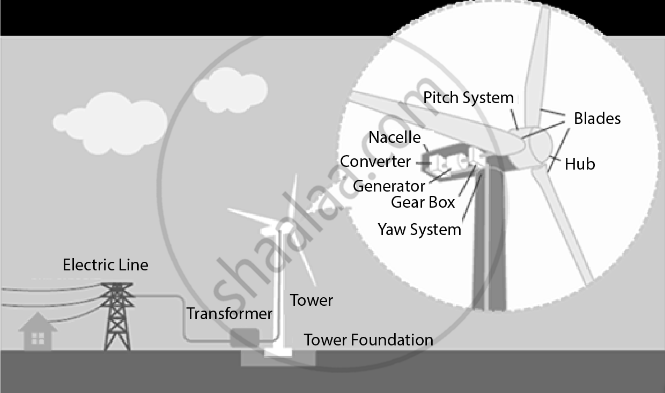
Electricity is Generated in a Turbine
Wind Turbine:
- A wind turbine is a machine that turns wind energy into electricity.
- When the wind blows, it turns the blades of the wind turbine.
- As the blades spin, they produce mechanical energy (the energy of movement).
- The turbine is connected to a generator, which takes the mechanical energy from the blades and turns it into electrical energy.
A wind turbine works similarly to the fan in your home but in reverse. In a fan, electrical energy is turned into mechanical energy to spin the blades and move the air. In a wind turbine, mechanical energy from the wind is turned into electrical energy.
Wind Power:
Wind power is the electricity produced by wind turbines. It is a type of renewable energy, which means it comes from a natural source (the wind) and can be used again and again without running out. Other renewable energy sources include solar energy (from the sun) and hydroelectric energy (from moving water).
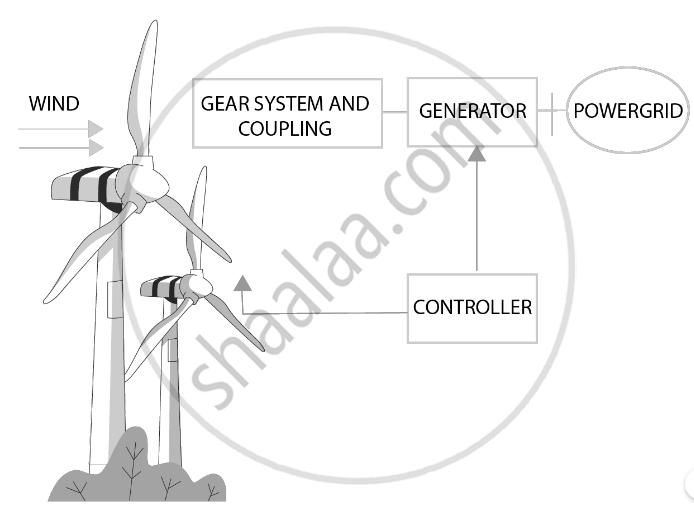
Complete Connection of Windmills to Generate Electricity
Uses of Wind Energy:
- Generating Electricity: The most common use of wind energy is to produce electricity. As we discussed, wind turbines convert the energy from moving air into electrical energy, which powers homes, schools, and businesses.
- Milling Grains: In the past, wind energy was used to grind grains into flour. Windmills had large blades connected to millstones. As the wind turned the blades, the millstones ground the grains.
- Pumping Water: Wind energy can also be used to pump water from the ground. Special machines called wind pumps use wind energy to move water upward, which can be helpful for farming or getting drinking water.
Key Points: Electricity Generation using Wind Energy
- Working Principle: Wind energy uses the kinetic energy of moving air to rotate the blades of a wind turbine.
- Electricity Generation: The rotating turbine drives a generator, converting kinetic energy into electrical energy.
- Energy Transformation:
Kinetic energy in wind → Kinetic energy in turbine → Electrical energy. - Clean Energy: Wind energy is a clean and renewable source with no fuel combustion or air pollution.
- Limitations: Wind turbines require sufficient wind velocity, which is not available everywhere, limiting widespread use.
