Topics
Matter
- Matter (Substance)
- Composition of Matter
- Characteristics of Particles (Molecules) of Matter
- States of Matter
- The Solid State
- The Liquid State
- The Gaseous State
- Change of State
- Concept of Melting (Fusion)
- Vaporisation or Boiling
Physical Quantities and Measurement
- Measurements
- Unit and Its Types
- Unit Systems
- Physical Quantities
- Rules and Conventions for Writing SI Units and Their Symbols
- The International System of Units (SI)
- Unit Prefixes
- Measurement of Length
- Devices for Measuring Length
- Measurement of Mass
- Devices for Measuring Mass
- Measurement of Time
- Devices for Measuring Time
- The Temperature and a Thermometer
- Measuring Temperature
- Area and It’s Unit
- Measurement of Area
Force
- Force - Push or Pull
- Effect of Force
- Types of Forces>Contact and Non-Contact Forces
- Force of Friction
- Effects of Friction
- Types of Friction>Rolling Friction
- Increasing and Reducing Friction
Simple Machines
- Concept of Work
- Concept of Energy
- Concept of Machines
- Principle of a Machine
- Efficiency of a Machine
- Simple Machines
- Mechanical Advantage
- Levers
- Types of Levers
- Pulley
- A Wheel and Axle
- An Inclined Plane
- A Wedge
- Screw
- Care of Machines
- Machines (Numerical)
Light
Magnetism
- Discovery of Magnets
- Classification of Magnets
- Magnetic and Non-magnetic Materials
- Magnet
- Magnetic Properties of Materials
- Concept of Magnetic Field
- Concept of Magnetism
- Making a Magnet
- Electromagnet
- Making of an Electromagnet
- Uses of Electromagnet
- Care and Storage of Magnets
- Demagnetization of a Magnet
Maharashtra State Board: Class 6
Care and Storage of Magnets:
Magnets can lose their magnetic properties when they are not handled properly. Exposure to heat, sudden impacts like drops or knocks, or being broken into pieces can all damage a magnet.
- Never expose magnets to heat (like fire or hot surfaces). Heat can demagnetise a magnet, which means it will lose its magnetic strength.
- Avoid dropping, hitting, or throwing magnets. Rough handling can alter the alignment of the magnetic particles inside the magnet, weakening its magnetic force.
- When storing magnets, it's helpful to place a piece of soft iron with them. This soft iron piece is known as a magnet keeper.
- The keeper helps to maintain the strength of the magnet by completing a magnetic circuit, which reduces the chance of the magnet getting demagnetised.
- It’s also important to keep magnets away from electronic devices because their magnetic fields can interfere with or damage electronic components.
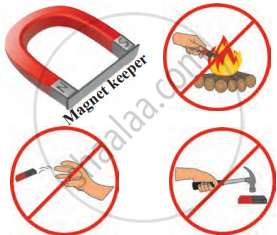
Guarding a magnet
