Topics
Units and Measurements
- The International System of Units (SI)
- Measurement of Length
- Accuracy, Precision and Least Count of Measuring Instruments
- Errors in Measurements>Systematic Errors
- Significant Figures
- Dimensions of Physical Quantities
- Dimensional Formulae and Dimensional Equations
- Dimensional Analysis and Its Applications
- Need for Measurement
- Units of Measurement
- Derived Quantities and Units
- Length, Mass and Time Measurements
- Introduction of Units and Measurements
Physical World and Measurement
Physical World
Kinematics
Motion in a Straight Line
- Position, Path Length and Displacement
- Average Velocity
- Instantaneous Velocity
- Instantaneous Speed
- Kinematic Equations for Uniformly Accelerated Motion
- Acceleration in Linear Motion
- Elementary Concept of Differentiation and Integration for Describing Motion
- Uniform and Non-uniform Motion
- Uniformly Accelerated Motion
- Position-time, Velocity-time and Acceleration-time Graphs
- Position - Time Graph
- Relations for Uniformly Accelerated Motion (Graphical Treatment)
- Introduction of Motion in One Dimension
- Motion in a Straight Line
Laws of Motion
Motion in a Plane
- Vector Analysis
- Multiplication of Vectors by a Real Number or Scalar
- Vector Operations>Addition and Subtraction of Vectors
- Resolution of Vectors
- Vector Addition – Analytical Method
- Motion in a Plane
- Equations of Motion in a Plane with Constant Acceleration
- Uniform Circular Motion (UCM)
- Vector
- Instantaneous Velocity
- Rectangular Components
- Scalar (Dot) and Vector (Cross) Product of Vectors
- Relative Velocity in Two Dimensions
- Cases of Uniform Velocity
- Cases of Uniform Acceleration Projectile Motion
- Acceleration in Linear Motion
- Angular Velocity
- Introduction of Motion in One Dimension
Laws of Motion
- Aristotle’s Fallacy
- The Law of Inertia
- Newton's First Law of Motion
- Newton’s Second Law of Motion
- Newton's Third Law of Motion
- Conservation of Momentum
- Equilibrium of a Particle
- Common Forces in Mechanics
- Circular Motion and Its Characteristics
- Solving Problems in Mechanics
- Types of Friction>Kinetic Friction
- Laws of Friction
- Inertia
- Concept of Force
- Dynamics of Uniform Circular Motion - Centripetal Force
- Examples of Circular Motion (Vehicle on a Level Circular Road, Vehicle on a Banked Road)
- Lubrication - (Laws of Motion)
- Law of Conservation of Linear Momentum and Its Applications
- Types of Friction>Rolling Friction
- Introduction of Motion in One Dimension
Work, Energy and Power
Motion of System of Particles and Rigid Body
Work, Energy and Power
- Introduction of Work, Energy and Power
- Notions of Work and Kinetic Energy: the Work-energy Theorem
- Mechanical Energy > Kinetic Energy (K)
- Types of Forces>Work Done by a Variable Force
- Concept of Work
- Mechanical Energy > Potential Energy (U)
- Conservation of Mechanical Energy
- Potential Energy of a Spring
- Concept of Power
- Collisions
- Types of Forces>Conservative and Non-Conservative Forces
System of Particles and Rotational Motion
- Motion - Rigid Body
- Centre of Mass>Mathematical Understanding of Centre of Mass
- Motion of Centre of Mass
- Linear Momentum of a System of Particles
- Angular Velocity and Its Relation with Linear Velocity
- Torque and Angular Momentum
- Equilibrium of Rigid Body
- Moment of Inertia
- Theorems of Perpendicular and Parallel Axes
- Kinematics of Rotational Motion About a Fixed Axis
- Dynamics of Rotational Motion About a Fixed Axis
- Angular Momentum in Case of Rotation About a Fixed Axis
- Rolling Motion
- Momentum Conservation and Centre of Mass Motion
- Centre of Mass of a Rigid Body
- Centre of Mass of a Uniform Rod
- Rigid Body Rotation
- Equations of Rotational Motion
- Comparison of Linear and Rotational Motions
- Values of Moments of Inertia for Simple Geometrical Objects (No Derivation)
Gravitation
Properties of Bulk Matter
Gravitation
- Kepler’s Laws
- Newton's Universal Law of Gravitation
- The Gravitational Constant
- Acceleration Due to Gravity of the Earth
- Acceleration Due to Gravity Below and Above the Earth's Surface
- Variation in the Acceleration>Variation in Gravity with Altitude
- Expression for Gravitational Potential Energy
- Escape Speed
- Earth Satellites
- Binding Energy of an Orbiting Satellite
- Geostationary and Polar Satellites
- Weightlessness
- Escape Velocity
- Orbital Velocity of a Satellite
Thermodynamics
Mechanical Properties of Solids
Mechanical Properties of Fluids
- Thrust and Pressure
- Pascal’s Law
- Variation of Pressure with Depth
- Atmospheric Pressure and Gauge Pressure
- Hydraulic Machines
- Streamline and Turbulent Flow
- Applications of Bernoulli’s Equation
- Viscous Force or Viscosity
- Reynold's Number
- Surface Tension
- Effect of Gravity on Fluid Pressure
- Terminal Velocity
- Critical Velocity
- Excess of Pressure Across a Curved Surface
- Introduction of Mechanical Properties of Fluids
- Archimedes' Principle
- Stoke's Law
- Continuous and Discontinuous Functions
- Torricelli's Law
Behaviour of Perfect Gases and Kinetic Theory of Gases
Oscillations and Waves
Thermal Properties of Matter
- Temperature and Heat
- Measurement of Temperature
- Absolute Zero and Absolute Temperature
- Thermal Expansion
- Specific Heat Capacity
- Calorimetry
- Latent Heat
- Conduction
- Convection
- Radiation
- Newton’s Law of Cooling
- Qualitative Ideas of Black Body Radiation
- Wien's Displacement Law
- Stefan's Law
- Anomalous Expansion of Water
- Liquids and Gases
- Thermal Expansion of Solids
- Green House Effect
Thermodynamics
- Thermal Equilibrium
- Measurement of Temperature
- Heat, Internal Energy and Work
- First Law of Thermodynamics
- Specific Heat Capacity
- Thermodynamic State Variables and Equation of State
- Thermodynamic Process
- Heat Engine
- Refrigerators and Heat Pumps
- Entropy and Second Law of Thermodynamics
- Reversible and Irreversible Processes
- Carnot Engine
Kinetic Theory
- Gases and Its Characteristics
- Equation of State of a Perfect Gas
- Work Done in Compressing a Gas
- Introduction of Kinetic Theory of an Ideal Gas
- Interpretation of Temperature in Kinetic Theory
- Law of Equipartition of Energy
- Specific Heat Capacities - Gases
- Mean Free Path
- Kinetic Theory of Gases - Concept of Pressure
- Assumptions of Kinetic Theory of Gases
- RMS Speed of Gas Molecules
- Degrees of Freedom
- Avogadro's Number
Oscillations
- Periodic and Oscillatory Motion
- Simple Harmonic Motion (S.H.M.)
- Simple Harmonic Motion and Uniform Circular Motion
- Velocity and Acceleration in Simple Harmonic Motion
- Force Law for Simple Harmonic Motion
- Energy in Simple Harmonic Motion
- Some Systems Executing Simple Harmonic Motion
- Damped Simple Harmonic Motion
- Forced Oscillations and Resonance
- Displacement as a Function of Time
- Periodic Functions
- Oscillations - Frequency
- Simple Pendulum
Waves
- Reflection of Transverse and Longitudinal Waves
- Displacement Relation for a Progressive Wave
- The Speed of a Travelling Wave
- Principle of Superposition of Waves
- Introduction of Reflection of Waves
- Standing Waves and Normal Modes
- Beats
- Doppler Effect
- Wave Motion
- Speed of Wave Motion
Notes
Kinematic Equations of Motion
If an object starts with velocity ”u” and after some time “t” its velocity changes to v, if the uniform acceleration is a and distance travelled in time (t) is s, then we obtain the following kinematic equations of uniformly accelerated motion.
First Equation Of Motion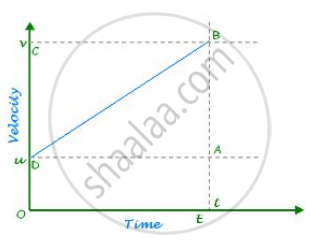
As shown in the graph above,
Let an object is moving with uniform acceleration
u = initial velocity of the object
v = final velocity of object
a = uniform acceleration
Let object reach point B after time (t) Now, from the graph
Slope= Acceleration(a)=change in velocity/time
Change in velocity = AB =`bar v-bar u`
Time = AD = t
`a=(bar v- bar u)/t`
Solving this we get the first equation of motion:
`bar v=bar u+a bar t`
Second Equation Of Motion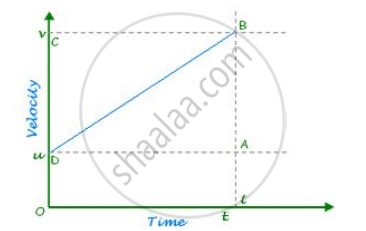
Consider an object starting with an initial velocity u and moving with uniform acceleration a as shown in the graph above. Distance covered by the object at the given time t is given by the area of the trapezium ABDOE. Let in the given time ‘t’, the displacement covered by the moving object ‘s’ is given by the area of a trapezium, ABDOE
Displacement (s) = Area of ABD + Area of ADOE
`1/2` × AB× AD+ AE ×OE, AB= dc= at
=`1/2` at× t+ ut
Hence, the second equation of motion is:
`bar s=bar ut +1/2 bar a t^2`
Third Equation Of Motion
Velocity time graph of a uniformly accelerated motion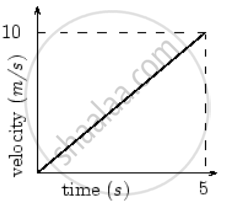
The velocity-time graph of a uniformly accelerated motion is a straight line graph inclining towards the time axis. If the object has positive constant acceleration, the graph slopes upward. In case the object has negative constant acceleration, the velocity-time graph will slope downward.
