Topics
Relations and Functions
Relations and Functions
Inverse Trigonometric Functions
Algebra
Calculus
Matrices
- Concept of Matrices
- Types of Matrices
- Equality of Matrices
- Operation on Matrices
- Multiplication of a Matrix by a Scalar
- Properties of Matrix Addition
- Properties of Matrix Multiplication
- Transpose of a Matrix
- Symmetric and Skew Symmetric Matrices
- Invertible Matrices
- Overview of Matrices
- Negative of Matrix
- Operation on Matrices
- Proof of the Uniqueness of Inverse
- Symmetric and Skew Symmetric Matrices
Vectors and Three-dimensional Geometry
Determinants
- Determinants of Matrix of Order One and Two
- Determinant of a Matrix of Order 3 × 3
- Minors and Co-factors
- Inverse of a Square Matrix by the Adjoint Method
- Applications of Determinants and Matrices
- Symmetric and Skew Symmetric Matrices
- Properties of Determinants
- Determinant of a Square Matrix
- Rule A=KB
- Overview of Determinants
- Geometric Interpretation of the Area of a Triangle
Continuity and Differentiability
- Continuous and Discontinuous Functions
- Algebra of Continuous Functions
- Concept of Differentiability
- Derivative of Composite Functions
- Derivatives of Implicit Functions
- Derivative of Inverse Function
- Exponential and Logarithmic Functions
- Logarithmic Differentiation
- Derivatives of Functions in Parametric Forms
- Second Order Derivative
- Derivative - Exponential and Log
- Proof Derivative X^n Sin Cos Tan
- Infinite Series
- Higher Order Derivative
- Mean Value Theorem
- Overview of Continuity and Differentiability
Linear Programming
Applications of Derivatives
- Introduction to Applications of Derivatives
- Rate of Change of Bodies or Quantities
- Increasing and Decreasing Functions
- Maxima and Minima
- Maximum and Minimum Values of a Function in a Closed Interval
- Simple Problems on Applications of Derivatives
- Graph of Maxima and Minima
- Approximations
- Tangents and Normals
- Overview of Applications of Derivatives
Probability
Sets
Integrals
- Introduction of Integrals
- Integration as an Inverse Process of Differentiation
- Some Properties of Indefinite Integral
- Methods of Integration> Integration by Substitution
- Integration Using Trigonometric Identities
- Integrals of Some Particular Functions
- Methods of Integration> Integration Using Partial Fraction
- Methods of Integration> Integration by Parts
- Fundamental Theorem of Integral Calculus
- Evaluation of Definite Integrals by Substitution
- Properties of Definite Integrals
- Definite Integrals
- Indefinite Integral Problems
- Comparison Between Differentiation and Integration
- Geometrical Interpretation of Indefinite Integrals
- Indefinite Integral by Inspection
- Definite Integral as the Limit of a Sum
- Evaluation of Simple Integrals of the Following Types and Problems
- Overview of Integrals
Applications of the Integrals
Differential Equations
- Differential Equations
- Order and Degree of a Differential Equation
- General and Particular Solutions of a Differential Equation
- Linear Differential Equations
- Homogeneous Differential Equations
- Solutions of Linear Differential Equation
- Equations in Variable Separable Form
- Formation of a Differential Equation Whose General Solution is Given
- Procedure to Form a Differential Equation that Will Represent a Given Family of Curves
- Overview of Differential Equations
Vectors
- Vector
- Basic Concepts of Vector Algebra
- Direction Ratios, Direction Cosine & Direction Angles
- Vector Operations>Addition and Subtraction of Vectors
- Properties of Vector Addition
- Vector Operations>Multiplication of a Vector by a Scalar
- Components of Vector
- Vector Joining Two Points
- Section Formula in Coordinate Geometry
- Vector (Or Cross) Product of Two Vectors
- Scalar (Or Dot) Product of Two Vectors
- Projection of a Vector on a Line
- Geometrical Interpretation of Scalar
- Scalar Triple Product
- Position Vector of a Point Dividing a Line Segment in a Given Ratio
- Magnitude and Direction of a Vector
- Vectors Examples and Solutions
- Introduction of Product of Two Vectors
- Overview of Vectors
Three - Dimensional Geometry
- Introduction of Three Dimensional Geometry
- Direction Cosines and Direction Ratios of a Line
- Relation Between Direction Ratio and Direction Cosines
- Equation of a Line in Space
- Angle Between Two Lines
- Shortest Distance Between Two Lines
- Three - Dimensional Geometry Examples and Solutions
- Equation of a Plane Passing Through Three Non Collinear Points
- Equations of Line in Different Forms
- Coplanarity of Two Lines
- Distance of a Point from a Plane
- Angle Between Line and a Plane
- Angle Between Two Planes
- Vector and Cartesian Equation of a Plane
- Equation of a Plane in Normal Form
- Equation of a Plane Perpendicular to a Given Vector and Passing Through a Given Point
- Plane Passing Through the Intersection of Two Given Planes
- Overview of Three Dimensional Geometry
Linear Programming
Probability
- Definition of Relation
- Domain
- Co-domain and Range of a Relation
Notes
Notes
There are some operations which when performed on two sets give rise to another set. We will now define certain operations on sets and examine their properties. Henceforth, we will refer all our sets as subsets of some universal set.
Definition
Given two non-empty sets P and Q. The cartesian product P × Q is the set of all ordered pairs of elements from P and Q, i.e., P × Q = { (p,q) : p ∈ P, q ∈ Q } If either P or Q is the null set, then P × Q will also be empty set, i.e., P × Q = Ø
Notes
Suppose A is a set of 2 colours and B is a set of 3 objects, i.e., A = {red, blue}and B = {b, c, s}, where b, c and s represent a particular bag, coat and shirt, respectively.
From the illustration given above we note that A × B = {(red,b), (red,c), (red,s), (blue,b), (blue,c), (blue,s)}.
Note:
(i) Two ordered pairs are equal, if and only if the corresponding first elements are equal and the second elements are also equal.
(ii) If there are p elements in A and q elements in B, then there will be pq elements in A × B, i.e., if n(A) = p and n(B) = q, then n(A × B) = pq.
(iii) If A and B are non-empty sets and either A or B is an infinite set, then so is A × B.
(iv) A × A × A = {(a, b, c) : a, b, c ∈ A}. Here (a, b, c) is called an ordered triplet.
Definition
A relation R from a non-empty set A to a non-empty set B is a subset of the cartesian product A × B. The subset is derived by describing a relationship between the first element and the second element of the ordered pairs in A × B. The second element is called the image of the first element.
The set of all first elements of the ordered pairs in a relation R from a set A to a set B is called the domain of the relation R.
The set of all second elements in a relation R from a set A to a set B is called the range of the relation R. The whole set B is called the codomain of the relation R. Note that range ⊂ codomain.
Notes
(i) A relation may be represented algebraically either by the Roster method or by the Set-builder method.
(ii) An arrow diagram is a visual representation of a relation.
Consider the two sets P = {a, b, c} and Q = {Ali, Bhanu, Binoy, Chandra, Divya}.
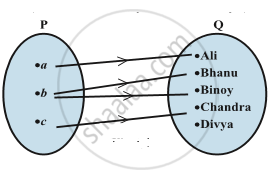
The cartesian product of P and Q has 15 ordered pairs which can be listed as P × Q = {(a, Ali), (a,Bhanu), (a, Binoy), ..., (c, Divya)}. We can now obtain a subset of P × Q by introducing a relation R between the first element x and the second element y of each ordered pair (x, y) as R= { (x,y): x is the first letter of the name y, x ∈ P, y ∈ Q}. Then R = {(a, Ali), (b, Bhanu), (b, Binoy), (c, Chandra)} A visual representation of this relation R (called an arrow diagram) is shown in Fig .
A relation R from A to A is also stated as a relation on A.