Topics
Part 1
Integers
- Natural Numbers
- Whole Numbers
- Negative and Positive Numbers
- Integers
- Representation of Integers on the Number Line
- Ordering of Integers
- Addition of Integers
- Subtraction of Integers
- Properties of Addition and Subtraction of Integers
- Multiplication of a Positive and a Negative Integers
- Multiplication of Two Negative Integers
- Product of Three Or More Negative Integers
- Closure Property of Multiplication of Integers
- Commutative Property of Multiplication of Integers
- Multiplication of Integers with Zero
- Multiplicative Identity of Integers
- Associative Property of Multiplication of Integers
- Distributive Property of Multiplication of Integers
- Making Multiplication Easier of Integers
- Division of Integers
- Properties of Division of Integers
Large Numbers Around Us
Part 2
Arithmetic Expressions
Fractions and Decimals
- Concept of Fraction
- Types of Fractions
- Concept of Proper and Improper Fractions
- Concept of Mixed Fractions
- Concept of Equivalent Fractions
- Like and Unlike Fraction
- Comparing Fractions
- Addition of Fraction
- Subtraction of Fraction
- Multiplication of a Fraction by a Whole Number
- Using Operator 'Of' with Multiplication and Division
- Multiplication of Fraction
- Division of Fractions
- Concept of Reciprocals or Multiplicative Inverses
- Problems Based on Fraction
- The Decimal Number System
- Comparing Decimal Numbers
- Addition of Decimal Fraction
- Subtraction of Decimal Numbers
- Multiplication of Decimal Numbers
- Division of Decimal Numbers
- Problems Based on Decimal Numbers
A Peek Beyond the Point
Data Handling
Expressions using Letter-Numbers
Simple Equations
Lines and Angles
Parallel and Intersecting Lines
The Triangle and Its Properties
- Basic Concepts of Triangles
- Classification of Triangles based on Sides
- Classification of Triangles based on Angles
- Median of a Triangle
- Altitudes of a Triangle
- Exterior Angle of a Triangle and Its Property
- Some Special Types of Triangles - Equilateral and Isosceles Triangles
- Basic Properties of a Triangle
- Right-angled Triangles and Pythagoras Property
Number Play
Congruence of Triangles
- Similarity and Congruency of Figures
- Congruence Among Line Segments
- Congruence of Angles
- Congruence of Triangles
- Criteria for Congruence of Triangles
- Criteria for Similarity of Triangles
- SAS Congruence Criterion
- ASA Congruence Criterion
- RHS Congruence Criterion
- Exceptional Criteria for Congruence of Triangles
A Tale of Three Intersecting Lines
Comparing Quantities
- Ratio
- Concept of Equivalent Ratios
- Proportion
- Unitary Method
- Basic Concept of Percentage
- Estimation in Percentages
- Interpreting Percentages
- Conversion between Percentage and Fraction or Decimal
- Ratios to Percents
- Increase Or Decrease as Percent
- Basic Concepts of Profit and Loss
- Profit or Loss as a Percentage
- Calculation of Interest
Working with Fractions
Rational Numbers
- Rational Numbers
- Equivalent Rational Number
- Positive and Negative Rational Numbers
- Rational Numbers on a Number Line
- Rational Numbers in Standard Form
- Comparison of Rational Numbers
- Rational Numbers Between Two Rational Numbers
- Addition of Rational Number
- Subtraction of Rational Number
- Multiplication of Rational Numbers
- Division of Rational Numbers
Geometric Twins
Perimeter and Area
- Basic Concepts in Mensuration
- Concept of Perimeter
- Perimeter of a Rectangle
- Perimeter of Squares
- Perimeter of Triangle
- Perimeter of Polygon
- Concept of Area
- Area of Square
- Area of Rectangle
- Triangles as Parts of Rectangles and Square
- Generalising for Other Congruent Parts of Rectangles
- Area of a Parallelogram
- Area of a Triangle
- Circumference of a Circle
- Area of Circle
- Conversion of Units
- Problems based on Perimeter
- Problems based on Area
Algebraic Expressions
Operations with Integers
Practical Geometry
- Construction of a Line Parallel to a Given Line, Through a Point Not on the Line
- Construction of Triangles
- Constructing a Triangle When the Length of Its Three Sides Are Known (SSS Criterion)
- Constructing a Triangle When the Lengths of Two Sides and the Measure of the Angle Between Them Are Known. (SAS Criterion)
- Constructing a Triangle When the Measures of Two of Its Angles and the Length of the Side Included Between Them is Given. (ASA Criterion)
- Constructing a Right-angled Triangle When the Length of One Leg and Its Hypotenuse Are Given (RHS Criterion)
Exponents and Powers
- Concept of Exponents
- Multiplying Powers with the Same Base
- Dividing Powers with the Same Base
- Taking Power of a Power
- Multiplying Powers with Different Base and Same Exponents
- Dividing Powers with Different Base and Same Exponents
- Numbers with Exponent Zero, One, Negative Exponents
- Miscellaneous Examples Using the Laws of Exponents
- Decimal Number System Using Exponents and Powers
- Crores
Finding Common Ground
Symmetry
Another Peek Beyond the Point
Connecting the Dots
Visualizing Solid Shapes
Constructions and Tilings
Finding the Unknown
- Introduction
- Formula: Perimeter
- Units of Perimeter
- Example 1
- Example 2
- Key Points Summary
Introduction
The perimeter is the total distance around the outside edge or boundary of any closed two-dimensional shape (a plane figure). If you were to walk along every side of a park and return to your starting point, the total distance you walked would be the perimeter.
Why is it Important? Understanding perimeter is fundamental in many real-world tasks, such as:
-
Planning how much fencing is needed for a garden or yard.
-
Calculating the length of decorative border or trim required for a room.
-
Measuring the length of a running track or sports field boundary.
Formula: Perimeter
Perimeter = Sum of all side lengths
Units of Perimeter
- Centimeter (cm) – For small objects
-
Meter (m) – For medium to large objects
-
Kilometer (km) – For very large areas
-
1 cm = 1/10 dm, and 1 m = 100 cm
Important: When calculating perimeter, ensure all measurements are in the same unit before adding them together.
Example 1
Find the perimeter
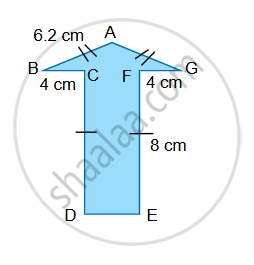
Solution:
Required perimeter
= AB + BC + CD + DE + EF + FG + GA
= 6.2 cm + 4 cm + 8 cm + 4 cm + 8 cm + 4 cm + 6.2 cm
= 40.4 cm
Example 2
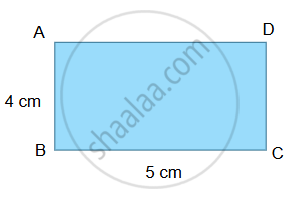
The lengths of adjacent sides of rectangle ABCD are 4 cm and 5 cm.
Since opposite sides of a rectangle are equal:
Perimeter = 2 × (Length + Breadth)
= 2 × (5 + 4)
= 18 cm
Key Points Summary
-
Perimeter = sum of all side lengths of a closed figure
-
Always convert measurements to the same unit before calculating
-
Unit of perimeter is always linear (cm, m, km, etc.)
-
Method: Identify all side lengths → Convert to same unit → Add all values → Write answer with unit
Example Question 1
Find the perimeter of the following figure:
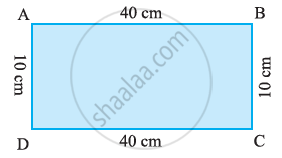
Perimeter = AB + BC + CD + DA
= 40 + 10 + 40 + 10
= 100 cm
Example Question 2
Find the perimeter of the following figure:
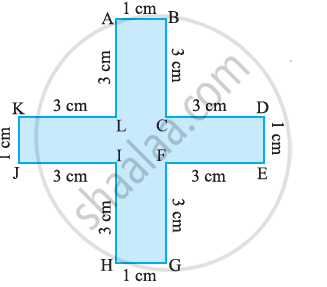
Perimeter =AB + BC + CD + DE + EF + FG + GH + HI + IJ + JK + KL + LA
= 1 + 3 + 3 + 1 + 3 + 3 + 1 + 3 + 3 + 1 + 3 + 3.
= 28 cm
Example Question 3
Find the perimeter of the following figure:
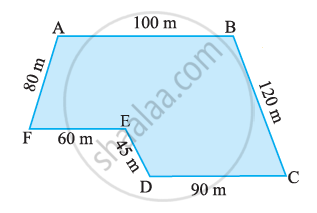
Perimeter = AB + BC + CD + DE + EF + FA
= 100 + 120 + 90 + 45 + 60 + 80
= 495 m
Test Yourself
Shaalaa.com | Perimeter
Series: Concept of Perimeters
Related QuestionsVIEW ALL [80]

Sanya, Aarushi, Manav and Kabir made greeting cards. Complete the table for their cards:
| Whose card | Length | Width | Perimeter | Area |
| Sanya | 10 cm | 8 cm | ||
| Manav | 11 cm | 44 cm | ||
| Aarushi | 8 cm | 80 square cm | ||
| Kabir | 40 cm | 100 square cm |
