Topics
Integers
- Natural Numbers
- Whole Numbers
- Negative and Positive Numbers
- Integers
- Representation of Integers on the Number Line
- Ordering of Integers
- Addition of Integers
- Subtraction of Integers
- Properties of Addition and Subtraction of Integers
- Multiplication of a Positive and a Negative Integers
- Multiplication of Two Negative Integers
- Product of Three Or More Negative Integers
- Closure Property of Multiplication of Integers
- Commutative Property of Multiplication of Integers
- Multiplication of Integers with Zero
- Multiplicative Identity of Integers
- Associative Property of Multiplication of Integers
- Distributive Property of Multiplication of Integers
- Making Multiplication Easier of Integers
- Division of Integers
- Properties of Division of Integers
Part 1
Large Numbers Around Us
Arithmetic Expressions
Fractions and Decimals
- Concept of Fraction
- Types of Fractions
- Concept of Proper and Improper Fractions
- Concept of Mixed Fractions
- Concept of Equivalent Fractions
- Like and Unlike Fraction
- Comparing Fractions
- Addition of Fraction
- Subtraction of Fraction
- Multiplication of a Fraction by a Whole Number
- Using Operator 'Of' with Multiplication and Division
- Multiplication of Fraction
- Division of Fractions
- Concept of Reciprocals or Multiplicative Inverses
- Problems Based on Fraction
- The Decimal Number System
- Comparing Decimal Numbers
- Addition of Decimal Fraction
- Subtraction of Decimal Numbers
- Multiplication of Decimal Numbers
- Division of Decimal Numbers
- Problems Based on Decimal Numbers
Part 2
A Peek Beyond the Point
Data Handling
Simple Equations
Expressions using Letter-Numbers
Parallel and Intersecting Lines
Lines and Angles
Number Play
The Triangle and Its Properties
- Basic Concepts of Triangles
- Classification of Triangles based on Sides
- Classification of Triangles based on Angles
- Median of a Triangle
- Altitudes of a Triangle
- Exterior Angle of a Triangle and Its Property
- Some Special Types of Triangles - Equilateral and Isosceles Triangles
- Basic Properties of a Triangle
- Right-angled Triangles and Pythagoras Property
Comparing Quantities
- Ratio
- Concept of Equivalent Ratios
- Proportion
- Unitary Method
- Basic Concept of Percentage
- Estimation in Percentages
- Interpreting Percentages
- Conversion between Percentage and Fraction or Decimal
- Ratios to Percents
- Increase Or Decrease as Percent
- Basic Concepts of Profit and Loss
- Profit or Loss as a Percentage
- Calculation of Interest
A Tale of Three Intersecting Lines
Congruence of Triangles
- Similarity and Congruency of Figures
- Congruence Among Line Segments
- Congruence of Angles
- Congruence of Triangles
- Criteria for Congruence of Triangles
- Criteria for Similarity of Triangles
- SAS Congruence Criterion
- ASA Congruence Criterion
- RHS Congruence Criterion
- Exceptional Criteria for Congruence of Triangles
Rational Numbers
- Rational Numbers
- Equivalent Rational Number
- Positive and Negative Rational Numbers
- Rational Numbers on a Number Line
- Rational Numbers in Standard Form
- Comparison of Rational Numbers
- Rational Numbers Between Two Rational Numbers
- Addition of Rational Number
- Subtraction of Rational Number
- Multiplication of Rational Numbers
- Division of Rational Numbers
Working with Fractions
Geometric Twins
Perimeter and Area
- Basic Concepts in Mensuration
- Concept of Perimeter
- Perimeter of a Rectangle
- Perimeter of Squares
- Perimeter of Triangle
- Perimeter of Polygon
- Concept of Area
- Area of Square
- Area of Rectangle
- Triangles as Parts of Rectangles and Square
- Generalising for Other Congruent Parts of Rectangles
- Area of a Parallelogram
- Area of a Triangle
- Circumference of a Circle
- Area of Circle
- Conversion of Units
- Problems based on Perimeter
- Problems based on Area
Algebraic Expressions
Practical Geometry
- Construction of a Line Parallel to a Given Line, Through a Point Not on the Line
- Construction of Triangles
- Constructing a Triangle When the Length of Its Three Sides Are Known (SSS Criterion)
- Constructing a Triangle When the Lengths of Two Sides and the Measure of the Angle Between Them Are Known. (SAS Criterion)
- Constructing a Triangle When the Measures of Two of Its Angles and the Length of the Side Included Between Them is Given. (ASA Criterion)
- Constructing a Right-angled Triangle When the Length of One Leg and Its Hypotenuse Are Given (RHS Criterion)
Operations with Integers
Exponents and Powers
- Concept of Exponents
- Multiplying Powers with the Same Base
- Dividing Powers with the Same Base
- Taking Power of a Power
- Multiplying Powers with Different Base and Same Exponents
- Dividing Powers with Different Base and Same Exponents
- Numbers with Exponent Zero, One, Negative Exponents
- Miscellaneous Examples Using the Laws of Exponents
- Decimal Number System Using Exponents and Powers
- Crores
Finding Common Ground
Symmetry
Another Peek Beyond the Point
Visualizing Solid Shapes
Connecting the Dots
Constructions and Tilings
Finding the Unknown
- Introduction
- Symbol of Percentage
- Formula: Percentage
- Steps to Convert Fractions to Percentages
- Example 1
- Example 2
- Real-Life Examples
- Key Points Summary
Introduction
What is a Percentage?
- The word "percent" means "out of 100".
-
It tells us how many parts out of 100 something represents.
-
For example, 25% means 25 parts out of 100 parts.
- When a fraction is written in such a way that the denominator is 100, then the numerator of that fraction is called a 'percent' or 'percentage'.
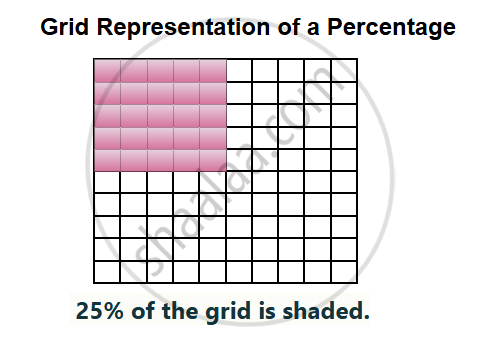
Symbol of Percentage
-
The symbol for percent is %.
-
So, 75% means 75 out of 100.
Formula: Percentage
Percentage = `"value"/"Total value"` × 100
% (Percentage) = `"Part"/"Whole"` × 100
Percent is the numerator of a fraction with a denominator of 100.
Steps to Convert Fractions to Percentages
-
Step 1: Change the fraction to an equivalent fraction with denominator 100.
-
Step 2: The numerator becomes the percentage.
Example:
`7/50` = `"7 × 2 "/"50 × 2"`= `14/100` = 14%
Example 1
1.60 out of 100
= `"60"/"100"`
= 60 as a percent, written as 60%.
2. `"3"/"5"` × 100%
= 60 %
Example 2
Express each of the following statements in the percentage form:
- 5 out of 20 eggs are bad.
- 3 children in a class of 30 are absent.
Solution:
(i) 5 out of 20 eggs are bad, which means `"5"/"20"`
And `"5"/"20"` = `"5 × 5 "/"20 × 5"`= `"25"/"100"` = 25%
∴ 25% eggs are bad.
(ii) 3 children out of 30 are absent is written as `"3"/"30"`
And `"3"/"30"` = `"1"/"10"`= `"10"/"100"` = 10%
∴ 10% children are absent.
Real-Life Examples
-
If an exam is of 100 marks and Geeta scores 83, she scored 83% marks.
-
If Rohit scored 67%, it means he got 67 marks out of 100.
Key Points Summary
-
"Percent" means "out of 100".
-
The symbol % represents percentage.
-
Convert fractions to percentages by making the denominator 100 and the numerator the percentage.
-
Visualising percentages with grids and tables helps in understanding.
-
Percentages are useful to compare parts of a whole easily.