Topics
Orienting Yourself: The Use of Coordinates
Number Systems
Number Systems
Part 1
Introduction to Polynomials
Introduction to Linear Polynomials
Part 2
Algebra
Algebraic Expressions
Algebraic Identities
Coordinate Geometry
The World of Numbers
Sequences and Progressions
Exploring Algebraic Identities
Geometry
Exploring Algebraic Identities
Area
Constructions
- Introduction of Constructions
- Geometric Constructions
- Some Constructions of Triangles
Mensuration
I’m Up and Down, and Round and Round
Linear Equations in Two Variables
Statistics and Probability
Measuring Space: Perimeter and Area
Coordinate Geometry
Probability
The Mathematics of Maybe: Introduction to Probability
Introduction to Euclid’s Geometry: Axioms and Postulates
Lines and Angles
- Introduction to Lines and Angles
- Basic Terms and Definitions
- Intersecting Lines and Non-intersecting Lines
- Parallel Lines
- Concept of Pairs of Angles
- Concept of Transversal Lines
- Basic Properties of a Triangle
Predicting What Comes Next: Exploring Sequences
Triangles: Congruence Theorems
4-gons (Quadrilaterals)
- Properties of Quadrilateral
- Another Condition for a Quadrilateral to Be a Parallelogram
- Theorem of Midpoints of Two Sides of a Triangle
- Property: The Opposite Sides of a Parallelogram Are of Equal Length.
- Theorem: A Diagonal of a Parallelogram Divides It into Two Congruent Triangles.
- Theorem : If Each Pair of Opposite Sides of a Quadrilateral is Equal, Then It is a Parallelogram.
- Property: The Opposite Angles of a Parallelogram Are of Equal Measure.
- Theorem: If in a Quadrilateral, Each Pair of Opposite Angles is Equal, Then It is a Parallelogram.
- Property: The diagonals of a parallelogram bisect each other. (at the point of their intersection)
- Theorem : If the Diagonals of a Quadrilateral Bisect Each Other, Then It is a Parallelogram
Circles
Area and Perimeter
- Area of a Triangle by Heron's Formula
- Application of Heron’s Formula in Finding Areas of Quadrilaterals
- Geometric Interpretation of the Area of a Triangle
Surface Area and Volume
Statistics
Introduction to Probability
- Introduction
- Types of Expressions
- Rules for Separating Terms
- Framing Algebraic Expressions and Formulas
- Real-Life Applications
- Key Points Summary
Introduction
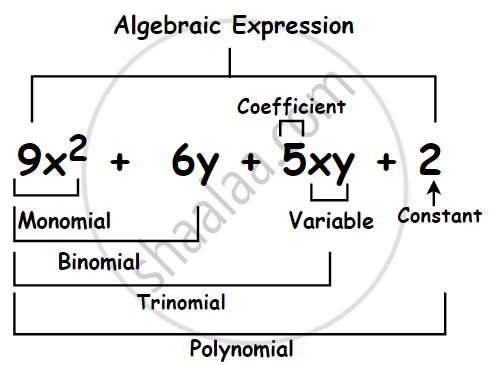
Algebraic expressions consist of terms joined by +/– signs. Understanding term separation, expression types, and framing processes is essential.
An algebraic expression is like a grocery cart of items (terms) joined by + or – signs.
-
Term: A single item (e.g., 5x, 7).
-
Constant term: No letters (e.g., 7).
-
Note: × and ÷ do not split terms.
Types of Expressions
| Type | Definition | Example |
|---|---|---|
| Monomial | 1 term | -8, xy |
| Binomial | 2 unlike terms | 5x + 2y |
| Trinomial | 3 unlike terms | ax² + bx + c |
| Multinomial | ≥ 2 terms | 7 + x - xy + y² |
| Polynomial | One or more unlike terms; whole-number powers | 3x + 2y - 7z + 8 |
Rules for Separating Terms
-
Plus (+) and minus (−) signs separate terms.
-
Multiplication (×) and division (÷) do not separate terms.
-
Example: In 3p + 5z − 7y, there are three terms (3p, 5z, −7y).
-
In 3p × 5z − 7y, there are only two terms (3p × 5z, −7y).
-
Framing Algebraic Expressions and Formulas
Framing Algebraic Expressions:
- Converting a statement into mathematical terms (no equals sign).
- Example: The area of a rectangle is the product of length and breadth:
Expression: l × b
Framing Formulas:
- Converting a complete statement into an equation (with an equals sign).
- Examples: "The sum of x and y is 75" → x + y = 75
- The formula for time taken by a hiker is distance divided by speed:
Formula: t = `D/S`
Real-Life Applications
| Situation | Expression/Formula |
|---|---|
| Recipe ingredients | 2c + 3s (2 cups flour + 3 spoons sugar) |
| Movie ticket cost | T = 150n (150 rupees per person × n people) |
| Pizza sharing | P ÷ f (Pizza slices ÷ friends) |
| Savings goal | S = M × 12 (Monthly savings × 12 months) |
Key Points Summary
-
Terms are separated by '+/–' only.
-
Expression types depend on term count and whole-number exponents.
-
Frame as an expression (no “=”) or a formula (with “=”).
-
Polynomials need whole number powers only
-
A constant term has no letters (like the number 7)
