Topics
Orienting Yourself: The Use of Coordinates
Number Systems
Number Systems
Part 1
Introduction to Polynomials
Introduction to Linear Polynomials
Part 2
Algebra
Algebraic Expressions
Algebraic Identities
Coordinate Geometry
The World of Numbers
Sequences and Progressions
Geometry
Exploring Algebraic Identities
Exploring Algebraic Identities
Area
Constructions
- Introduction of Constructions
- Geometric Constructions
- Some Constructions of Triangles
I’m Up and Down, and Round and Round
Mensuration
Linear Equations in Two Variables
Statistics and Probability
Coordinate Geometry
Measuring Space: Perimeter and Area
Probability
Introduction to Euclid’s Geometry: Axioms and Postulates
The Mathematics of Maybe: Introduction to Probability
Lines and Angles
- Introduction to Lines and Angles
- Basic Terms and Definitions
- Intersecting Lines and Non-intersecting Lines
- Parallel Lines
- Concept of Pairs of Angles
- Concept of Transversal Lines
- Basic Properties of a Triangle
Predicting What Comes Next: Exploring Sequences
Triangles: Congruence Theorems
4-gons (Quadrilaterals)
- Properties of Quadrilateral
- Another Condition for a Quadrilateral to Be a Parallelogram
- Theorem of Midpoints of Two Sides of a Triangle
- Property: The Opposite Sides of a Parallelogram Are of Equal Length.
- Theorem: A Diagonal of a Parallelogram Divides It into Two Congruent Triangles.
- Theorem : If Each Pair of Opposite Sides of a Quadrilateral is Equal, Then It is a Parallelogram.
- Property: The Opposite Angles of a Parallelogram Are of Equal Measure.
- Theorem: If in a Quadrilateral, Each Pair of Opposite Angles is Equal, Then It is a Parallelogram.
- Property: The diagonals of a parallelogram bisect each other. (at the point of their intersection)
- Theorem : If the Diagonals of a Quadrilateral Bisect Each Other, Then It is a Parallelogram
Circles
Area and Perimeter
- Area of a Triangle by Heron's Formula
- Application of Heron’s Formula in Finding Areas of Quadrilaterals
- Geometric Interpretation of the Area of a Triangle
Surface Area and Volume
Statistics
Introduction to Probability
Notes
If two chords of a circle are equal, then their corresponding arcs are congruent and conversely, if two arcs are congruent, then their corresponding chords are equal. In following fig.
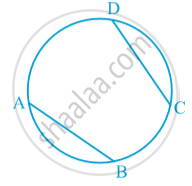
Conversely, If two arcs are equal or congruent then their corresponding chords are equal.
AB ≅ CD
`=>` AB = CD
Theorem
Theorem: The angle subtended by an arc at the centre is double the angle subtended by it at any point on the remaining part of the circle.
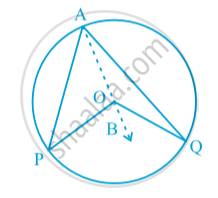
If in a circle with centre O , arc PQ of a circle subtends ∠POQ at centre and arc PQ subtends ∠PAQ on the remaining part of the circle than ∠POQ = 2 PAQ.
Theorem: Angles in the same segment of a circle are equal.
Suppose we join points P and Q and form a chord PQ in the above figures. Then ∠ PAQ is also called the angle formed in the segment PAQP.
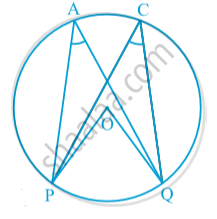
∠ POQ = 2 ∠ PCQ = 2 ∠ PAQ
Therefore, ∠ PCQ = ∠ PAQ.
Here ∠PAQ is an angle in the segment, which is a semicircle. Also, ∠ PAQ = `1/2`
∠POQ = `1/2 xx = 180° =90° `
Theorem: If a line segment joining two points subtends equal angles at two other points lying on the same side of the line containing the line segment, the four points lie on a circle (i.e. they are concyclic).
In following fig. AB is a line segment, which subtends equal angles at two points C and D. That is ∠ ACB = ∠ ADB
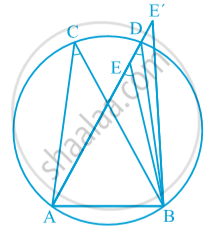
To show that the points A, B, C and D lie on a circle. let us draw a circle through the points A, C and B. Suppose it does not pass through the point D. Then it will intersect AD (or extended AD) at a point, say E .
If points A, C, E and B lie on a circle,
∠ ACB = ∠ AEB
But it is given that ∠ ACB = ∠ ADB.
Therefore, ∠ AEB = ∠ ADB.
This is not possible unless E coincides with D.
Similarly, E′ should also coincide with D.
Shaalaa.com | Theorem : The angle subtended by an arc at the centre is double the angle subtended by it at any point on the remaining part of the circle.
Series:
00:13:32 undefined
00:06:29 undefined
00:06:06 undefined