Topics
Part 1
Number Systems
Number Systems
Orienting Yourself: The Use of Coordinates
Algebra
Introduction to Linear Polynomials
Part 2
Introduction to Polynomials
Algebraic Expressions
Algebraic Identities
Sequences and Progressions
Coordinate Geometry
The World of Numbers
Geometry
Exploring Algebraic Identities
Exploring Algebraic Identities
Area
Constructions
- Introduction of Constructions
- Geometric Constructions
- Some Constructions of Triangles
Linear Equations in Two Variables
Mensuration
I’m Up and Down, and Round and Round
Statistics and Probability
Measuring Space: Perimeter and Area
Coordinate Geometry
Probability
Introduction to Euclid’s Geometry: Axioms and Postulates
The Mathematics of Maybe: Introduction to Probability
Lines and Angles
- Introduction to Lines and Angles
- Basic Terms and Definitions
- Intersecting Lines and Non-intersecting Lines
- Parallel Lines
- Concept of Pairs of Angles
- Concept of Transversal Lines
- Basic Properties of a Triangle
Predicting What Comes Next: Exploring Sequences
Triangles: Congruence Theorems
4-gons (Quadrilaterals)
- Properties of Quadrilateral
- Another Condition for a Quadrilateral to Be a Parallelogram
- Theorem of Midpoints of Two Sides of a Triangle
- Property: The Opposite Sides of a Parallelogram Are of Equal Length.
- Theorem: A Diagonal of a Parallelogram Divides It into Two Congruent Triangles.
- Theorem : If Each Pair of Opposite Sides of a Quadrilateral is Equal, Then It is a Parallelogram.
- Property: The Opposite Angles of a Parallelogram Are of Equal Measure.
- Theorem: If in a Quadrilateral, Each Pair of Opposite Angles is Equal, Then It is a Parallelogram.
- Property: The diagonals of a parallelogram bisect each other. (at the point of their intersection)
- Theorem : If the Diagonals of a Quadrilateral Bisect Each Other, Then It is a Parallelogram
Circles
Area and Perimeter
- Area of a Triangle by Heron's Formula
- Application of Heron’s Formula in Finding Areas of Quadrilaterals
- Geometric Interpretation of the Area of a Triangle
Surface Area and Volume
Statistics
Introduction to Probability
- Adjacent Sides and Angles
- Opposite Sides and Angles
- Diagonals of a Quadrilateral
- Angle Sum Property of a Quadrilateral
Adjacent Sides and Angles of a Quadrilateral
Adjacent Sides: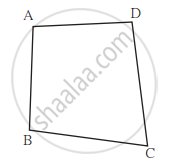
Definition: Adjacent sides are two sides of a quadrilateral that meet at a common vertex.
Example (□ABCD):
AB and AD
AD and DC
DC and CB
CB and BA
A quadrilateral has 4 pairs of adjacent sides.
Adjacent Angles: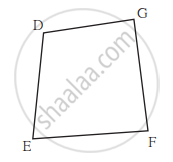
Definition: Adjacent angles are two angles of a quadrilateral that share a common side (arm).
Example (□DEFG):
∠DEF and ∠EFG
∠EFG and ∠FGD
∠FGD and ∠GDE
∠GDE and ∠DEF
A quadrilateral has 4 pairs of adjacent angles.
Opposite Sides and Opposite Angles of a Quadrilateral
Opposite Sides :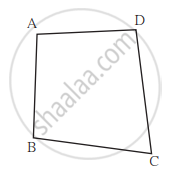
Definition: The term "opposite sides" refers to two sides of a quadrilateral that do not share a common vertex.
Example (in □ABCD):
AB and DC
AD and BC
A quadrilateral has two opposite pairs of sides.
Opposite Angles :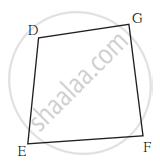
Definition: Opposite angles are two angles of a quadrilateral that do not share a common side (arm).
Example (in □DEFG):
∠DEF and ∠DGF
∠EFG and ∠GDE
A quadrilateral has 2 pairs of opposite angles.
Diagonals of a Quadrilateral
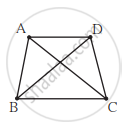 Definition: The diagonals of a quadrilateral are the line segments that connect the vertices of its opposite angles.
In a quadrilateral like ABCD, some corners (angles) are opposite to each other.
Example: ∠A and ∠C, ∠B and ∠D.
If you join the opposite corners with a straight line, you get a diagonal.
So, in □ABCD:
Line AC is a diagonal (joins ∠A and ∠C)
Line BD is another diagonal (joins ∠B and ∠D)
Activity
The sum of the measures of the four angles of a quadrilateral is 360°.
Steps:
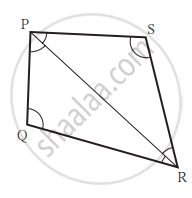
- Draw a quadrilateral (any four-sided shape like PQRS).
- Draw one diagonal (for example, draw line PR).
- This procedure divides the quadrilateral into two triangles: △PSR and △RQP.
- Measure all the angles inside both triangles.
- Add all the angles of the two triangles.
Observation:
Each triangle has an angle sum of 180°.
Two triangles → 180° + 180° = 360°
Conclusion:
The sum of the four angles in any quadrilateral is always 360°.
This is due to the ability to split a quadrilateral into two triangles:
180° + 180° = 360°