Advertisements
Advertisements
प्रश्न
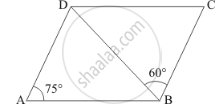
In Fig. below, ABCD is a parallelogram in which ∠DAB = 75° and ∠DBC = 60°. Compute
∠CDB and ∠ADB.
Advertisements
उत्तर

To find `∠`CDB and `∠`ADB
`∠`CBD = `∠`ABD = 60° [Alternative interior angle AD || BC and BD is the transversal]
In a parallelogram ABCD
`∠`A = `∠`C = 75° [ ∵ Opposite side angles of a parallelogram are equal]
In `∠`BDC
`∠`CBD + `∠`C + `∠`CDB =180° [Angle sum property]
⇒ 60° + 75° + `∠`CDB = 180°
⇒`∠`CDB = 180° - (60° + 75°)
⇒ `∠`CDB = 45°
Hence `∠`CDB = 45°, `∠`ADB = 60°
APPEARS IN
संबंधित प्रश्न
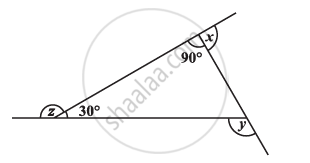
Find x + y + z
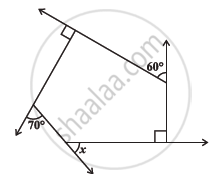
Find x in the following figures.
Three angles of a quadrilateral are respectively equal to 110°, 50° and 40°. Find its fourth angle
The diagonals of a rectangle ABCD meet at O, If ∠BOC = 44°, find ∠OAD.
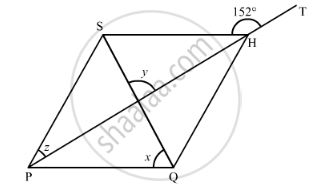
In the given figure, PQRS is a rhombus in which the diagonal PR is produced to T. If ∠SRT = 152°, find x, y and z.
The figure formed by joining the mid-points of the adjacent sides of a square is a
Can the angles 110º, 80º, 70º and 95º be the angles of a quadrilateral? Why or why not?
A quadrilateral has three acute angles. If each measures 80°, then the measure of the fourth angle is ______.
The polygon in which sum of all exterior angles is equal to the sum of interior angles is called ______.
Three angles of a quadrilateral are equal. Fourth angle is of measure 120°. What is the measure of equal angles?
