Advertisements
Advertisements
प्रश्न
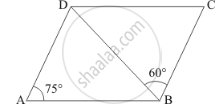
In Fig. below, ABCD is a parallelogram in which ∠DAB = 75° and ∠DBC = 60°. Compute
∠CDB and ∠ADB.
Advertisements
उत्तर

To find `∠`CDB and `∠`ADB
`∠`CBD = `∠`ABD = 60° [Alternative interior angle AD || BC and BD is the transversal]
In a parallelogram ABCD
`∠`A = `∠`C = 75° [ ∵ Opposite side angles of a parallelogram are equal]
In `∠`BDC
`∠`CBD + `∠`C + `∠`CDB =180° [Angle sum property]
⇒ 60° + 75° + `∠`CDB = 180°
⇒`∠`CDB = 180° - (60° + 75°)
⇒ `∠`CDB = 45°
Hence `∠`CDB = 45°, `∠`ADB = 60°
APPEARS IN
संबंधित प्रश्न
Find the angle measure x in the given Figure
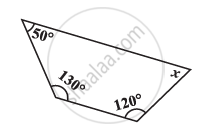
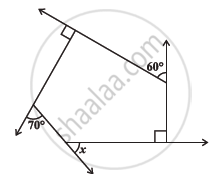
Find x in the following figures.
Three angles of a quadrilateral are respectively equal to 110°, 50° and 40°. Find its fourth angle
In a quadrilateral ABCD, CO and DO are the bisectors of `∠`C and ∠D respectively. Prove that
`∠`COD = `1/2` (`∠`A+ `∠`B).
ABCD is a parallelogram in which ∠A = 70°. Compute ∠B, ∠C and ∠D .
PQRS is a square such that PR and SQ intersect at O. State the measure of ∠POQ.
If the angles of a quadrilateral are in the ratio 3 : 5 : 9 : 13, then find the measure of the smallest angle.
Can all the four angles of a quadrilateral be obtuse angles? Give reason for your answer.
One angle of a quadrilateral is of 108º and the remaining three angles are equal. Find each of the three equal angles.
The angle between two altitudes of a parallelogram through the vertex of an obtuse angle of the parallelogram is 60º. Find the angles of the parallelogram.
