Advertisements
Advertisements
प्रश्न
ABCD is a parallelogram in which ∠A = 70°. Compute ∠B, ∠C and ∠D .
Advertisements
उत्तर
In a parallelogram ABCD.
`∠`A = 70°
`∠`A = `∠`B = 180° [ ∴ Adjacent angles supplementary]
70° + `∠`B = 180° `∠`A = 70°]
`∠`B =180° - 70°
=110°
In a parallelogram opposite sides are equal
`∠`A = `∠`C = 70°
`∠`B = `∠`D = 110°
APPEARS IN
संबंधित प्रश्न
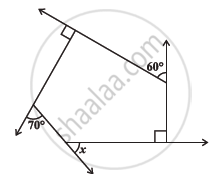
Find the angle measure x in the given Figure
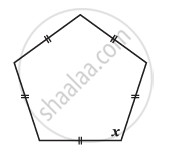
Find x in the following figures.
PQRS is a square such that PR and SQ intersect at O. State the measure of ∠POQ.
Diagonals necessarily bisect opposite angles in a
If the diagonals of a rhombus are 18 cm and 24 cm respectively, then its side is equal to
All the angles of a quadrilateral are equal. What special name is given to this quadrilateral?
One angle of a quadrilateral is of 108º and the remaining three angles are equal. Find each of the three equal angles.
The angle between two altitudes of a parallelogram through the vertex of an obtuse angle of the parallelogram is 60º. Find the angles of the parallelogram.
The angles P, Q, R and S of a quadrilateral are in the ratio 1:3:7:9. Then PQRS is a ______.
Three angles of a quadrilateral are equal. Fourth angle is of measure 120°. What is the measure of equal angles?
