Advertisements
Advertisements
प्रश्न
Diagonals necessarily bisect opposite angles in a
पर्याय
rectangle
parallelogram
isosceles trapezium
square
Advertisements
उत्तर
From the given choices, only in a square the diagonals bisect the opposite angles.
Let us prove it.
Take the following square ABCD with diagonal AD.
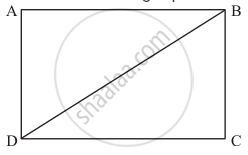
In ΔABD and ΔCBD:
AD = BC (Opposite sides of a square are equal.)
BD = BD (Common)
AB = DC (Opposite sides of a square are equal.)
Thus,
ΔABD ≅ ΔCBD (By SSS Congruence Rule)
By Corresponding parts of congruent triangles property we have:
∠ABD = ∠CBD
∠ADB = ∠CDB
Therefore, in a square the diagonals bisect the opposite angles.
Hence the correct choice is (d).
APPEARS IN
संबंधित प्रश्न
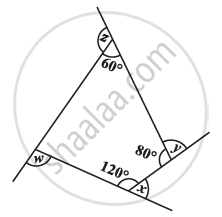
Find x + y + z + w
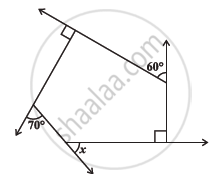
Find x in the following figures.
Three angles of a quadrilateral are respectively equal to 110°, 50° and 40°. Find its fourth angle
The angles of a quadrilateral are in the ratio 3 : 5 : 9 : 13 Find all the angles of the quadrilateral.
If the angles of a quadrilateral are in the ratio 3 : 5 : 9 : 13, then find the measure of the smallest angle.
In the given figure, ABCD is a rectangle in which diagonal AC is produced to E. If ∠ECD = 146°, find ∠AOB.
The figure formed by joining the mid-points of the adjacent sides of a square is a
If an angle of a parallelogram is two-third of its adjacent angle, the smallest angle of the parallelogram is
One angle of a quadrilateral is of 108º and the remaining three angles are equal. Find each of the three equal angles.
Sum of all the angles of a quadrilateral is 180°.
