Advertisements
Advertisements
प्रश्न
Diagonals necessarily bisect opposite angles in a
विकल्प
rectangle
parallelogram
isosceles trapezium
square
Advertisements
उत्तर
From the given choices, only in a square the diagonals bisect the opposite angles.
Let us prove it.
Take the following square ABCD with diagonal AD.
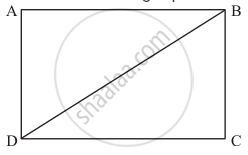
In ΔABD and ΔCBD:
AD = BC (Opposite sides of a square are equal.)
BD = BD (Common)
AB = DC (Opposite sides of a square are equal.)
Thus,
ΔABD ≅ ΔCBD (By SSS Congruence Rule)
By Corresponding parts of congruent triangles property we have:
∠ABD = ∠CBD
∠ADB = ∠CDB
Therefore, in a square the diagonals bisect the opposite angles.
Hence the correct choice is (d).
APPEARS IN
संबंधित प्रश्न
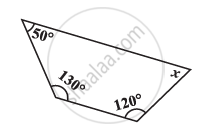
Find the angle measure x in the given Figure
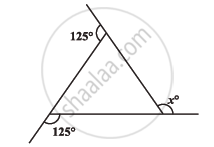
Find x in the following figure:
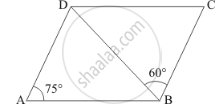
In Fig. below, ABCD is a parallelogram in which ∠DAB = 75° and ∠DBC = 60°. Compute
∠CDB and ∠ADB.
In the given figure, PQRS is a rhombus in which the diagonal PR is produced to T. If ∠SRT = 152°, find x, y and z.
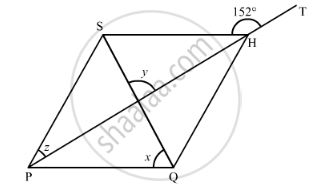
In the given figure, ABCD is a rectangle in which diagonal AC is produced to E. If ∠ECD = 146°, find ∠AOB.
Can all the angles of a quadrilateral be right angles? Give reason for your answer.
One angle of a quadrilateral is of 108º and the remaining three angles are equal. Find each of the three equal angles.
If three angles of a quadrilateral are each equal to 75°, the fourth angle is ______.
The sum of all ______ of a quadrilateral is 360°.
Three angles of a quadrilateral are equal. Fourth angle is of measure 120°. What is the measure of equal angles?
